AI NPC Gossip Protocol 2026: Scaling Multi-Agent Reputation Systems to 50,000+ Characters

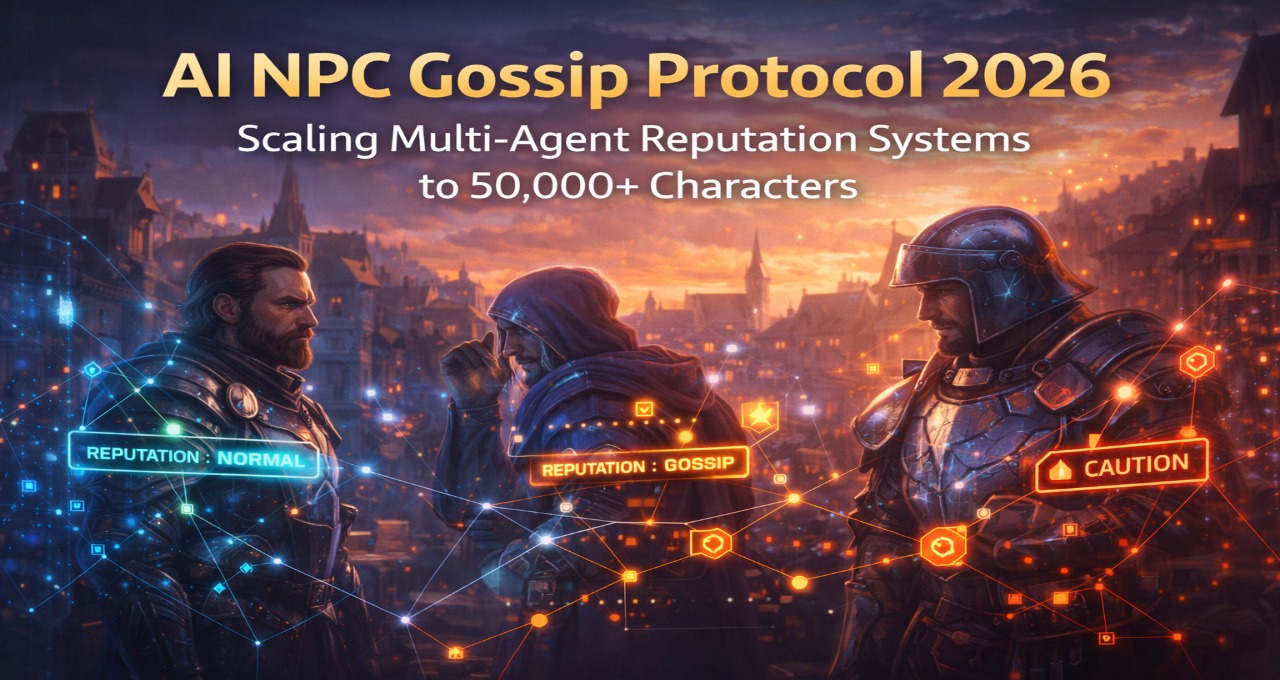
Social Graph Protocol architecture showing decentralized multi-agent NPC gossip propagation and reputation flow in 2026 gaming systems

In early game AI systems, reputation was a single global variable. If you stole bread in one village, guards across the kingdom instantly knew. That illusion no longer holds in persistent, decentralized worlds. In 2026, immersive AI-driven societies rely on distributed agent networks — the same architectural shift outlined in our deep technical breakdown of … Read more

Beyond the Cloud: Optimizing 3B–8B SLMs for On-Device NPC Inference in 2026

On-device NPC inference 2026 architecture showing NPU vs GPU AI processing with sub-100ms latency

Cloud-powered NPCs were impressive in 2024. They were also slow, expensive, and architecturally fragile. By 2026, the industry has reached a breaking point. Players no longer tolerate 200–500ms “cloud lag” in dialogue responses. Studios no longer tolerate per-token API costs scaling with player engagement. And regulators no longer tolerate opaque cross-border data transmission without audit … Read more

How to Automate EU AI Act Compliance Before August 2026

EU AI Act compliance architecture stack 2026 data governance documentation logging monitoring layers

If your organization operates a high-risk AI system in the EU, manual compliance is no longer viable. By August 2, 2026, automated controls for documentation, logging, and post-market monitoring will be essential to avoid enforcement exposure. Automating EU AI Act compliance requires embedding regulatory checks directly into your AI development lifecycle — from risk classification … Read more

AI Fraud Detection in European Banks 2026: Article 50 Disclosure, PSD3 Liability Shift & DORA Enforcement

AI fraud detection system in European banks 2026 showing EU AI Act Article 50, PSD3 liability shift and DORA compliance infrastructure

In 2026, AI fraud detection in European banks is no longer a performance arms race. It is a regulatory survival discipline shaped by the EU AI Act, PSD3 liability reform, and DORA operational resilience mandates. Fraud systems are now classified as high-risk AI systems, triggering mandatory logging, transparency, and human oversight obligations. At the same … Read more

Remote AI Engineer Jobs in CEE: Tax & Liability Shift 2026

Remote AI engineer in Central Eastern Europe with EU compliance, IP Box tax optimization and AI infrastructure concept for 2026

In 2026, the market for remote AI engineers in Central Eastern Europe (CEE) is no longer driven by wage arbitrage. It is driven by regulatory asymmetry. As the EU AI Act enters enforcement and NIS2 liability cascades into contractor ecosystems, the decision to hire — or to work — from Warsaw, Cluj, Prague, or Sofia … Read more

Beyond the Tutorial: The 2026 Enterprise Standard for Defensible RAG

Enterprise RAG traceability flow diagram showing hybrid retrieval, RRF re-ranking, compliance validation, and structured audit logging in 2026.

In 2026, Retrieval-Augmented Generation (RAG) is no longer a prototype architecture of “vector search + LLM.” In regulated enterprises, RAG systems now influence audit conclusions, vendor risk scoring, internal policy interpretation, and customer-facing advisory responses. That shift transforms RAG from an engineering pattern into a governed decision infrastructure. Shadow vector silos, hallucination liability, EU AI … Read more

Conversational AI Chatbot Development in 2026: From Q&A Bots to Autonomous Agentic Systems

Futuristic illustration of a governed conversational AI system in 2026 showing multi-agent orchestration, GraphRAG knowledge graph, vLLM local deployment, and EU compliance oversight.

In 2026, conversational AI chatbot development has shifted from simple intent-matching systems to autonomous, auditable agentic workflows. Enterprises are no longer deploying bots that merely answer questions — they are deploying agents that execute refunds, query internal databases, trigger workflows, and operate under regulatory scrutiny. The shift introduces architectural consequences: cost volatility, hallucination liability, logging … Read more

Shadow AI Audit Fees: The 2026 Pricing Matrix for EU Security Boutiques

Shadow AI audit fees in Europe showing hidden AI systems and regulatory risk under the EU AI Act 2026

In 2026, European companies are no longer asking whether they have Shadow AI.They are asking how exposed they already are. Unauthorized AI usage—employees running copilots, autonomous agents, browser extensions, and embedded models outside approved governance—has quietly become one of the fastest-growing regulatory liabilities under the EU AI Act. For cybersecurity consultants, this has created a … Read more