
The Global Workforce Is Quietly Replacing Meetings With AI-Orchestrated Workflows
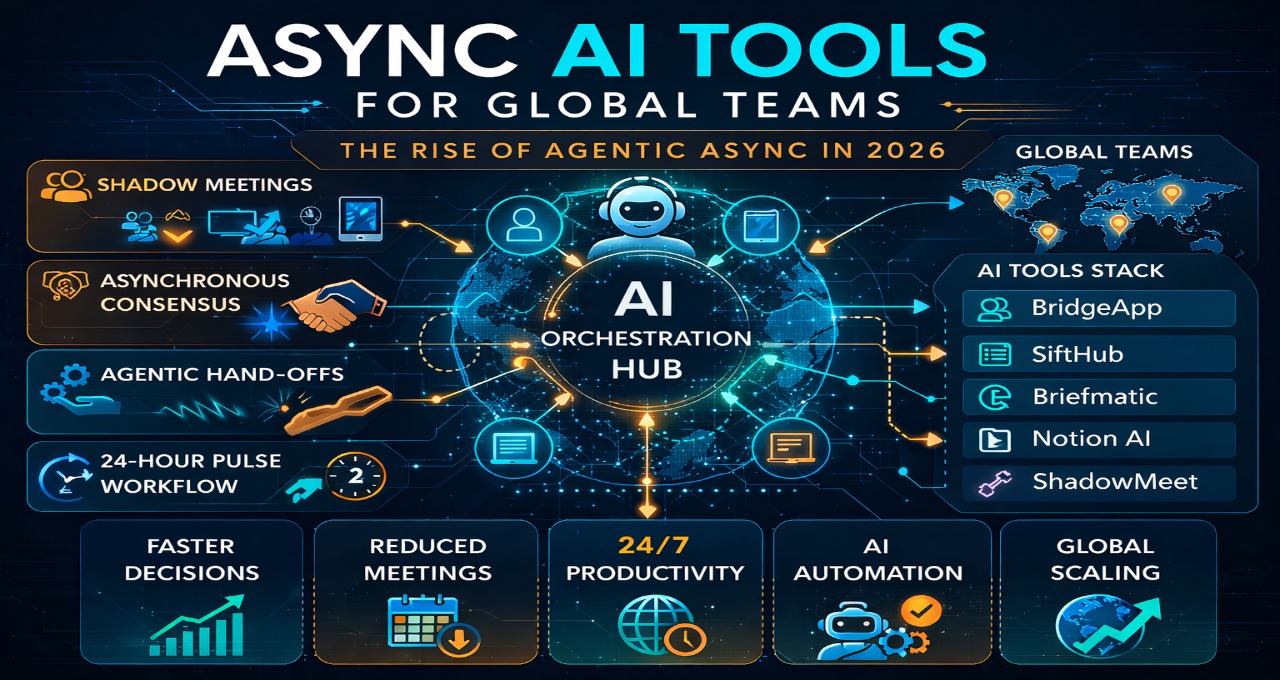
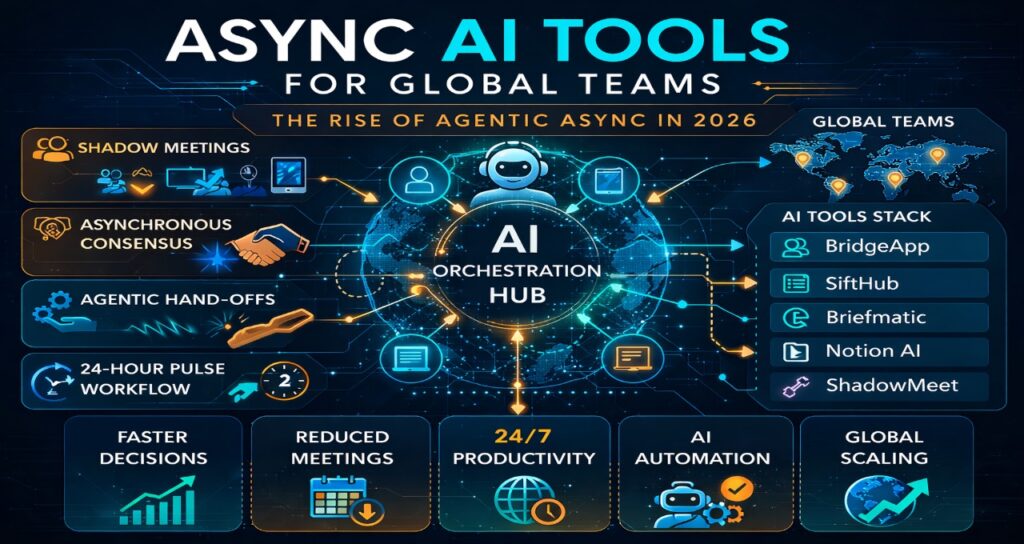
Async AI tools for global teams are evolving far beyond recorded video updates and message threads. In 2026, the most advanced collaboration systems use AI agents that collect input, synthesize decisions, and execute next steps automatically across time zones—allowing distributed organizations to operate continuously without relying on live meetings.
By 2024, remote teams had already discovered the hidden cost of meetings.
By 2025, the industry tried to solve the problem with recorded updates and AI-generated summaries. But these solutions still required humans to interpret information and coordinate the next action.
The real bottleneck was never documentation—it was coordination latency.
When a product decision requires stakeholders across San Francisco, London, and Singapore, the workflow stalls while everyone waits for the next meeting window.
In 2026, global teams are solving this problem through Agentic Async workflows. These systems combine AI agents, long-context memory, and automated decision logic to move projects forward even while employees are offline.
Instead of documenting meetings, AI systems increasingly replace them.
The Core Technology Behind Async AI Collaboration
Async collaboration tools once focused on enabling people to communicate without meetings.
Today, they focus on enabling work to progress without people being present at the same time.
Modern Async AI platforms rely on three key technologies.
Persistent Context Memory
Large language models now support extended context windows and structured memory systems, allowing AI agents to remember project decisions across weeks or months.
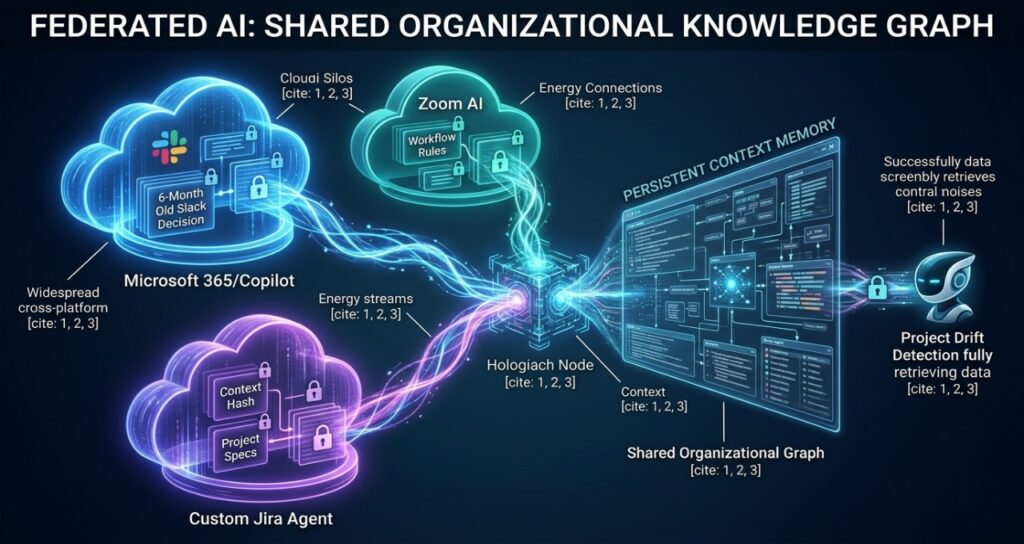
A decision made in a Slack thread six months ago can be retrieved instantly and referenced in a new discussion.
Federated AI Collaboration
Organizations rarely rely on a single AI system anymore.
Instead, collaboration stacks increasingly include federated AI assistants embedded across different platforms—project management tools, messaging systems, documentation platforms, and development environments.
These AI agents exchange structured context, effectively creating a shared organizational memory layer.
Autonomous Workflow Execution
The most advanced async tools can now automatically:
- generate documentation updates
- assign tasks in project systems
- draft code or design revisions
- trigger approvals based on predefined rules
- notify the next team in another time zone
This turns collaboration tools into execution engines rather than communication archives.
Why Async AI Matters Now
Several macro trends are accelerating the shift toward AI-driven asynchronous work.
Global Talent Distribution
Modern startups increasingly operate across continents. Product teams may span:
- North America
- Europe
- South Asia
- Southeast Asia
This creates time zone fragmentation that traditional meeting-based workflows struggle to manage.
The Coordination Tax
Research across distributed organizations shows that 20–40% of knowledge work time is spent coordinating schedules rather than producing output.
Async AI tools aim to eliminate that tax by automating coordination.
Companies exploring distributed productivity stacks often begin with platforms highlighted in best AI productivity tools for remote teams, but the newest generation of tools goes significantly further by introducing agent-driven workflow orchestration.
AI Agents in Workplace Software
Enterprise collaboration platforms are rapidly embedding AI systems that can understand project context and execute tasks automatically.
For example:
- productivity ecosystems from Microsoft
- collaboration platforms like Zoom
- AI infrastructure built on models from OpenAI
These technologies allow AI to act as a coordination layer between tools.
Architecture of Agentic Async Systems
Modern async AI collaboration platforms follow a layered architecture designed for continuous project execution.
1. Context Aggregation Layer
This layer collects signals from:
- messaging platforms
- project trackers
- documentation systems
- code repositories
These inputs form the organizational knowledge graph used by AI agents.
Organizations exploring this approach often deploy architectures similar to those described in agentic AI workflow automation for enterprises.
2. Decision Intelligence Layer
AI models analyze incoming updates to detect:
- approval requests
- conflicts between stakeholders
- project blockers
If predefined conditions are satisfied, the system can approve tasks automatically.
These capabilities closely resemble the agent coordination patterns emerging in AI agents for project management.
3. Execution and Hand-off Layer
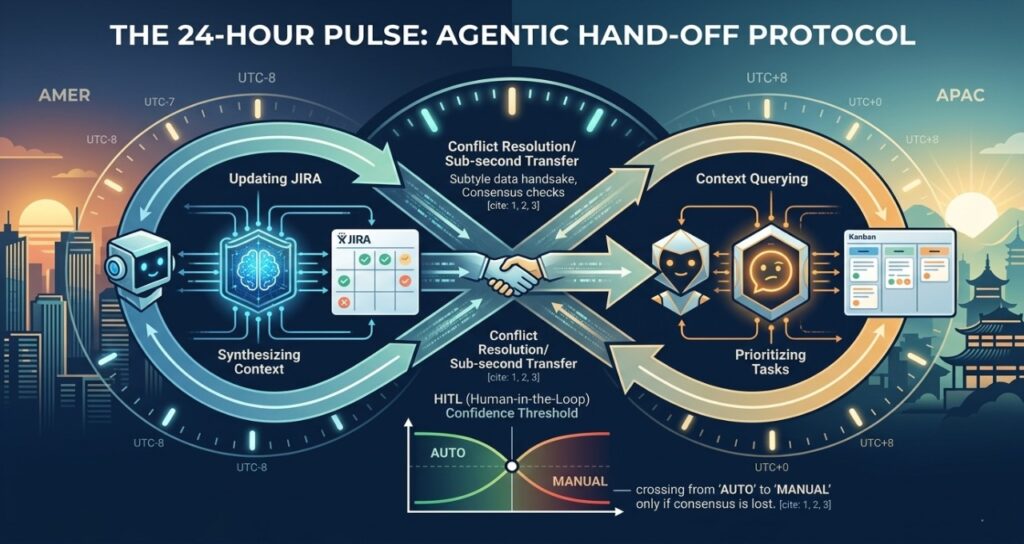
Once a decision is finalized, AI agents trigger downstream actions such as:
- assigning tasks
- updating documentation
- preparing development environments
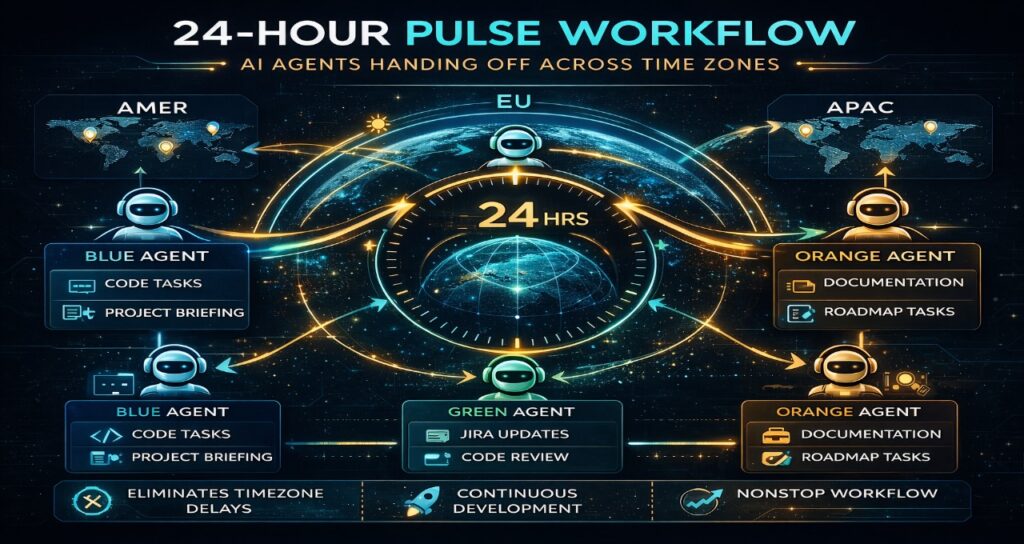
- notifying the next regional team
This enables workflows to move seamlessly across global regions.
Comparison Table — Evolution of Async Collaboration
| Metric | Basic Async (2024–2025) | Agentic Async (2026) |
| Collaboration Model | Recorded updates | AI-orchestrated workflows |
| Meeting Replacement | Video summaries | AI-generated decision synthesis |
| Project Memory | Limited conversation history | Persistent cross-platform memory |
| Time zone Coordination | Manual handoffs | Autonomous AI handoffs |
| Task Execution | Human initiated | AI-triggered workflows |
The Rise of the Shadow Meeting
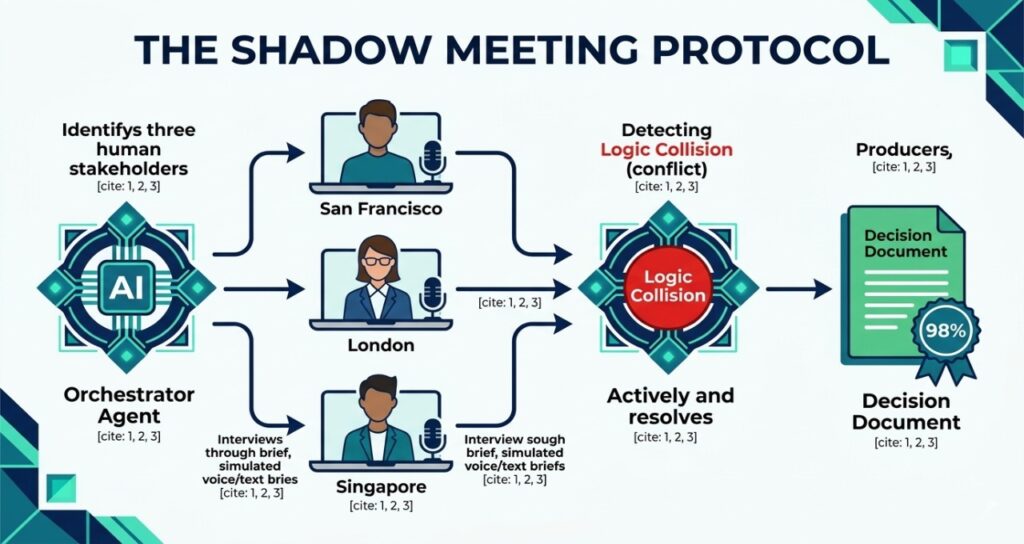
One of the most significant innovations in asynchronous collaboration is the Shadow Meeting.
Instead of gathering everyone on a call, an AI agent orchestrates the discussion asynchronously.
The workflow typically works like this:
- The system identifies required stakeholders.
- Each participant submits input asynchronously through text or voice.
- AI analyzes responses and identifies conflicts.
- A synthesized decision document is generated.
If consensus confidence exceeds a predefined threshold, the meeting never happens.
These workflows build on coordination systems originally developed for AI scheduling agents, similar to the orchestration strategies explained in AI scheduling agents for remote teams.
Shadow Meetings dramatically reduce the number of routine coordination calls while preserving decision transparency.
Strategic Industry Implications
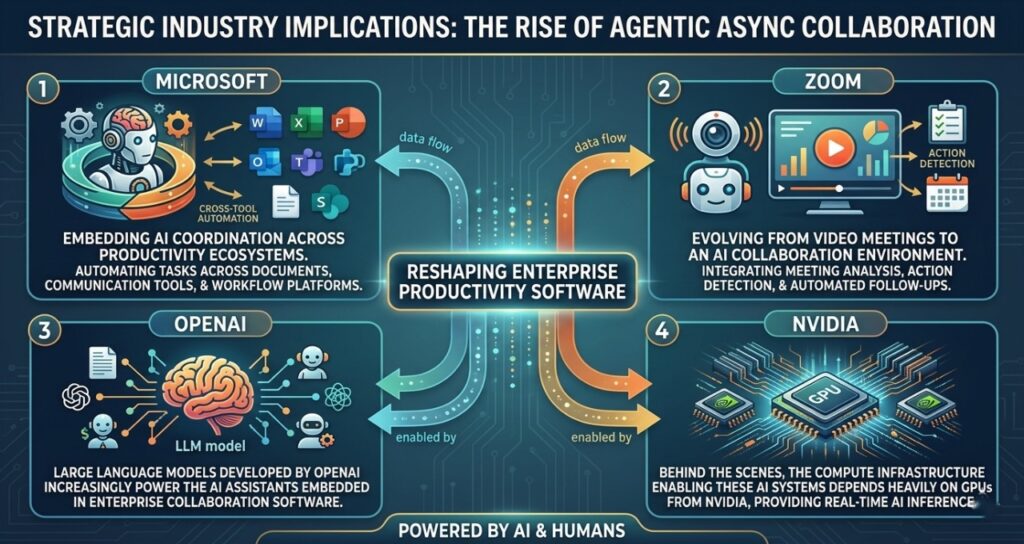
The rise of agentic async collaboration is reshaping enterprise productivity software.
Microsoft
Microsoft is embedding AI coordination capabilities across productivity ecosystems, allowing agents to automate tasks across documents, communication tools, and workflow platforms.
Zoom
Zoom is evolving from a video meeting platform into an AI collaboration environment, integrating meeting analysis, action detection, and automated follow-ups.
OpenAI
Large language models developed by OpenAI increasingly power the AI assistants embedded in enterprise collaboration software.
Nvidia
Behind the scenes, the compute infrastructure enabling these AI systems depends heavily on GPUs from Nvidia, which provide the processing power required for real-time AI inference across collaboration platforms.
Future Outlook (2026–2028)
Async AI collaboration systems are still in their early stages.
Over the next three years, several major shifts are likely.
Persistent Organizational Memory
AI agents will maintain long-term knowledge graphs of company decisions, making it easier to track how strategies evolved over time.
Autonomous Workflow Governance
Future collaboration systems may automatically detect workflow drift—alerting leaders when projects deviate from strategic goals.
These governance systems are closely connected to broader compliance frameworks, especially in regulated markets adopting standards like those discussed in automating EU AI Act compliance.
AI-Native Workspaces
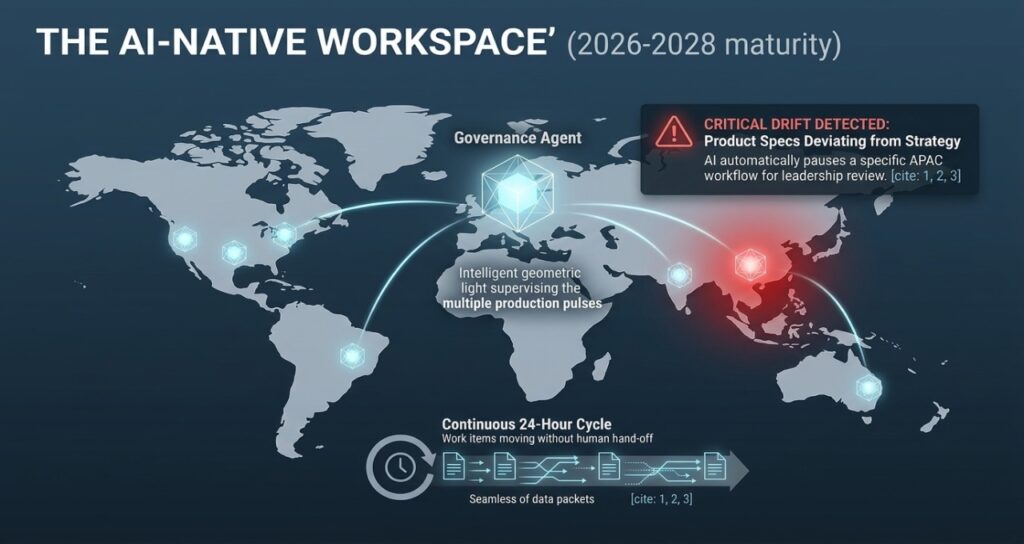
Instead of layering AI on top of existing tools, a new generation of AI-native collaboration platforms may emerge where communication, decision-making, and execution happen inside a unified AI environment.
In that future, distributed organizations may finally achieve a continuous 24-hour operational cycle, where projects move forward regardless of time zone boundaries.
FAQ — Async AI Tools for Global Teams
1.What are async AI tools for global teams?
Ans-Async AI tools allow distributed teams to collaborate without needing to be online at the same time. These systems use AI agents to interpret updates, synthesize decisions, and trigger project actions automatically.
2.What is Agentic Async?
Ans-Agentic Async refers to asynchronous workflows where AI agents actively execute tasks instead of simply documenting discussions. These systems can assign tasks, generate documentation updates, and coordinate approvals.
3.What is a Shadow Meeting?
Ans-A Shadow Meeting is an AI-orchestrated decision process where stakeholder input is collected asynchronously. The AI analyzes responses, detects conflicts, and produces a decision summary—often eliminating the need for a live meeting.
4.Can async AI replace meetings completely?
Ans-No. Strategic planning, conflict resolution, and creative brainstorming still benefit from real-time collaboration. However, routine coordination meetings are increasingly being replaced by AI-driven workflows.
5.Are async AI collaboration tools secure?
Ans-Enterprise deployments increasingly rely on private AI infrastructure, encrypted collaboration environments, and controlled model access to ensure sensitive business information remains protected.
Sources
European Commission – Artificial Intelligence Act (EU AI Act)
https://digital-strategy.ec.europa.eu/en/policies/european-ai-act
European Commission – Digital Strategy and AI Governance
https://digital-strategy.ec.europa.eu/
OECD – Artificial Intelligence Policy Observatory
https://oecd.ai/
Stanford University – AI Index Report
https://aiindex.stanford.edu/
Nvidia – Enterprise AI Infrastructure and Agentic Systems
https://www.nvidia.com/en-us/ai/
Microsoft – AI Productivity and Copilot Research
https://www.microsoft.com/en-us/ai
McKinsey Global Institute – The Future of Work in the Age of AI
https://www.mckinsey.com/mgi
Gartner – AI-Augmented Workforce and Autonomous Systems Research
https://www.gartner.com/en/artificial-intelligence
Author Bio
Saameer is the founder of Tech Plus Trends and an independent technology analyst specializing in AI infrastructure, distributed systems, and the future of global work. His research focuses on how emerging technologies—particularly AI agents, autonomous workflows, and enterprise AI platforms—are reshaping productivity, software architecture, and remote collaboration.
Saameer regularly analyzes developments in AI regulation, semiconductor ecosystems, cloud infrastructure, and agentic automation, translating complex technical trends into practical insights for founders, developers, and technology leaders. His work explores how organizations deploy AI-driven workflows, asynchronous collaboration systems, and next-generation productivity tools to scale globally in the era of intelligent automation.
Through Tech Plus Trends, Saameer publishes in-depth research and industry analysis on AI infrastructure strategy, enterprise AI adoption, and emerging developer ecosystems, helping readers understand the technologies shaping the next generation of digital organizations.
AI Transparency & Editorial Disclosure
Editorial Process & Integrity This article was developed by Tech Plus Trends using a collaborative “Human-in-the-Loop” (HITL) AI workflow. While advanced agentic systems were utilized to synthesize multi-platform data, 2026 infrastructure trends, and technical protocols, the final strategic analysis and editorial conclusions were verified and finalized by Saameer, our founder and lead analyst. We prioritize technical accuracy over automated volume.
EU AI Act Compliance (Article 50) In accordance with transparency requirements for AI-generated and AI-assisted content, be advised that the workflows, “Shadow Meeting” concepts, and “Agentic Async” protocols described herein involve interaction with autonomous AI systems. This content is intended to provide an objective analysis of how these technologies function within enterprise environments.
Data Privacy & Ethics The discussion of “Persistent Context Memory” and “Shared Organizational Knowledge” refers to emerging enterprise standards for private, encrypted AI environments. Tech Plus Trends advocates for Privacy-by-Design and the use of VPC-hosted or on-device LLMs to ensure that sensitive company logic remains under the user’s local control and is not used for training public models.
3 thoughts on “Async AI Tools for Global Teams: Why Agentic Async Is Replacing Meetings in 2026”