
Remote Work Solved Geography — But Created the Coordination Tax
Remote teams solved geography. But they introduced a new operational problem: coordination overhead.
Across distributed organizations, scheduling a simple meeting can trigger an avalanche of emails, Slack messages, and calendar negotiation. Time zones overlap imperfectly. Context disappears between project tools and messaging platforms. Managers spend hours coordinating discussions instead of making decisions.
By 2026, many enterprises discovered a surprising statistic: nearly 40% of knowledge work time is spent on coordination tasks rather than actual project execution.
This is where AI scheduling agents are transforming the modern remote workplace.
Instead of passive scheduling links, organizations are now deploying autonomous calendar agents that negotiate meeting times, protect focus blocks, and dynamically adapt schedules based on project priorities.
The result is the emergence of an entirely new architecture for time management: Agentic Scheduling Systems.
The End of “When Works for You?”
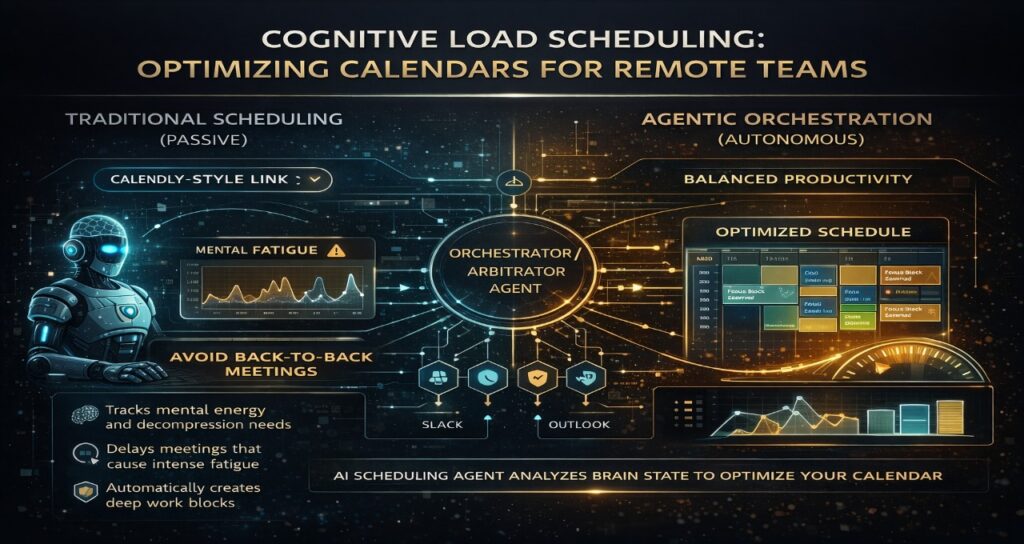
For years, scheduling software followed a reactive, human-dependent model. You would send a booking link, the recipient would manually scan their own mental workload, pick a slot, and confirm. While tools like Calendly popularized this approach, the model has fundamentally broken down in the 2026 enterprise environment. In a world of dynamic calendars, shifting hourly priorities, and cross-continental collaboration, the booking link has become a source of “link fatigue” rather than a solution.
The modern workplace requires more than a passive window into your availability; it requires Autonomous Orchestration.
In 2026, advanced scheduling systems behave less like static utilities and more like digital employees with agency. These agents do not simply “check for free space”—they continuously analyze the relationship between your calendar, your real-time project deadlines in Jira or Monday.com, and your historical productivity data.
The Agentic Handshake
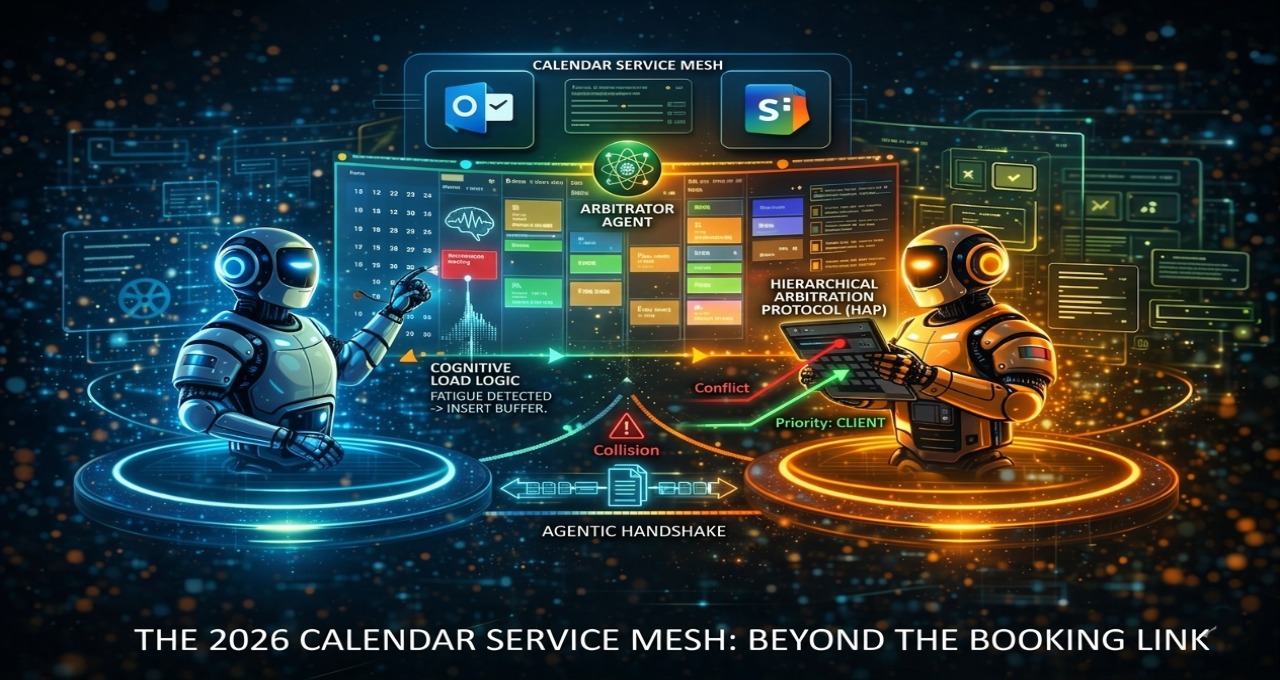
The most significant shift is the replacement of the “When works for you?” email with the “Agentic Handshake.” This is a secure, sub-second negotiation protocol where two autonomous calendars exchange encrypted availability metadata.
Instead of a human middleman, your AI agent “talks” to your colleague’s agent. They negotiate based on mutual priority levels, travel buffers, and even individual focus-time requirements. The meeting is finalized and placed on both calendars without a single human interaction.
From Triggers to Objectives
Unlike traditional automation that waits for a trigger, these agents pursue objectives. If you tell your agent, “I need to sync with the Design Team before Friday’s sprint,” the agent doesn’t just look for a hole in the schedule. It evaluates the “Critical Path” of the project, realizes the Lead Designer is in a different time zone, and automatically reshuffles your lower-priority internal tasks to create a “Golden Hour” overlap that suits both parties.
The result is a shift from a world where humans serve their calendars, to a world where Agentic Scheduling Systems serve the human’s strategic goals.
The Rise of the Calendar Service Mesh
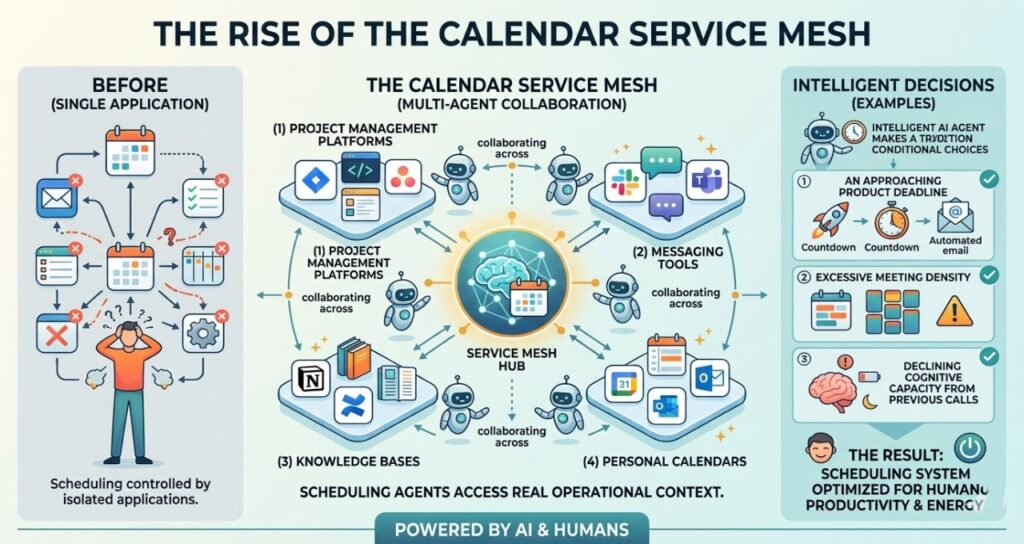
Modern scheduling is no longer controlled by a single application. Instead, organizations are building what researchers call a Calendar Service Mesh.
In this architecture, multiple intelligent systems collaborate across:
- project management platforms
- messaging tools
- knowledge bases
- personal calendars
This allows scheduling agents to access real operational context rather than simply scanning empty time slots.
For example:
An agent may delay a meeting if it detects:
- an approaching product deadline
- excessive meeting density
- declining cognitive capacity from previous calls
The result is a scheduling system optimized not only for availability, but for human productivity and energy.
Cognitive Load Scheduling: The Next Frontier Traditional calendars treat every hour as identical. But human performance is not linear. In 2026, advanced scheduling systems incorporate Cognitive Load Logic—algorithms that measure the mental intensity of a user’s workday.
To address the extreme privacy requirements of 2026, leading tools are moving this logic to the Edge. By utilizing NPUs (Neural Processing Units) on modern laptops and smartphones, the AI analyzes your focus patterns and fatigue levels locally. This ensures your biometric productivity data never leaves your device, satisfying both corporate security and personal privacy. Platforms like Motion, Reclaim.ai, and Clockwise now automatically insert “Decompression Buffers” after high-stress calls to protect your creative energy.
Solving the Time-Zone Paradox
Global teams face a persistent challenge: there is rarely a meeting time that works for everyone.
Modern AI scheduling tools solve this through a technique known as Asynchronous Consensus.
Instead of forcing live participation, teams use Shadow Meetings.
Here’s how it works:
- The meeting host records a short briefing.
- AI agents distribute summaries to relevant team members.
- Participants review and respond asynchronously.
- A live meeting is triggered only if a decision conflict emerges.
This dramatically reduces meeting volume while preserving collaboration.
For globally distributed teams, asynchronous consensus has become a critical productivity innovation.
2026 Platform Comparison: Autonomous Scheduling Orchestrators
| Platform | Orchestration Model | Cognitive Load Logic | Compliance & Privacy | Best For |
| Motion | Active reprioritization engine | Prevents meeting overload | SOC2 + GDPR | High-velocity startups |
| Reclaim.ai | Habit-based scheduling | Protects deep work blocks | Enterprise isolation | Remote teams |
| Clockwise | Network-wide optimization | Department-wide focus time | Privacy Shield 2.0 | Large organizations |
| Vimcal | Natural-language scheduling agent | Priority-aware calendar logic | EU AI Act ready | Executives & sales teams |
| Asana Intelligence | Context-aware scheduling | Project-deadline driven | Enterprise security stack | Integrated PM teams |
These tools represent the shift from calendar software to scheduling orchestration engines.
Solving Logic Collisions in Multi-Agent Scheduling
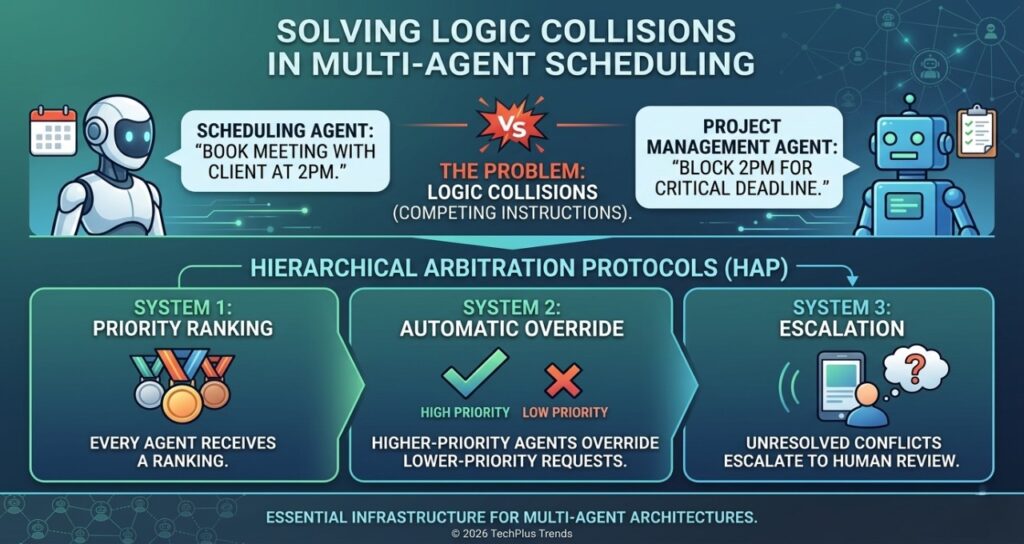
When multiple AI agents manage scheduling simultaneously, conflicts inevitably occur.
These conflicts—known as Logic Collisions—happen when two autonomous systems issue competing instructions.
Example:
- A scheduling agent books a meeting with a client.
- A project management agent blocks that same time for a critical deadline.
To resolve this, enterprises now implement Hierarchical Arbitration Protocols (HAP).
In this system:
- every agent receives a priority ranking
- higher-priority agents override lower-priority requests
- unresolved conflicts escalate to human review
As organizations adopt multi-agent architectures similar to those described in agentic AI workflow automation, arbitration frameworks have become essential infrastructure.
The Compliance Layer: EU AI Act and Scheduling Agents
AI scheduling systems must also meet increasing regulatory requirements.
Under the EU AI Act, transparency is mandatory when humans interact with AI systems.
In practice, this means calendar invitations generated by agents must disclose:
- that the scheduling process involved AI
- which system generated the meeting request
- what data sources were used
Organizations deploying multi-agent scheduling frameworks are therefore integrating governance models similar to those used in enterprise multi-agent security governance environments.
Privacy, auditability, and data ownership have become critical design considerations.
From Scheduling Tools to Autonomous Workflows
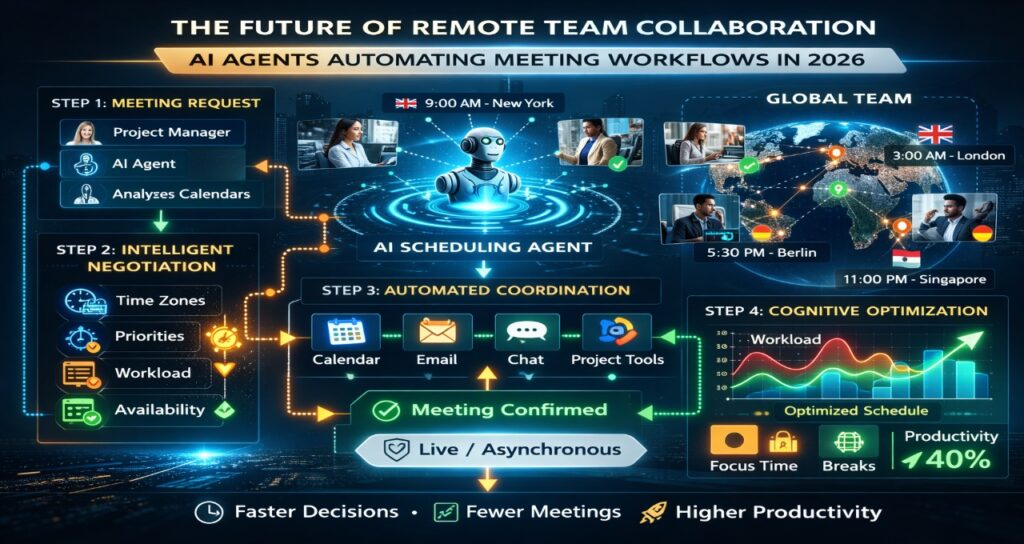
The real power of scheduling AI emerges when it integrates with broader operational systems.
In modern organizations, calendar agents increasingly coordinate with:
- project management platforms
- CRM systems
- task automation tools
- communication platforms
These integrations allow scheduling decisions to be based on actual business context rather than isolated calendar data.
For example, agents may prioritize meetings related to product launches or client escalations detected in project management systems such as those explored in AI agents for project management.
Over time, this creates a new operational layer: Autonomous Workflow Coordination.
The Economics of Agentic Scheduling
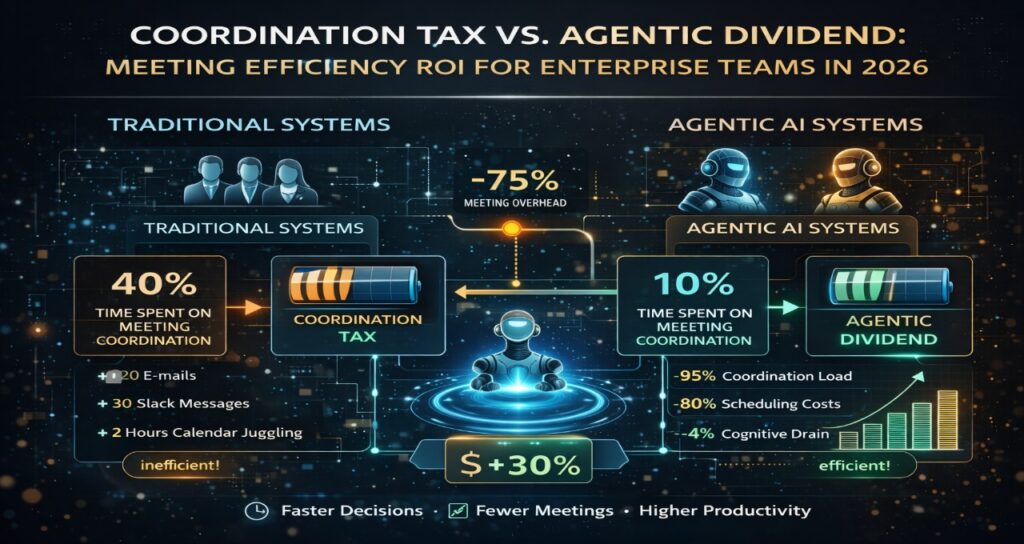
Automating scheduling may seem trivial, but the economic impact is substantial.
Enterprise research suggests distributed teams save thousands of hours annually by eliminating manual coordination.
This efficiency improvement contributes to what analysts describe as the Agentic Dividend—the measurable productivity gain from delegating operational tasks to autonomous systems.
Organizations building these systems increasingly evaluate them through frameworks similar to the cost analysis discussed in agentic AI token economics.
The conclusion is consistent: autonomous coordination dramatically reduces operational friction.
Technical Glossary: The New Scheduling Vocabulary
Agentic Orchestration
Autonomous AI systems coordinating complex workflows across multiple applications.
Cognitive Load Logic
Scheduling algorithms that optimize calendars based on mental workload rather than simple availability.
Hierarchical Arbitration Protocol (HAP)
A governance model used to resolve conflicts between autonomous agents.
Model Context Protocol (MCP)
A communication standard that allows AI systems to securely access operational context from multiple software platforms.
Shadow Meetings
Asynchronous collaboration sessions where AI summarizes discussions and collects feedback across time zones.
Service Mesh Scheduling
A distributed architecture that synchronizes scheduling data across multiple calendar ecosystems.
FAQ: AI Scheduling Tools for Remote Teams
1.What are AI scheduling agents?
Ans-AI scheduling agents are autonomous software systems that negotiate meeting times, coordinate calendars, and optimize schedules using machine learning and contextual data.
2.Can AI scheduling tools protect focus time?
Ans-Yes. Modern tools automatically block deep-work windows, prevent meeting overload, and adapt schedules based on project priorities.
3.How do AI scheduling systems solve calendar conflicts?
Ans-They use hierarchical arbitration models where higher-priority tasks override lower-priority events.
4.Are AI scheduling agents compliant with European regulations?
Ans-Most enterprise tools now include transparency disclosures to comply with the EU AI Act, ensuring users understand when AI systems are involved in scheduling.
Final Thoughts: Your Calendar Is Becoming a Digital Employee
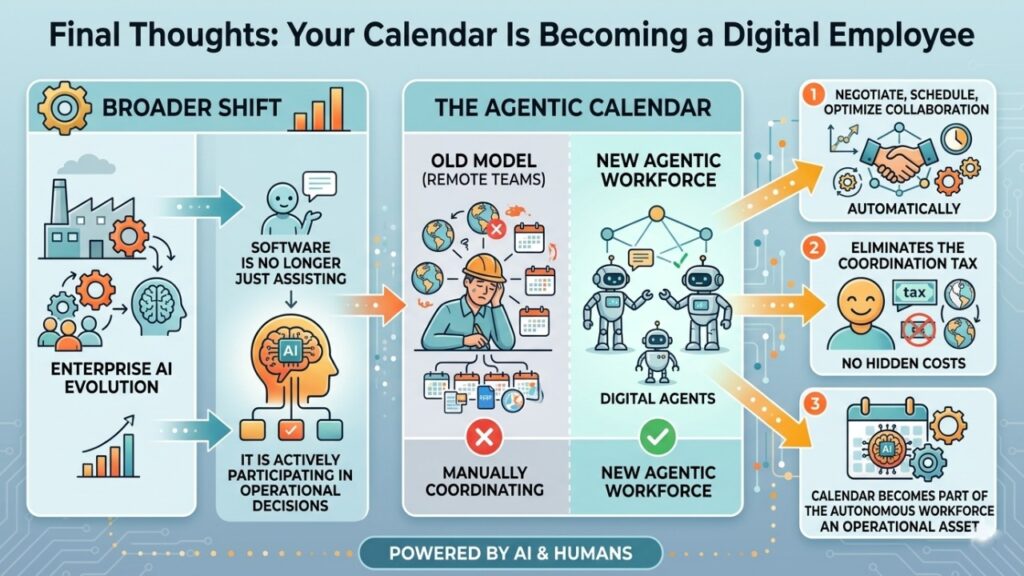
The evolution of scheduling technology reflects a broader shift in enterprise AI.
Software is no longer simply assisting workers—it is actively participating in operational decisions.
The next generation of remote teams will not manually coordinate calendars.
Instead, their digital agents will negotiate, schedule, and optimize collaboration automatically.
For organizations operating across multiple time zones, this shift eliminates one of the largest hidden costs of distributed work: the coordination tax.
In the age of agentic software, even your calendar is becoming part of the autonomous workforce.
Sources
European Commission – Artificial Intelligence Act (EU AI Act)
https://digital-strategy.ec.europa.eu/en/policies/european-ai-act
European Commission – Digital Strategy and AI Governance
https://digital-strategy.ec.europa.eu/
OECD – Artificial Intelligence Policy Observatory
https://oecd.ai/
Stanford University – AI Index Report
https://aiindex.stanford.edu/
Nvidia – Enterprise AI Infrastructure and Agentic Systems
https://www.nvidia.com/en-us/ai/
Microsoft – AI Productivity and Copilot Research
https://www.microsoft.com/en-us/ai
McKinsey Global Institute – The Future of Work in the Age of AI
https://www.mckinsey.com/mgi
Gartner – AI-Augmented Workforce and Autonomous Systems Research
https://www.gartner.com/en/artificial-intelligence
Author Bio
Saameer is a technology journalist and AI systems analyst at Tech Plus Trends, where he covers the evolution of autonomous software, agentic workflows, and enterprise artificial intelligence infrastructure. His reporting focuses on how emerging technologies such as AI agents, distributed orchestration systems, and autonomous productivity platforms are transforming modern organizations and redefining the future of work.
Saameer specializes in analyzing the shift from traditional SaaS tools to agent-driven digital workforces, exploring how businesses deploy AI to automate coordination, manage complex workflows, and reduce operational friction in distributed teams. His work often examines topics including multi-agent systems, AI governance frameworks, productivity automation, and the global regulatory landscape shaping enterprise AI adoption.
Through long-form explainers and deep technical guides, Saameer helps founders, engineers, and technology leaders understand the structural shifts driving the agentic economy and the next generation of intelligent workplace systems.
AI Transparency & Editorial Disclosure
Editorial Transparency: This article was developed by Tech Plus Trends using a collaborative “Human-in-the-Loop” (HITL) AI workflow. While advanced agentic systems were utilized to synthesize multi-platform data and architectural trends for 2026, the final technical analysis, strategic insights, and editorial conclusions were verified and finalized by Saameer, our founder and lead technology infrastructure analyst.
EU AI Act Compliance Note: In alignment with the transparency requirements outlined in Article 50 of the EU AI Act, please be advised that portions of the scheduling frameworks and “Agentic Handshake” protocols described in this post involve interaction with autonomous AI systems. Our goal is to provide an objective look at how these systems operate within enterprise environments.
Data Privacy & Ethics: The discussion regarding “Cognitive Load Logic” and “NPU-based processing” refers to emerging privacy-first hardware standards. Tech Plus Trends advocates for Privacy-by-Design and the use of on-device processing to ensure that personal productivity data remains under the user’s local control.