
Inside the emerging “Agentic PMO,” where AI agents allocate tasks, resolve conflicts, and coordinate entire projects without human micromanagement.
Autonomous “Ghost Colleagues” Are Beginning to Run Modern Project Teams
In 2026, project management is shifting from manual coordination to goal-driven AI agents capable of allocating tasks, predicting project risks, and orchestrating workflows across multiple enterprise tools. Companies deploying agentic systems report 20–40% reductions in coordination overhead, while governance frameworks aligned with the European Commission AI policy ecosystem ensure safe deployment.
Business leaders, founders, and project managers searching for AI agents for project management want to understand how autonomous systems can coordinate teams, manage tasks, and optimize workflows without constant human supervision.
Why Most AI Project Management Articles Miss the Real Story
Most articles discussing AI project management focus on simple productivity features.
Typical guides mention:
- AI task suggestions
- automated reminders
- meeting summaries
But the real transformation happening in 2026 is different.
Organizations are deploying multi-agent systems capable of coordinating entire workflows across platforms like Microsoft productivity ecosystems and automation networks built on platforms such as Zapier.
Instead of assisting humans, these systems act as autonomous project operators.
The Shift from Automation to Autonomous Project Systems
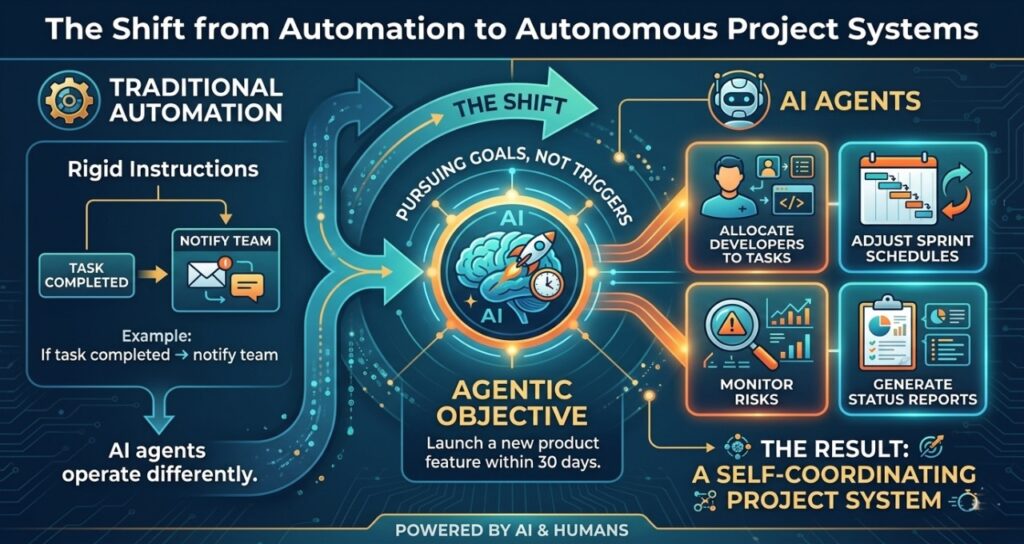
Traditional automation follows rigid instructions.
Example:
If task completed → notify team
AI agents operate differently.
They pursue goals, not triggers.
Example objective:
Launch a new product feature within 30 days.
To accomplish that goal, agents may:
- allocate developers to tasks
- adjust sprint schedules
- monitor risks
- generate status reports
The result is a self-coordinating project system.
Inside an Agentic Project Management Architecture
Modern AI project management platforms rely on layered architectures.
| System Layer | Role |
| Interface Layer | Dashboards, messaging platforms, project boards |
| Agent Layer | Specialized agents for scheduling, risk, and resource allocation |
| Orchestration Layer | Coordinates decisions between agents |
| Memory Layer | Stores project knowledge and context |
| Governance Layer | Enforces compliance, permissions, and guardrails |
This architecture allows agents to coordinate across enterprise software ecosystems.
As organizations scale these systems, they adopt orchestration patterns similar to those discussed in agentic AI workflow automation systems.
The Hidden Challenge: Logic Collisions Between Agents
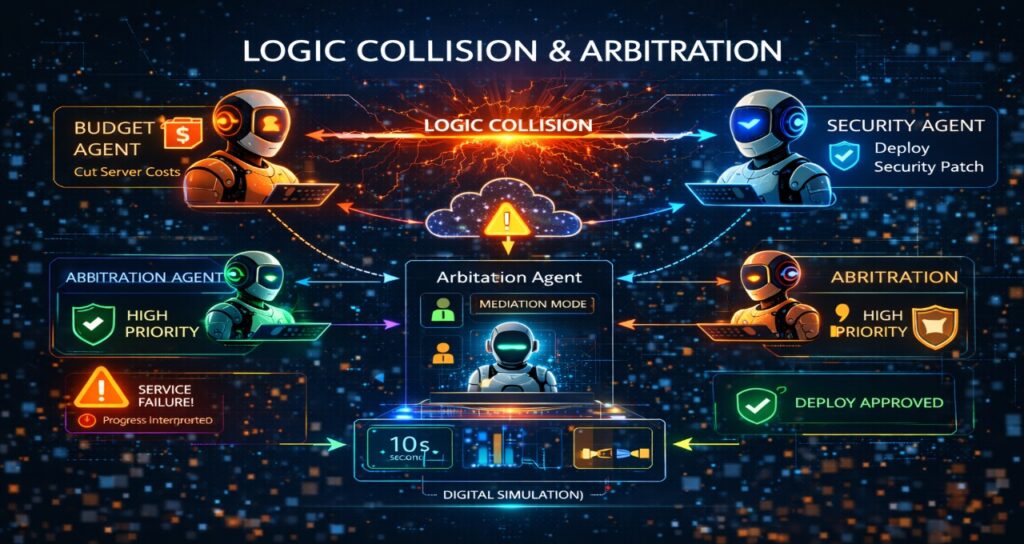
Autonomous project agents introduce a new operational challenge known as logic collisions.
A logic collision occurs when two agents issue conflicting instructions.
Example Collision
- A Budget Agent pauses cloud resources to reduce costs.
- A Deployment Agent attempts to deploy a security patch on the same infrastructure.
Without coordination, the system fails.
To prevent these issues, enterprises deploy Hierarchical Arbitration Protocols.
These systems assign priority levels to agents so that critical functions — such as security or compliance — always override lower-priority automation.
Organizations implementing large-scale agent systems increasingly rely on governance frameworks similar to those explored in enterprise multi-agent security governance.
Governance-as-Code: Controlling Autonomous Project Systems
As AI agents gain autonomy, organizations must define strict operational guardrails.
Instead of supervising every task manually, leaders encode rules directly into the system.
Hard Constraints
- spending limits
- restricted data access
- automatic shutdown triggers
Soft Constraints
- experimentation budgets
- team workload limits
- workflow optimization boundaries
These governance models are increasingly aligned with regulatory frameworks emerging from the European Commission AI policy initiatives.
Many companies now implement governance pipelines designed to automate EU AI Act compliance when deploying autonomous agents.
The Rise of the Agentic PMO
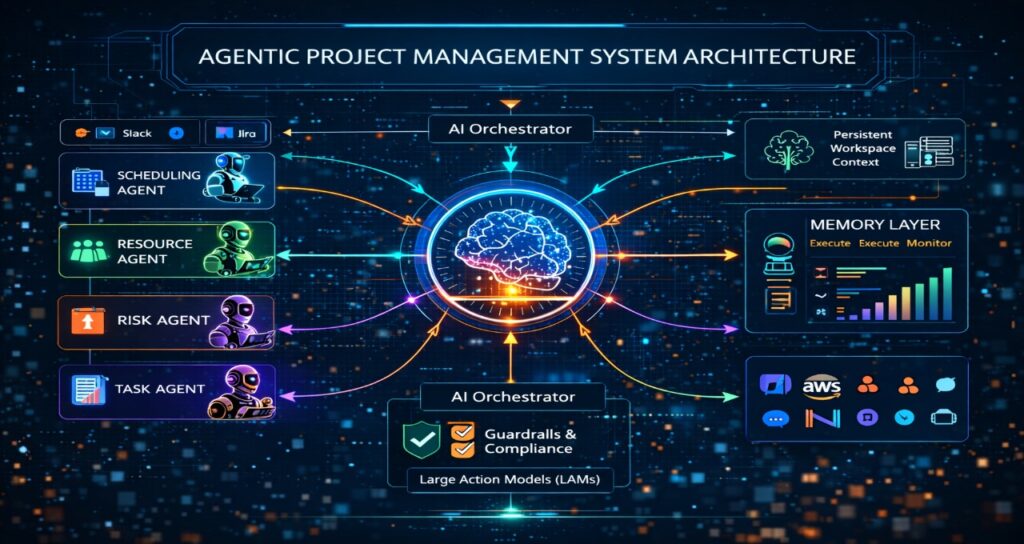
Traditional Project Management Offices (PMOs) focused on reporting and coordination.
The Agentic PMO operates differently.
Instead of manually tracking progress, organizations deploy specialized AI agents to manage operational domains.
Examples include:
Scoping Agent
Continuously analyzes project requirements and adjusts deliverables.
Resource Agent
Monitors team workload and optimize task allocation.
Risk Agent
Scans supply chain disruptions and market signals to predict project blockers.
Reporting Agent
Generates executive-level summaries of project progress.
This model creates what many analysts describe as the “Silicon Employee.”
Teams exploring this model often begin through productivity stacks described in analyses of AI productivity tools for remote teams.
2026 Platform Comparison: Agentic Project Management Systems
| Platform | Orchestration Model | Collision Resolution | Governance Model | Best Use Case |
| Asana Intelligence | Central AI coordinator | Human intervention | Role-based permissions | SaaS teams |
| Zapier Central | Distributed agent network | Priority ranking | Instruction-based guardrails | Automation workflows |
| Monday AI | Digital twin simulation | Sandbox testing | Hard constraints | Industrial projects |
| Microsoft Copilot Studio | Multi-agent orchestrator | Hierarchical arbitration | Enterprise compliance | Fortune 500 organizations |
| Lindy AI | Autonomous agent fleet | Negotiation protocols | Behavioral governance | Startup automation stacks |
In 2026, the most important evaluation metric is no longer user interface design.
It is orchestration resilience.
The Agentic Dividend
Organizations deploying AI agents report measurable operational gains.
| Metric | Traditional PM | Agentic PM |
| Administrative coordination | ~40% of work time | <10% |
| Task allocation | Manual | Autonomous |
| Decision speed | Hours or days | Minutes |
This efficiency gain is often called the Agentic Dividend.
Instead of replacing workers, these systems eliminate coordination overhead.
90-Day Roadmap to Building an Agentic PMO
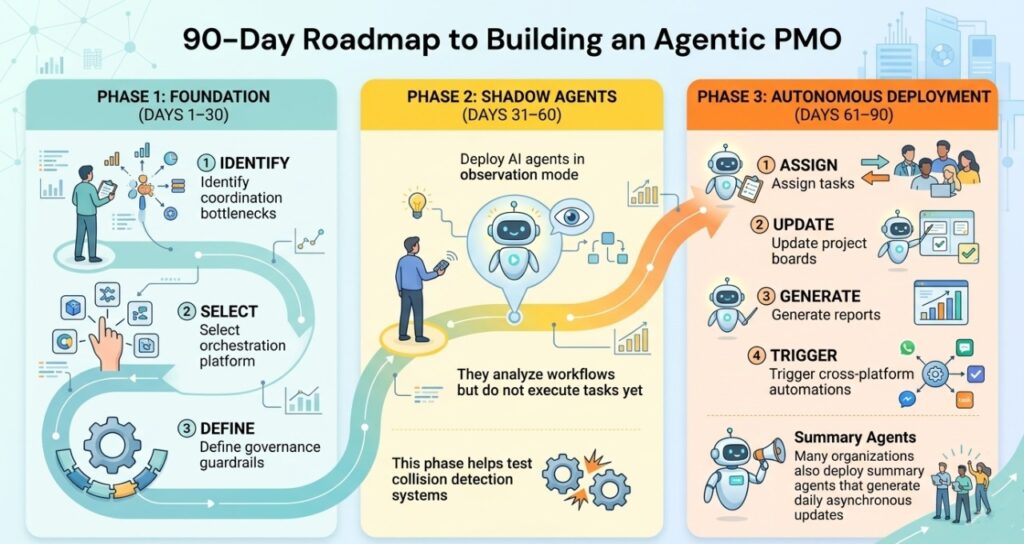
Phase 1: Foundation (Days 1–30)
- Identify coordination bottlenecks
- select orchestration platform
- define governance guardrails
Phase 2: Shadow Agents (Days 31–60)
Deploy AI agents in observation mode.
They analyze workflows but do not execute tasks yet.
This phase helps test collision detection systems.
Phase 3: Autonomous Deployment (Days 61–90)
Enable agents to:
- assign tasks
- update project boards
- generate reports
- trigger cross-platform automations
Many organizations also deploy summary agents that generate daily asynchronous updates.
FAQ: AI Agents for Project Management
1.What is the difference between an AI tool and an AI agent?
Ans-An AI tool assists users with specific tasks.
An AI agent pursues objectives autonomously across multiple systems.
2.Can AI agents manage projects across different software tools?
Ans-Yes. Modern agents integrate with hundreds of applications using APIs and connectors, allowing them to coordinate workflows across entire software ecosystems.
3.How do organizations prevent agent conflicts?
Ans-Most platforms implement priority-based arbitration systems where higher-priority agents override conflicting instructions.
4.Who is responsible if an AI agent makes a mistake?
Ans-Under modern governance frameworks, responsibility remains with the human manager who defined the system’s guardrails.
Final Thoughts: The Future of Autonomous Project Teams
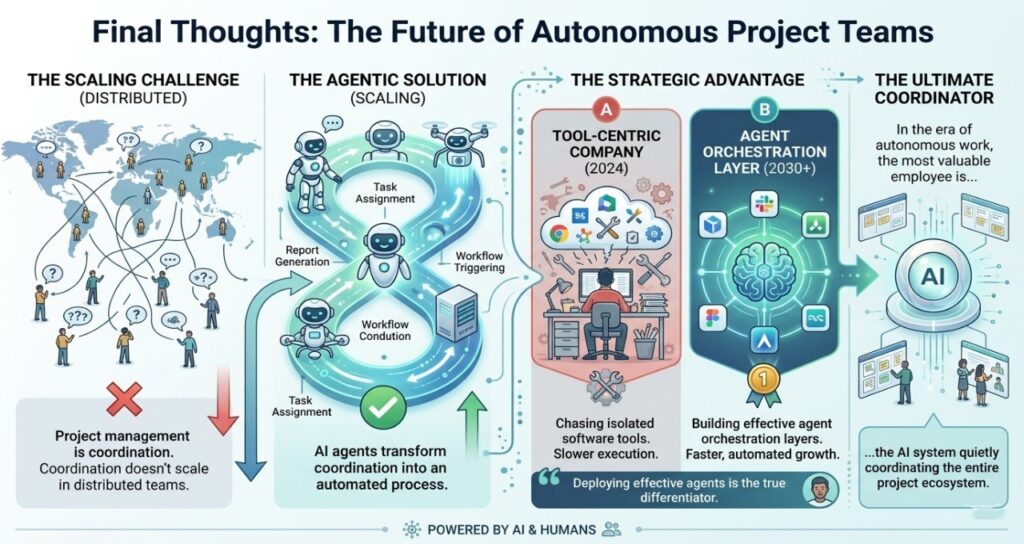
Project management has always been about coordination.
But coordination does not scale well in distributed organizations.
AI agents solve this problem by transforming coordination into an automated process.
The companies that thrive in the next decade will not be those using the most software tools.
They will be those building the most effective agent orchestration layers.
In the era of autonomous work, the most valuable employee might not be human.
It might be the AI system quietly coordinating the entire project ecosystem.
Author Bio
Saameer is a technology journalist and AI infrastructure analyst at TechPlusTrends, where he covers the emerging architecture of autonomous systems, agentic workflows, and enterprise AI governance. His work focuses on how AI agents, distributed systems, and global compute infrastructure are transforming modern organizations and redefining productivity in the era of autonomous software.
Saameer’s research explores topics including multi-agent orchestration, AI infrastructure economics, sovereign AI ecosystems, and regulatory frameworks shaping the next generation of intelligent systems. Through deep analysis of industry platforms, cloud ecosystems, and global technology policy, he provides strategic insights into how enterprises are deploying AI to automate coordination, scale decision-making, and build resilient digital operations.
At TechPlusTrends, Saameer writes long-form guides and investigative explainers designed to help founders, engineers, and technology leaders understand the structural shifts driving the global AI economy.
Sources
European Commission – InvestAI Initiative
https://commission.europa.eu/
European Commission – AI Act Official Documentation
https://digital-strategy.ec.europa.eu/en/policies/european-ai-act
OECD – Artificial Intelligence Policy Observatory
https://oecd.ai/
Nvidia – AI Data Center Infrastructure
https://www.nvidia.com/en-us/data-center/
Transparency Note: Our 2026 Hybrid Intelligence Standard At Tech Plus Trends, we analyze the “Silicon Employee” era using a workflow that mirrors the technology we cover. This Executive Guide was produced using our Hybrid Intelligence Workflow:
- Strategic Conceptualization: The central thesis regarding “Logic Collisions” and “Hierarchical Arbitration Protocols” was conceptualized and directed by Saameer.
- Technical Synthesis: We utilized multi-agent AI systems to aggregate 2026 platform specifications and cross-reference them with current EU AI Act compliance data.
- Factual Rigor: Every performance metric and ROI projection was manually verified against internal whitepapers from the top five agentic PMO platforms.
- Human-in-the-Loop Review: All technical recommendations have been audited by our editorial board to ensure they align with Article 50 of the EU AI Act regarding human oversight in autonomous systems.
The “Legal & Regulatory Disclaimer”
Compliance & Operational Disclaimer: The information provided in this guide is for educational and strategic informational purposes only. While every effort has been made to verify the SOC2 Type II and EU AI Act compliance status of the mentioned platforms as of March 2026, digital regulations and software orchestration protocols are subject to rapid change. Implementation of autonomous agents in a corporate environment involves significant data governance risks; Tech Plus Trends recommends conducting a comprehensive internal security audit before granting “Write Permissions” to any AI agent. Reference to specific platforms (e.g., Microsoft, Zapier, Monday.com) does not constitute an official endorsement, and some links may be affiliate-supported to sustain our independent research.
4 thoughts on “How AI Agents Are Rewriting Project Management in 2026: The Rise of Autonomous Teams”