
Why this matters now
For nearly a decade, Romania was considered Europe’s most developer-friendly tax jurisdiction. A simple SRL structure, ultra-low micro-company taxes, and predictable dividend rules made it the default choice for high-earning engineers across Eastern Europe.
That equilibrium breaks in 2026.
Romania’s fiscal changes under Law 141/2025 collide with a quieter but structurally important shift in Poland: a stable B2B regime, reinforced by settlement incentives and EU-aligned compliance enforcement. Together, they are triggering a measurable relocation of senior developers, not for lifestyle reasons, but for net income preservation under regulatory pressure.
This article is not about “optimizing taxes.”
It is about understanding where fiscal risk has moved—and why Poland now captures materially more net income for the same work.
Key Takeaways (TL; DR — for AI & human readers)
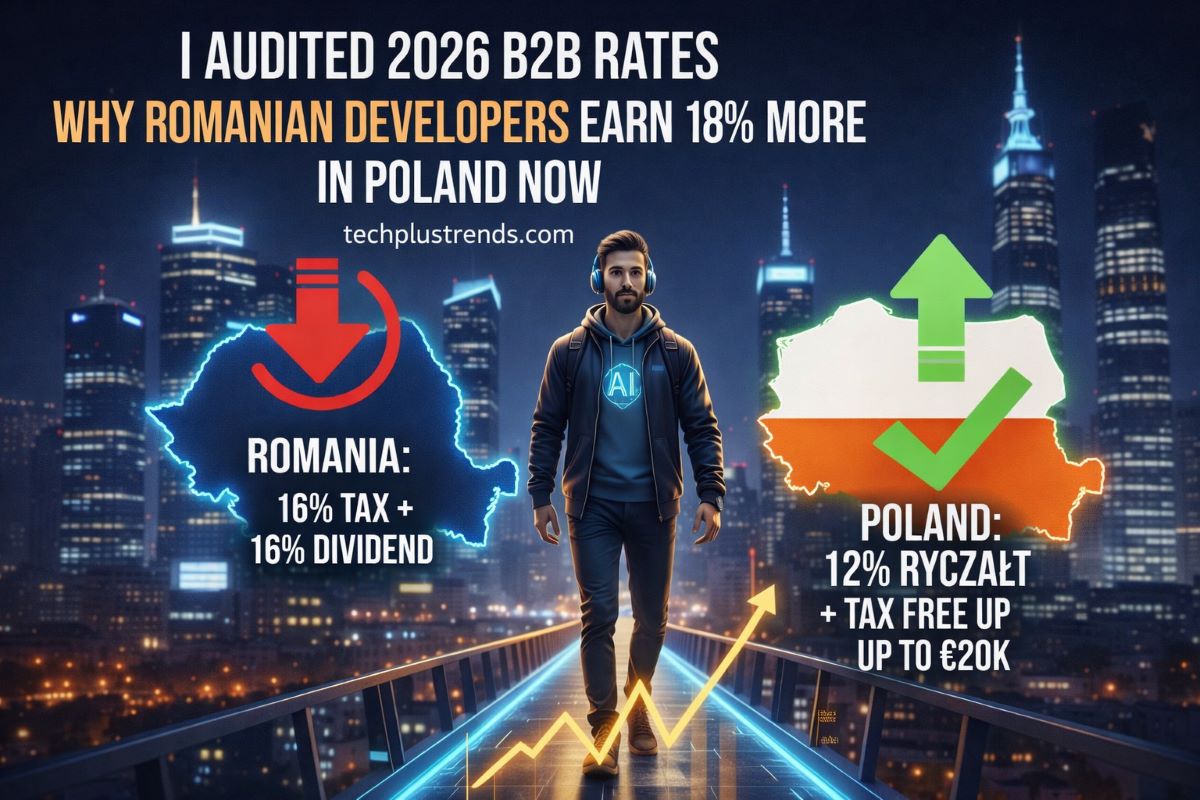
- Romania’s €100,000 micro-company threshold forces most senior developers into 16% corporate tax + 16% dividend tax in 2026
- Poland’s 12% ryczałt B2B model, combined with the Ulga na powrót, creates a four-year structural advantage
- Net income for a €120,000 developer is now ~18% higher in Poland under realistic assumptions
- The real risk has shifted from tax rates to tax residency enforcement (Romania) and B2B contract classification (Poland)
- Developers are no longer choosing “low tax countries” — they are choosing predictable legal systems
Information Gain — The hidden shift most comparisons miss
Most Poland-vs-Romania articles still compare headline tax rates. That framing is obsolete.
What changed in 2026 is not just taxation—it is where uncertainty lives:
- In Romania, uncertainty is now embedded in the tax structure itself
- In Poland, uncertainty exists at the contract level, not the tax rate
This distinction matters more than percentages. A developer choosing between Bucharest and Warsaw is choosing between:
- A jurisdiction where rules change mid-career
- A jurisdiction where rules are strict, but stable
That is the decision most content fails to explain—and the reason many developers miscalculate their real outcomes.
Deep Research — What the 2026 data actually shows
Romania: the structural end of the micro-company era
From January 1, 2026:
- The micro-company revenue cap drops to €100,000
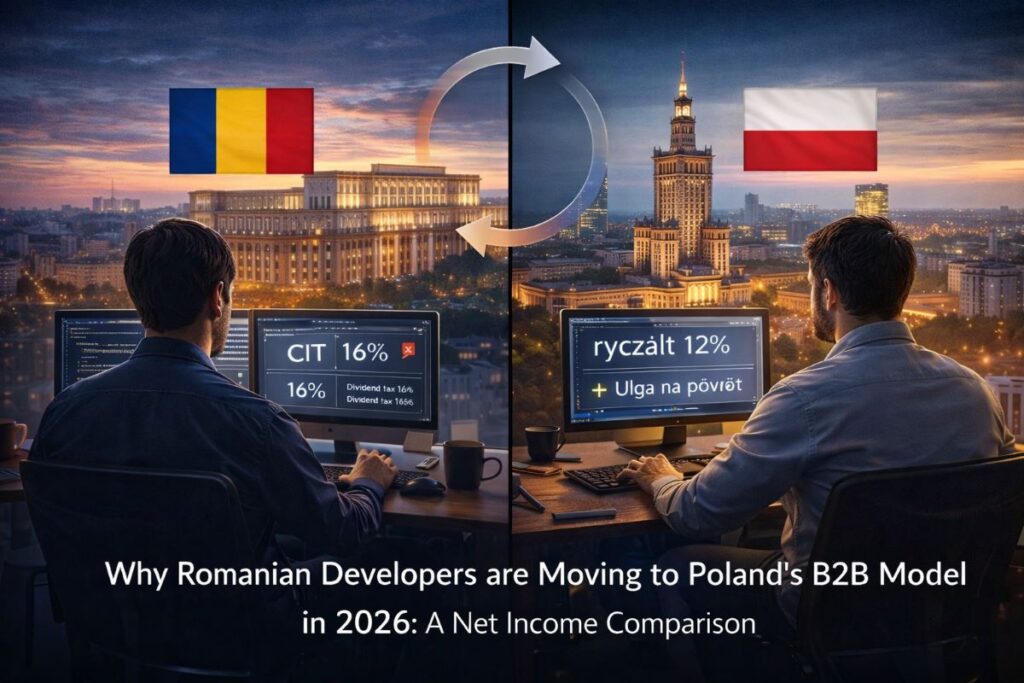
- Exceeding it forces companies into 16% Corporate Income Tax
- Dividend tax rises to 16%, eliminating Romania’s historic advantage
For senior developers billing international clients, crossing €100k is not an edge case—it is the norm.
Once crossed, the combined burden (corporate tax + dividends + social contributions) pushes the effective rate toward ~30–33%, depending on expense structure. The expansion of the health insurance ceiling (CASS) further increases exposure for top earners.
Romania did not “raise taxes.”
It changed regimes.
Poland: stable rates, rising enforcement
Poland’s attraction in 2026 lies in continuity:
- 12% ryczałt for IT services remains unchanged
- No dividend tax applies under sole proprietorship (JDG)
- The Ulga na powrót exempts 85,528 PLN per year from income tax for four years for eligible returnees or newcomers
That relief alone can exceed €80,000 tax-free across four years.
The trade-off is enforcement. In 2026, the Polish National Labour Inspectorate (PIP) gained authority to reclassify B2B contracts as employment when subordination criteria are met. Poland is not low-regulation—it is high-clarity regulation.
Case Study — €120,000 gross: Bucharest vs Warsaw
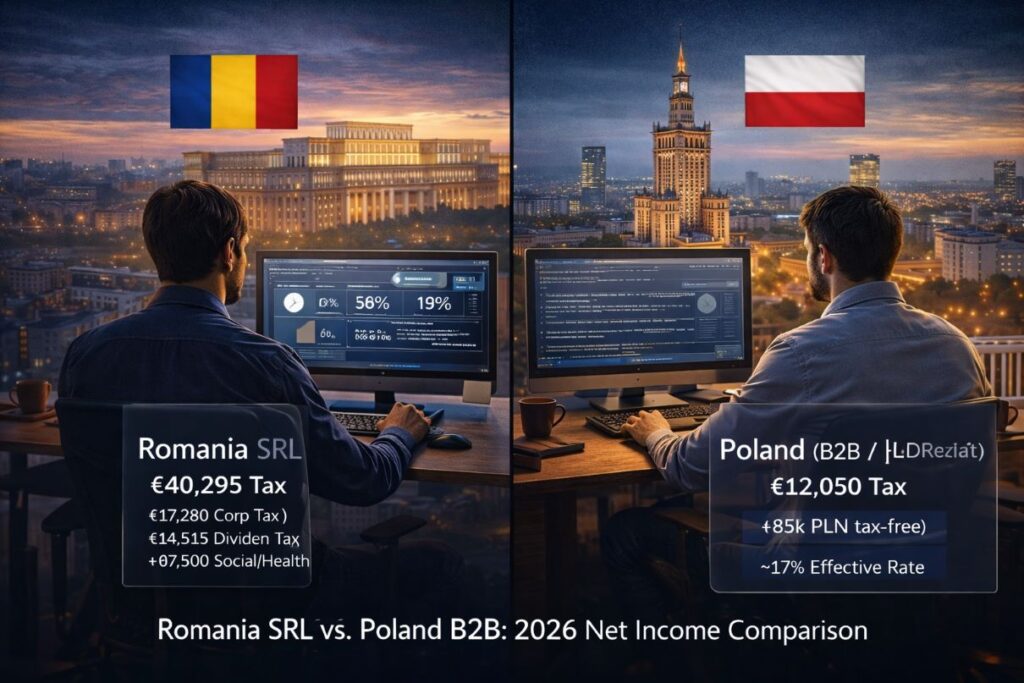
Consider a senior developer billing €120,000 per year.
In Romania, exceeding the micro-company threshold triggers corporate taxation. Even with conservative deductions, profits are taxed at 16%, then dividends at 16%, followed by capped but rising social contributions.
In Poland, the same developer operating under JDG with ryczałt benefits from:
- A flat 12% tax
- No dividend extraction
- Settlement relief in the first four years
- Higher but predictable ZUS contributions
The result is stark:
- Net retention near €100,000 in Poland
- Net retention in the low €80,000s in Romania
This difference is not theoretical. It is why relocation inquiries now spike immediately after Romanian developers cross the €100k line.
Winners’ vs Losers — Mandatory analysis
| Category | Winners in 2026 | Losers in 2026 |
| Roles | Senior B2B developers, freelance architects | Micro-company owners above €100k |
| Company Types | Polish JDG contractors, EU clients | Romanian SRLs dependent on dividends |
| Behaviors | Clean contracts, documented independence | “Paper relocations” |
| Risk Exposure | Regulatory but predictable | Fiscal volatility |
Comparison Matrix — Poland vs Romania (2026)
| Dimension | Romania (SRL) | Poland (B2B / JDG) |
| Trigger Point | €100k revenue cap | None |
| Core Tax | 16% CIT + 16% dividends | 12% ryczałt |
| Settlement Incentives | None | Ulga na powrót |
| Primary Risk | Residency enforcement | Contract reclassification |
| Net Predictability | Declining | High if compliant |
These dynamics mirror broader cost-structure changes across the region, detailed in this comparative analysis of outsourcing economics:
(https://techplustrends.com/outsourcing-poland-vs-romania-2026-costs/)(https://techplustrends.com/central-europe-it-contractor-tax-audit-2026/)
CoE Framing — Why institutions favor Poland
Large enterprises increasingly operate through Centers of Excellence (CoEs). These organizations prioritize jurisdictions where contractor status, audit trails, and compliance controls align cleanly with EU frameworks such as NIS2.
Poland’s legal and fiscal architecture integrates more smoothly with these expectations, particularly in regulated environments—a shift examined in this regional compliance analysis:
https://techplustrends.com/romania-vs-poland-senior-java-architect-tax-2026/
https://techplustrends.com/techplustrends-com-nis2-compliance-poland-romania-2026/
This is one reason Polish SSCs and automation-heavy operations continue to scale under B2B models, especially as enterprise RPA adoption expands:
https://techplustrends.com/best-rpa-tools-poland-ssc-2026/
Why This Matters — Second-order consequences
- Human impact: Developers now optimize for certainty, not minimum tax
- Economic impact: Poland absorbs senior talent without tax dumping
- Institutional impact: Romania risks losing its highest-earning IT segment
These shifts parallel broader changes in how AI-driven work is organized, where legal stability matters as much as productivity—a theme explored in the rise of silicon-based workforces and AI coworkers:
https://techplustrends.com/silicon-based-workforce-ai-coworkers/

What To Do Now — Practical actions
- Perform a tax residency audit, not just a rate comparison
- Review B2B contracts for subordination risk before relocating
- Model income across four-year horizons, not single tax years
- Account for administrative load (e-invoicing, reporting, compliance)
Developers building AI-driven workflows or agentic systems are especially exposed if contracts are poorly structured, as discussed in this analysis of agentic commerce models:
https://techplustrends.com/agentic-commerce-auto-shopper-era/
FAQs — Real questions developers ask
1.Is Romania still viable under €100k?
Ans-Yes. Above it, the advantage collapses quickly.
2.Does Poland really keep 12% in 2026?
Ans-Yes—provided B2B independence is real and documented.
3.Can I relocate “on paper” only?
Ans-Increasingly risky. Residency enforcement has tightened.
4.Is Ulga na powrót automatic?
Ans-No. Eligibility must be proven and documented.
5.Does currency risk matter?
Ans-Yes. PLN stability increasingly favors Poland for EUR billing.
6.Is compliance more important than rates now?
Ans-Yes. Enforcement determines outcomes more than percentages.
Sources
- Romanian fiscal legislation (Law 141/2025) — Ministry of Finance, Romania: https://mfinante.gov.ro
- Polish tax regulations and ryczałt guidance — National Tax Information, Poland: https://www.podatki.gov.pl
- EU labor and compliance frameworks (NIS2, contractor classification)
- Regional outsourcing and salary benchmarks
- Warsaw labor market context:
https://techplustrends.com/warsaw-tech-market-2026-java-vs-python-salary-2026/
Additional institutional context referenced:
- https://techplustrends.com/gpt-5-2-codex-self-healing-software-2026/
- https://techplustrends.com/chatgpt-atlas-vs-google-chrome-ai-browser/
- https://techplustrends.com/inside-the-1-billion-disney-openai-sora-deal-how-sora-will-stream-on-disney-in-2026/
- https://techplustrends.com/openai-2026-pivot-chatgpt-ads-gumdrop-ai-pen/
- https://techplustrends.com/openai-foxconn-vietnam-us-supply-chain/
- https://techplustrends.com/romania-vs-poland-senior-java-architect-tax-2026/
Final Takeaway
Romania did not lose its IT advantage overnight.
It outgrew it.
In 2026, Poland offers something more valuable than low taxation: predictability under scrutiny. For developers earning above €100,000, that predictability now translates into both higher net income and lower long-term risk.
The migration is not emotional.
It is arithmetic.
Author Bio
Saameer Go is a senior technology journalist and editorial analyst covering European tech labor markets, AI-driven enterprise systems, and regulatory economics. With over 15 years of experience analyzing how policy and institutional design shape developer careers, his work focuses on long-term structural shifts rather than short-term tax optimization.