The Bucharest Exodus: Why Romanian Devs Are Moving to Warsaw for the €300/hr “DORA Premium”

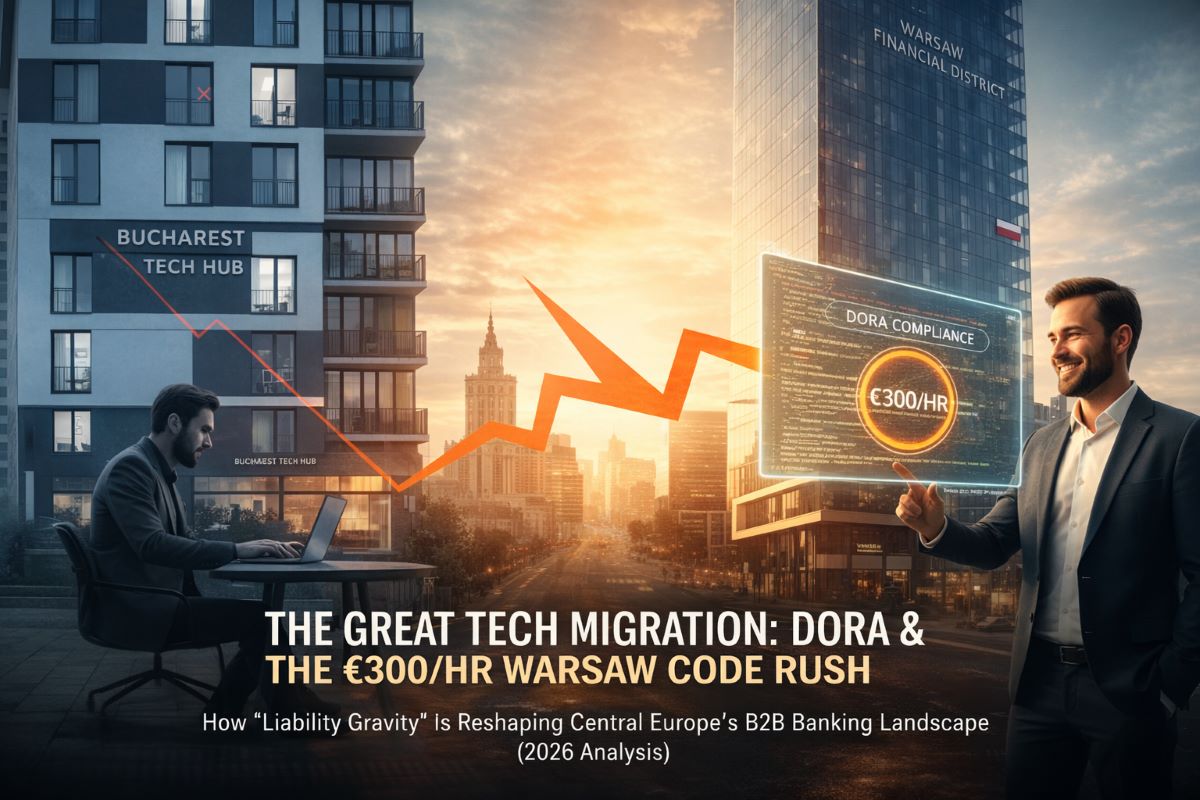
A split-screen visual showing a developer in Bucharest looking toward a high-tech Warsaw banking district skyscraper with a digital overlay of DORA 2026 compliance rates of €300 per hour.

The Quiet Capital Shift No One Is Pricing Correctly In 2026, Europe’s banking talent market is no longer governed by skills scarcity.It is governed by liability gravity. While Bucharest continues to produce world-class Java engineers, Tier-1 banks are quietly shifting their highest-paying B2B contracts toward Warsaw and Kraków. The reason is not talent quality, nor … Read more

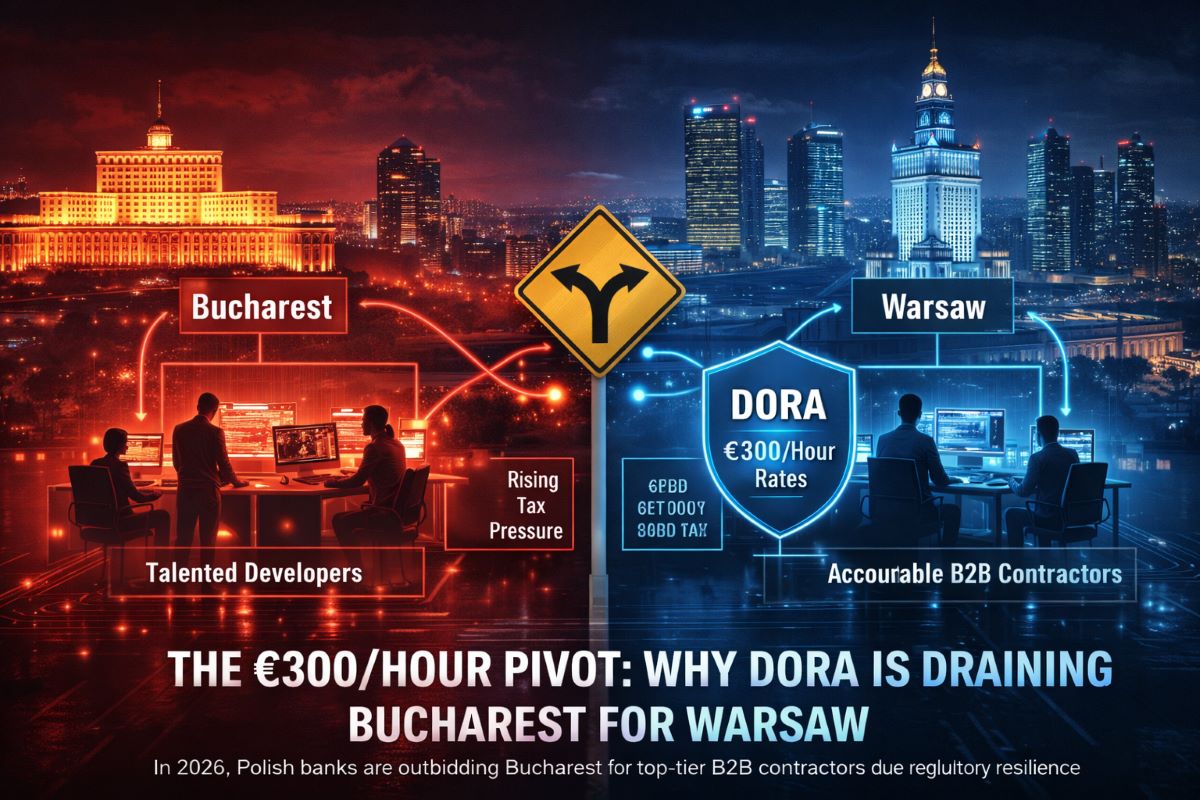
The €300/Hour Pivot: Why DORA Is Draining Bucharest for Warsaw (2026)

“DORA 2026 compliance is reshaping B2B IT economics, as Warsaw’s regulated banking infrastructure commands higher contractor rates than Bucharest due to audit liability and resilience requirements.”

Update (2026): This analysis reflects the latest DORA enforcement guidance, EU banking supervisory expectations, and contractor market conditions currently in force. By 2026, the most important shift in Europe’s financial-sector labor market is no longer about skills, salaries, or tax optimization. It is about liability placement. As the Digital Operational Resilience Act (DORA) enters live … Read more

Shadow AI: The “Silent Breach” Threatening Warsaw’s DORA 2026 Compliance (Java 25 Guide)

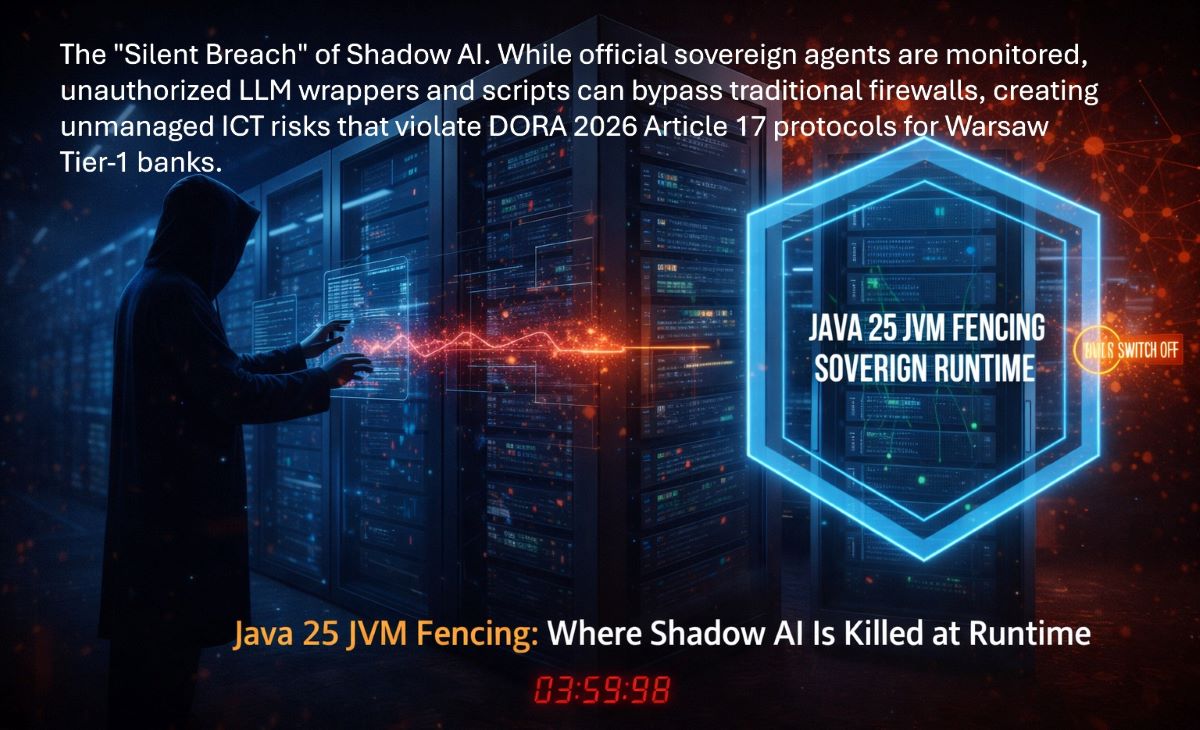
A conceptual visualization of Shadow AI as a glowing purple figure behind a banking firewall, representing unmanaged AI agents bypassing traditional ICT security in 2026.

Update (2026): This analysis reflects the latest DORA enforcement guidance, NIS2 implementation realities, and JVM platform changes now in force across EU Tier-1 banks. Warsaw’s Tier-1 banks are entering 2026 with one clear advantage: they operate inside one of Europe’s most tightly controlled, sovereign AI infrastructure environments. As detailed in Warsaw’s AI infrastructure versus Bucharest, … Read more

Beyond the Sandbox: The DORA 2026 Audit for Agentic AI in Warsaw’s Tier-1 Banks

DORA 2026 four-hour incident reporting window for agentic AI in Warsaw Tier-1 banks, showing Java 25 execution traceability and regulator audit pressure

Update (2026): This analysis reflects the latest regulatory, labor, and platform changes currently in force. Warsaw’s Tier-1 banks entered 2026 with a paradox. Their AI systems are more capable than ever—running on sovereign cloud infrastructure, powered by Java 25, and executing millions of autonomous decisions per hour. Yet regulatory risk has not declined. It has … Read more

The In-Region Mandate: Why Warsaw’s AI Banking Infrastructure Requires “On-Soil” Java 25 Experts in 2026

Map of Poland highlighting Warsaw’s Tier-1 AI banking infrastructure with on-soil Java 25 experts, NIS2 and EU Data Act compliance zones, and the concept of compliance proximity in 2026.

Update (2026): This analysis reflects the latest regulatory, labor, and platform changes currently in force across the EU banking sector. Warsaw has already established itself as Central Europe’s most advanced AI-ready banking hub. Sovereign cloud regions, GPU-dense infrastructure, and low-latency execution environments are now operational realities rather than roadmap promises. Yet in 2026, Tier-1 banks … Read more

Java 25 Migration & Project Loom: The Technical Debt “Gold Mine” for B2B Contractors in Poland’s Banking Sector

“Visual comparison of legacy Java 8 and Java 11 banking systems versus Java 25 architecture in 2026, highlighting Project Loom virtual threads, ZGC low-latency garbage collection, and sub-5ms execution targets in Warsaw Tier-1 bank cores.”

In 2026, Poland’s banking sector is facing a paradox. Warsaw hosts some of Europe’s most advanced AI-ready infrastructure, sovereign cloud regions, and GPU-dense data centers. Yet deep inside many Tier-1 banks, the core transaction engines still run on legacy Java architectures designed for a pre-agentic era. This gap—between modern infrastructure and outdated execution models—is no … Read more

Beyond the Code: Why Warsaw’s AI-Ready Infrastructure Is Outpacing Bucharest for Tier-1 Enterprise Contracts in 2026

“Visual comparison of Warsaw AI GPU infrastructure versus Bucharest talent hub in 2026, highlighting local Nvidia H100 compute density, latency differences, and sovereign energy-backed data centers.”

By 2026, Tier-1 enterprises have quietly rewritten their outsourcing playbook. The decisive variable is no longer developer headcount or hourly rates—it is where AI workloads physically execute. As banks, hyperscalers, and regulated enterprises deploy agentic AI systems handling billions in capital exposure, the competition between Central and Eastern European (CEE) hubs has shifted from talent … Read more

The New “Flat Tax” vs. “Lump Sum” (Ryczałt) for IT Contractors in Central Europe

IT contractor standing at a crossroads choosing between Poland’s Ryczałt tax system and Romania’s flat tax regime in 2026

A 2026 Audit of Net Income, Compliance Risk, and Career Stability Why This Matters Now By 2026, Central Europe’s IT contracting landscape has reached an inflection point. What used to be a simple comparison of tax percentages has become a structural decision shaped by real-time invoicing, cross-border data sharing, and enterprise compliance expectations. Poland, Romania, … Read more

Bucharest vs. Warsaw: Where Can a Senior Java Architect Save More After-Tax in 2026?

Senior Java architect comparing after-tax income in Bucharest vs Warsaw in 2026, highlighting Poland B2B tax advantages and Romania dividend taxes

Bucharest vs. Warsaw: Where Can a Senior Java Architect Save More After-Tax in 2026? Why This Matters Now For most of the last decade, Bucharest was the rational choice for senior Java architects optimizing for after-tax income inside the EU. That logic breaks in 2026. Romania’s fiscal overhaul under Law no. 141/2025 quietly dismantled the … Read more

I Audited 2026 B2B Rates: Why Romanian Developers Earn 18% More in Poland Now

Visual comparison of Poland’s 12% ryczałt tax and Romania’s 16% corporate and dividend tax system affecting developers in 2026.

Why this matters now For nearly a decade, Romania was considered Europe’s most developer-friendly tax jurisdiction. A simple SRL structure, ultra-low micro-company taxes, and predictable dividend rules made it the default choice for high-earning engineers across Eastern Europe. That equilibrium breaks in 2026. Romania’s fiscal changes under Law 141/2025 collide with a quieter but structurally … Read more