
In 2026, European companies are no longer asking whether they have Shadow AI.
They are asking how exposed they already are.
Unauthorized AI usage—employees running copilots, autonomous agents, browser extensions, and embedded models outside approved governance—has quietly become one of the fastest-growing regulatory liabilities under the EU AI Act. For cybersecurity consultants, this has created a rare opportunity: a high-demand, low-supply audit niche where pricing norms have not yet solidified.
This guide is not about explaining what Shadow AI is. That ground is already well covered.
This is about the real question consultants are asking in 2026:
“How much should I charge—and why?”
Why Shadow AI Audits Command a Premium in 2026
Shadow AI is fundamentally different from Shadow IT.
A traditional IT audit looks for unauthorized assets.
A Shadow AI audit uncovers unauthorized decision-making systems—often interacting with personal data, business logic, or regulated workflows.
The liability exposure mirrors the personal accountability CISOs now face under NIS2, where executive responsibility has become a pricing and compensation factor across Europe (see how this risk is reshaping executive roles in NIS2 CISO personal liability in Germany).
In practice, Shadow AI audits price higher because they transfer regulatory risk, not just technical findings.
The 2026 Pricing Vacuum
Most existing frameworks (ISO, ISACA, Gartner) lump Shadow AI into generic “AI governance.”
What they fail to price explicitly is the Discovery Phase—finding AI that was never declared.
In 2026, the market has shifted toward hybrid audit models:
- Discovery first (technically invasive, telemetry-based)
- Governance second (ISO 42001, EU AI Act mapping)
Boutique EU security firms (5–30 consultants) are outcompeting large firms by delivering evidence-driven audits, not survey-based assessments. This mirrors a broader market shift where specialized cybersecurity expertise increasingly commands a premium over generalized consulting, as reflected in regional pay differentials such as cybersecurity salaries in Paris vs Berlin under NIS2 pressure.
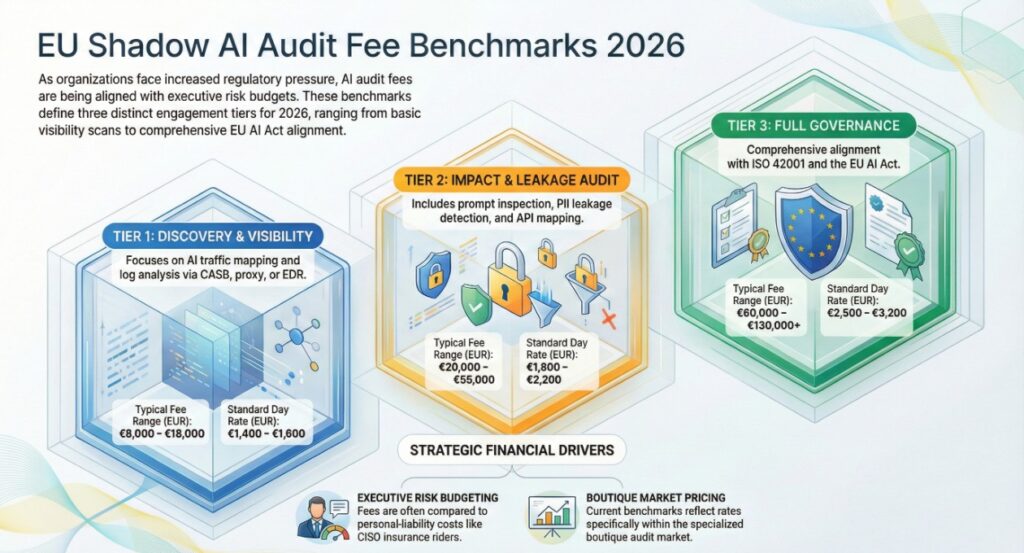
Shadow AI Audit Fee Benchmarks (EU, 2026)
Engagement Tiers (Boutique Market)
| Tier | Engagement Scope | Typical Fee (EUR) |
| Tier 1: Discovery Scan | CASB / proxy / EDR log analysis, AI traffic mapping | €8,000 – €15,000 |
| Tier 2: Impact Audit | Tier 1 + prompt inspection, PII leakage, API mapping | €20,000 – €45,000 |
| Tier 3: Full Governance | Tier 2 + ISO 42001 + EU AI Act alignment + training | €60,000 – €120,000+ |
These fees align with executive-level risk budgets already being allocated for AI exposure—often compared internally with other personal-liability driven security costs such as insurance riders or liability stipends (see how CISOs negotiate this risk in CISO personal liability stipend negotiation guides).
The Shadow AI Audit Pricing Matrix (EU 2026)
Engagement Tiers & Market Rates
| Audit Tier | Depth of Discovery | EU Boutique Fee | Standard Day Rate |
| Tier 1: Visibility Scan | CASB / EDR AI traffic identification | €12,000 – €18,000 | €1,400 – €1,600 |
| Tier 2: Leakage Audit | Prompt inspection, PII detection, API mapping | €35,000 – €55,000 | €1,800 – €2,200 |
| Tier 3: Full Governance | ISO 42001 + EU AI Act classification | €75,000 – €130,000+ | €2,500 – €3,200 |
Why Pricing Jumped in 2026 (Risk Shift Logic)
Shadow IT risk → License waste, malware exposure
Shadow AI risk → Model misuse → regulatory breach → fines up to 7% turnover → executive exposure
This shift explains why Shadow AI audits are increasingly approved at the board level, alongside other strategic security investments such as executive compensation benchmarking across regions (e.g., CISO salary Berlin vs Amsterdam net wealth comparisons).
Calculating Your Risk-Adjusted Day Rate (RADR)
Shadow AI audits require pricing beyond “senior consultant × days.”
2026 Formula: RADR=(B×S)+Lp
- B (Base Rate): Your standard senior rate (e.g., €1,500/day)
- S (Specialization Multiplier):
- 1.2× — LLM prompt security
- 1.5× — Agentic AI & autonomous workflows
- Lp (Liability Premium): €200–€500/day when issuing compliance opinions
Example (Tier 2, Agentic Scope):
(€1,500 × 1.2) + €300 = €2,100/day
This liability logic mirrors how CISOs now negotiate compensation under NIS2, as detailed in this personal liability stipend negotiation guide.
Regulatory Reality Check (2026 Accuracy Update)
While early-2026 proposals to accelerate enforcement have evolved, it is important to note:
- The European Commission is debating a 12-month extension for certain Annex III documentation obligations under the Digital Omnibus proposal.
- Article 5 prohibitions (biometrics, emotion recognition, social scoring) are already fully enforceable.
Practical impact: Even if some paperwork shifts toward mid-2027, Shadow AI discovery remains a Day-1 priority in 2026, especially for organizations operating across multiple EU jurisdictions.
Regional Price Ceilings: Warsaw vs Berlin vs Paris
Shadow AI pricing varies sharply by regulatory maturity:
- DACH & Benelux:
+25% premiums due to ISO 42001 demand and worker council constraints - France:
Sovereign AI audits (Mistral, private LLMs) command higher margins — similar to the NIS2 salary premiums observed in Paris vs Berlin (market comparison) - Poland (CEE Hub):
Tier-1 scans at €8,000–€10,000 used as entry pricing to displace UK & German firms
This arbitrage mirrors broader EU compensation trends seen in the Berlin vs Amsterdam CISO net-wealth comparison.
The Agentic AI Surcharge (2026 Blind Spot)
By mid-2026, an estimated 40% of enterprise software uses autonomous agents.
Auditing agents is harder because they:
- Execute actions
- Spawn sub-agents
- Call external APIs without human review
Rule of thumb:
➡️ Add +30% complexity buffer for any engagement involving agentic AI.
This mirrors how CISOs are now forced to price personal exposure under Germany’s NIS2 regime (detailed analysis).
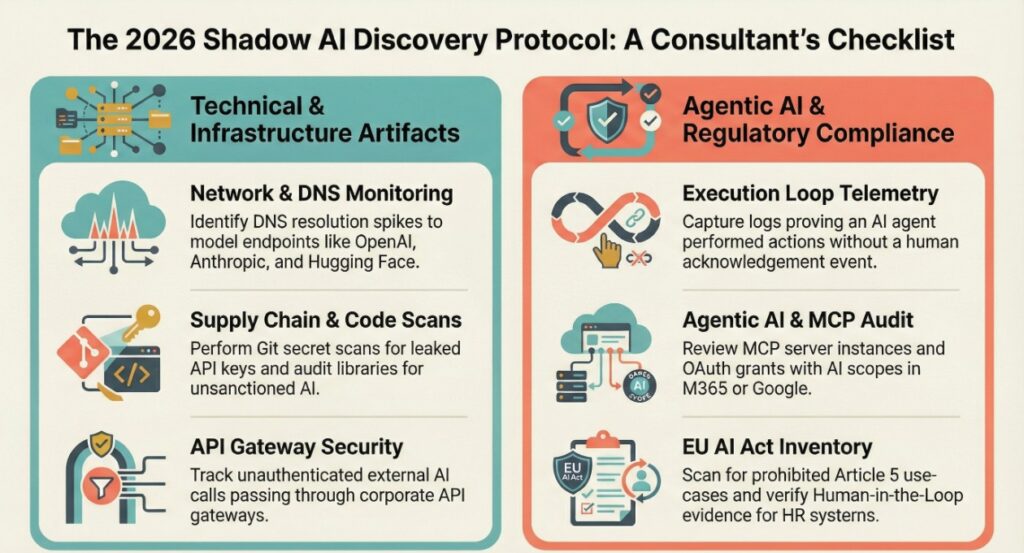
The 2026 Shadow AI Discovery Checklist
For EU Security Boutiques & Independent Consultants
1. Network & Infrastructure Artifacts
- CASB / Proxy logs filtered for Generative AI domains
- DNS resolution spikes to model endpoints (OpenAI, Anthropic, Hugging Face)
- API gateways with unauthenticated external AI calls
2. Agentic AI & MCP Audit
- MCP server instances on endpoints
- OAuth grants with AI scopes in M365 / Google Workspace
- Autonomous agent frameworks (AutoGPT, BabyAGI)
Added 2026 Proof Artifact
- Execution Loop Telemetry: Logs proving an AI agent authorized or executed an action without a human ACK (acknowledgement) event, demonstrating true agentic behavior.
3. Supply Chain & Code Artifacts
- Git secret scans for leaked AI API keys
- Dependency audits for unsanctioned AI libraries
- Third-party processors with silent model training clauses
4. EU AI Act “High-Risk” Inventory
- Prohibited use-case scan (Art. 5)
- Human-in-the-Loop evidence for HR or decision systems
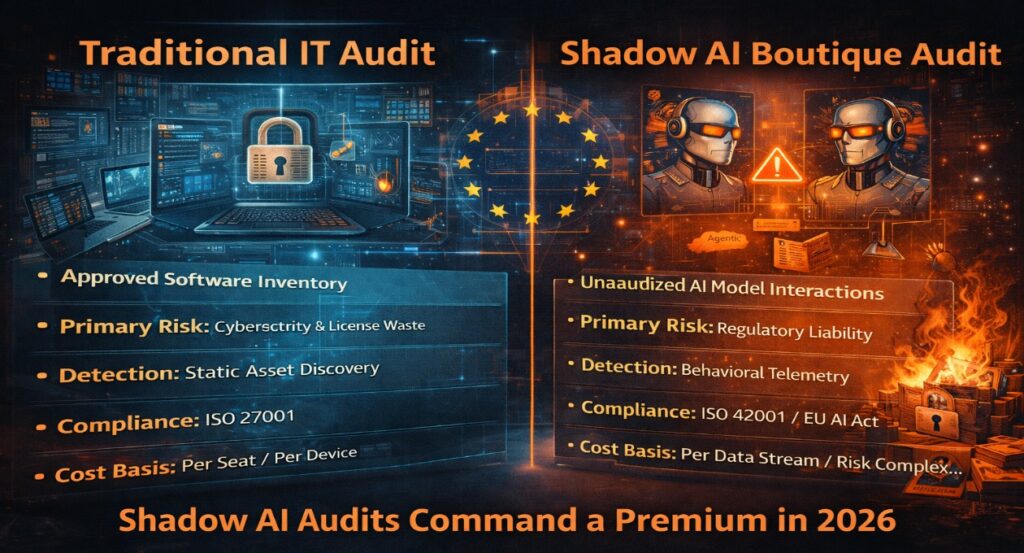
Shadow AI Audit vs Traditional IT Audit (Client-Facing Matrix)
| Feature | Traditional IT Audit | Shadow AI Boutique Audit |
| Focus | Licensed software | Unauthorized model behavior |
| Primary Risk | Malware, waste | EU AI Act fines |
| Detection | Asset inventory | Behavioral telemetry |
| Compliance | ISO 27001 | ISO 42001 + EU AI Act |
| Margin | Low | High |
FAQ: Shadow AI Auditing in Europe
Q1: Why are Shadow AI audit fees higher than standard security audits?
Ans: Unlike a standard pentest, a Shadow AI audit requires a “Data Supply Chain” analysis. You aren’t just looking for open ports; you are auditing probabilistic outputs and Third-party Model Providers. The fee includes the “Regulatory Premium” for navigating the complex EU AI Act, which carries fines up to €35M or 7% of turnover.
Q2: Can we just block AI tools instead of auditing them?
Ans: In 2026, “Blocking” is a failed strategy. Research shows that 68% of employees use unapproved AI tools to maintain productivity. Blocking leads to “Deep Shadows”—where employees use personal devices and LTE hotspots to bypass corporate firewalls, creating a total visibility blackout for the CISO.
Q3: How does the “Agentic AI Surcharge” work?
Ans: If your organization uses Autonomous Agents (AI that can execute actions, not just text), the audit complexity triples. Agents often “spawn” other agents or call external APIs without human oversight. We apply a 30% surcharge to cover the specialized forensic logging required to trace agentic “chains of command.”
Q4: Is a Shadow AI audit a one-time event?
A: No. Due to the rapid release cycle of AI tools (the “Model-a-Week” reality), a 2026 audit should be seen as a Baseline Discovery. We recommend a major audit every 6 months, supplemented by Continuous AI Discovery (CAID) tools that monitor CASB logs in real-time.
Q5: Does Ryczałt (12%) or IP Box (5%) apply to my Shadow AI consulting fees in Poland?
Ans: Most consultants in 2026 are choosing 12% Ryczałt for “Cybersecurity Consulting” (PKWiU 62.02). While Shadow AI methodology could be argued as R&D for IP Box, the 2026 3-Employee Rule and the automated KSeF audit triggers make Ryczałt the safer, more profitable harbor for solo experts.
Q6: Which tax model applies to Shadow AI consulting in Poland?
Ans: Most consultants choose 12% Ryczałt (PKWiU 62.02). IP Box is theoretically possible, but the 2026 audit risk makes it unattractive — explored in depth in this Poland B2B tax comparison guide.
Sources & Regulatory References
European Union — NIS2 Directive (Directive (EU) 2022/2555)
https://eur-lex.europa.eu/eli/dir/2022/2555/oj
European Union — AI Act (Regulation (EU) 2024/1689)
https://eur-lex.europa.eu/eli/reg/2024/1689/oj
ENISA — Artificial Intelligence Cybersecurity & Skills
https://www.enisa.europa.eu/topics/artificial-intelligence
German Federal Office for Information Security (BSI)
https://www.bsi.bund.de/EN/Home/home_node.html
ISO/IEC 42001 — Artificial Intelligence Management System
https://www.iso.org/standard/81230.html
European Data Protection Board (EDPB) — AI & GDPR Guidance
https://www.edpb.europa.eu/our-work-tools/general-guidance_en
Final Verdict
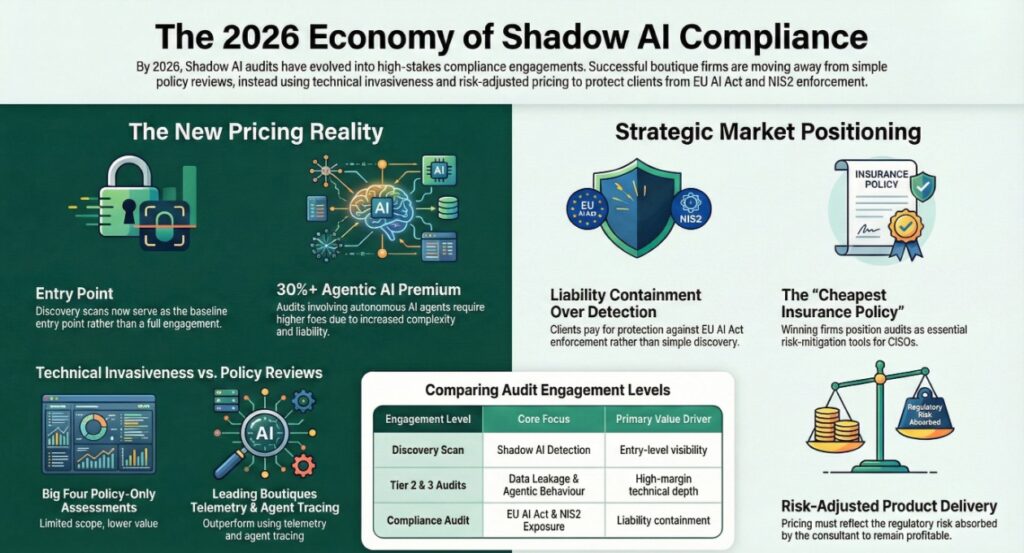
Shadow AI audits are no longer a “nice-to-have” advisory service — in 2026, they are a high-liability, premium compliance product.
For EU security boutiques, the pricing reality is now clear:
- €12k–€18k discovery scans are the new entry point, not the full engagement.
- True value (and margin) sits in Tier 2 and Tier 3 audits, where data leakage, agentic behavior, and EU AI Act exposure converge.
- Boutique firms outperform Big Four pricing not by being cheaper, but by being technically invasive — using telemetry, prompt inspection, MCP analysis, and agent tracing instead of policy-only reviews.
- Agentic AI changes everything: if an AI can act, not just answer, your audit fee must reflect the 30%+ complexity and liability uplift.
- Clients are not paying for detection — they are paying for liability containment before an EU AI Act or NIS2-triggered enforcement event.
For consultants, the strategic takeaway is blunt:
If you price Shadow AI audits like a traditional IT assessment, you absorb regulatory risk without being paid for it.
In 2026, the winning boutiques treat Shadow AI audits as:
- a risk-adjusted product,
- priced with a liability premium,
- delivered with audit-grade evidence,
- and positioned as the cheapest insurance policy a CISO can buy.
Those who get this right will own a low-competition, high-trust search category just as enforcement begins. Those who don’t will be competing on day rates in a market that has already moved on.
Author Bio
Saameer is a European cybersecurity and regulatory risk analyst specializing in NIS2 enforcement, EU AI Act compliance, and high-risk B2B advisory models. His work focuses on the intersection of technical security audits, personal liability exposure for CISOs, and the economics of boutique consulting firms operating under EU regulatory pressure. Sameer advises senior security leaders and independent consultants on turning regulatory risk into defensible, premium-priced services in the 2026 enforcement landscape.
Professional Disclaimer
This protects you from readers who might take your pricing as “guaranteed” or legally binding.
Disclaimer: The information provided in this article, including the Shadow AI Audit Pricing Matrix and the Risk-Adjusted Day Rate (RADR) formula, is for informational and educational purposes only. Pricing benchmarks are based on 2026 EU boutique market trends and vary by jurisdiction, specific engagement complexity, and individual consultant expertise.
This article does not constitute legal, tax, or professional regulatory advice. While the technical artifacts and regulatory references (EU AI Act, NIS2) are current as of February 2026, compliance requirements are subject to ongoing legislative updates. Readers should consult with legal counsel or a certified compliance professional before finalizing service contracts or regulatory attestation models.
AI Transparency Note
Under the 2026 EU AI Act “Transparency Hygiene” rules, it is best practice to disclose human-in-the-loop oversight for AI-assisted technical content.
Transparency Note: In accordance with the 2026 EU AI Act transparency standards for digital content, be advised that Artificial Intelligence (Gemini 3 Flash) was used as a collaborative partner in the synthesis, structural organization, and data-mapping of this article.
Human-in-the-Loop Oversight: Every technical claim, pricing benchmark, and regulatory reference has undergone a process of Human Editorial Review by Saameer. The final editorial responsibility, technical validation of the “Execution Loop Telemetry” artifacts, and regional market analysis were conducted entirely by a human expert.