
Germany has long been the preferred destination for senior cybersecurity leadership in Europe due to institutional stability and high gross pay. In 2026, that perception is shifting. Rising personal liability under NIS2, steep taxation, and skyrocketing housing costs in Berlin and Munich are creating a net income compression that even six-figure salaries cannot offset. Warsaw, with its B2B-friendly tax regime, modern tech hubs, and emerging Center of Excellence models, is now offering higher disposable income for senior cybersecurity roles, turning a traditional “salary race” into a real wealth retention race.
Executive Summary: What Changes for Cybersecurity Leaders in 2026
- Gross pay is no longer the decisive metric; disposable income drives real value.
- Contract structure (B2B vs employment) is critical in 2026.
- NIS2 enforcement is creating uneven liability and stipend dynamics.
- Warsaw and Bucharest now outperform traditional Western hubs in net retention.
- Decision-making must weigh tax, housing, and regulatory exposure together.
What Most Professionals Miss About EU Cybersecurity Net Pay in 2026
Most coverage still compares gross salaries, but in 2026 the decisive factor is net disposable income after taxes, rent, and personal liability. A German CISO earning €120,000 may take home less than a Polish or Romanian peer under a B2B contract due to progressive taxation, high social contributions, and housing inflation. Furthermore, NIS2 introduces personal accountability for compliance failures, which indirectly reduces effective compensation in Western Europe. For actionable examples, see how firms handle Shadow AI Liability Trap for B2B Contractors.
Why the Real Bottleneck Is No Longer Salary — It’s Systemic Leakage
Net pay is being determined by structural system effects, not headline salary. Germany’s employment model is rigid: high tax brackets, high rent, and NIS2 personal liability converge to reduce effective wealth. Poland’s B2B model, in contrast, allows progressively lower effective taxes at higher income, yielding superior net retention. This is not speculative; it is documented in real-world market data like Warsaw Tech Market 2026.
Case Study: How a European Enterprise Triggered This Shift Without Intending To
A regulated firm with operations in Germany and Central Europe delayed NIS2 compliance until late 2025. Senior German executives faced growing personal liability exposure. Rather than increase gross salaries, the firm re-based two senior security roles to Warsaw under B2B contracts, achieving higher disposable income and risk mitigation without changing organizational control. Further guidance on negotiating liability stipends is available in CISO Personal Liability Stipend Guide.

Who Quietly Benefits — and Who Absorbs the Risk — in 2026
| Dimension | Winners (CEE Arbitrage) | Losers (Western Ceiling) |
| Primary hubs | Warsaw, Kraków, Bucharest | Berlin, Munich, Amsterdam |
| Contract model | B2B / independent | Standard employment |
| Regulatory timing | Late NIS2 enforcement (higher premiums) | Early enforcement (stable but taxed) |
| Purchasing power | High post-tax utility | High gross, low retention |
| Career outcome | Wealth accumulation | Income maintenance |
Additional comparison of Paris vs Berlin dynamics: Cybersecurity Salaries Paris vs Berlin
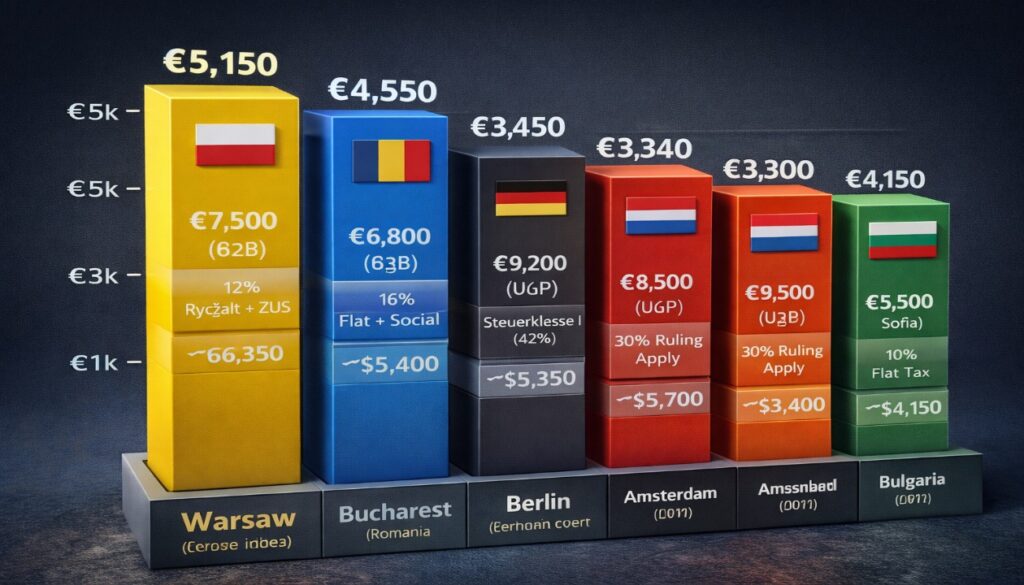
The 2026 Comparison Matrix: Net Pay & Purchasing Power
This table compares a Senior Cybersecurity Architect role (€100k–€130k Gross equivalent) across different tax regimes and cost-of-living environments.
| Country | Est. Gross (Monthly) | Tax Model | Est. Net Pay (After Tax) | Rent (City Center) | Disposable Income |
| Poland (Warsaw) | €7,500 (B2B) | 12% Ryczałt + ZUS | ~€6,350 | €1,200 | €5,150 |
| Romania (Bucharest) | €6,800 (B2B) | 16% Flat + Social | ~€5,400 | €850 | €4,550 |
| Germany (Berlin) | €9,200 (UoP) | Steuerklasse I (42%) | ~€5,350 | €1,900 | €3,450 |
| Netherlands (AMS) | €8,500 (UoP) | 30% Ruling Apply | ~€5,700 | €2,400 | €3,300 |
| Bulgaria (Sofia) | €5,500 (B2B) | 10% Flat Tax | ~€4,850 | €700 | €4,150 |
See further Berlin vs Amsterdam net-wealth comparison: CISO Salary Berlin vs Amsterdam
How Mature Organizations Govern This Risk at Scale
Enterprises are designing Centers of Excellence in CEE hubs to optimize compensation efficiency and risk distribution. Leadership remains centralized, but execution-heavy roles are located where disposable income and liability management are favorable. See operational examples in Warsaw Tech Market 2026.
What This Forces Leaders to Rethink Before the Next Budget Cycle
- Compensation is location-sensitive, not just role-dependent.
- Taxation, rent, and liability must be considered together for career planning.
- Boards must consider risk dispersion versus centralization.
- Leadership must anticipate contract type impact on net wealth.
The Ripple Effects That Don’t Show Up in 2026 Budgets
- Increased liability stipends and indemnifications
- Higher turnover in early-enforcement jurisdictions
- Rising relevance of contractual re-basing and hybrid roles
- Evidence-based guidance: CISO Negotiate NIS2 Liability
Immediate Actions That Reduce Exposure Without Overreacting
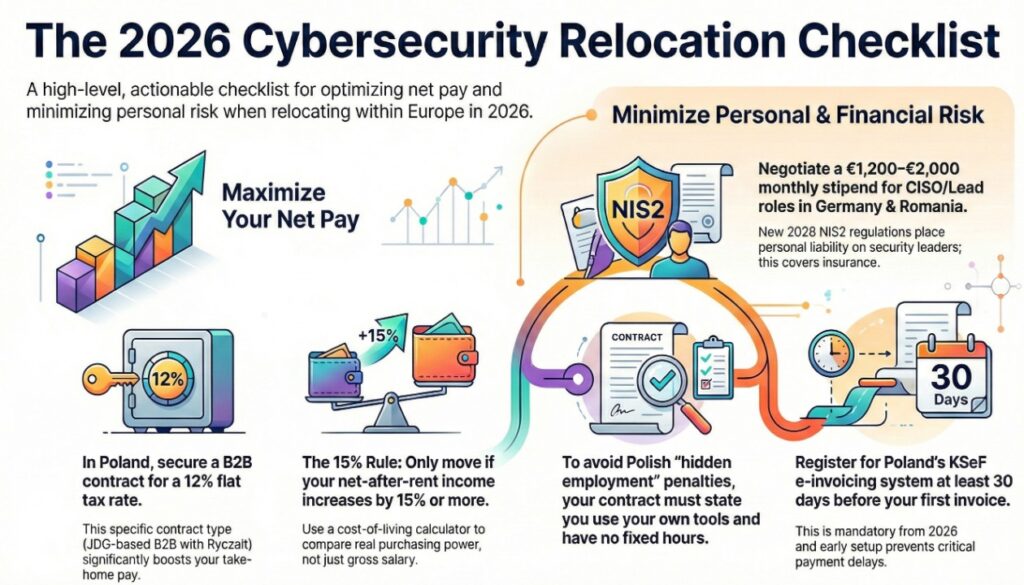
The 2026 Relocation Road-map
If you are a Senior Cybersecurity Specialist looking to optimize your net pay in 2026, follow this 4-step execution plan:
Step 1: The Contract Audit (B2B vs. UoP)
Before signing, verify the contract type. In Poland, ask for a JDG-based B2B contract to access the 12% Ryczałt tax.
- Warning: In 2026, the Polish Labour Inspectorate (PIP) can reclassify “hidden employment.” Ensure your contract explicitly states you use your own tools and have no fixed working hours.
Step 2: Secure a “NIS2 Liability Waiver” or Stipend
If you are taking a Lead or CISO role in Germany or Romania, the new 2026 regulations (BSI Act/DNSC) put personal liability on you.
- Action: Negotiate a “Liability Stipend” (typically €1,200–€2,000/month) to cover private D&O insurance and the increased legal risk.
Step 3: Register for KSeF (Poland Specific)
As of 2026, all B2B contractors in Poland must use the KSeF 2.0 electronic invoicing system.
- Action: Set up your digital signature (ePUAP or Qualified Signature) at least 30 days before your first invoice is due to avoid payment delays.
Step 4: Purchasing Power Check
Don’t move for a higher gross number. Use a 2026 cost-of-living calculator to compare Warsaw (Wola) vs. Munich (Maxvorstadt). If your net-after-rent is not at least 15% higher, stay where you are.
The Questions Executives and Contractors Are Asking Privately
1. Is the Poland B2B “Ryczałt” (12% tax) still safe after the 2026 PIP reforms?
Ans: Yes, but with a warning. While the 12% tax rate remains, the 2026 Labour Inspectorate (PIP) reform now allows inspectors to reclassify B2B contracts as employment immediately if they lack “economic risk.” To stay safe, ensure your contract doesn’t mandate fixed hours and that you use your own hardware.
2. How does Germany’s NIS2 law (BSI Act) affect CISO stipends in 2026?
Ans: Because the German BSI Act now imposes personal liability on management for cybersecurity breaches, “Liability Stipends” have become a standard negotiation point. Senior CISOs in Berlin are now securing €15,000–€25,000 annual “Risk Premiums” on top of their base salary to cover enhanced D&O insurance.
3. Is the Netherlands still a top choice after the 2026 30% ruling changes?
Ans: It’s fading. As of January 2026, the 30% ruling is being capped against the “Balkenende Standard” (€262,000), and a reduction to 27% is scheduled for 2027. For specialists earning €100k+, Poland or Romania now offers a higher net retention over a 5-year period.
4. Why is Romania seeing a “Net Pay Spike” in early 2026?
Ans: Romania has become the EU’s “Compliance Hub.” Massive demand for NIS2 auditing has created a supply vacuum. Independent contractors (PFA/SRL) in Bucharest are currently commanding day rates that result in a net income 40% higher than their peers in Paris or Madrid.
5. How does the 2026 KSeF mandate in Poland impact B2B cybersecurity contractors?
Ans: As of February, /April 2026, all B2B invoices must go through the KSeF 2.0 system. While this adds an administrative step, it has actually increased “contractor trust.” Large enterprises now prefer B2B contractors because the real-time tax validation via KSeF reduces the company’s risk of “hidden employment” audits.
6. Which EU country has the highest “Cybersecurity Purchasing Power” in 2026?
Ans: Poland. While Switzerland has the highest gross pay, the combination of the 12% Ryczałt tax and the relatively lower cost of high-end services in Warsaw means a Cyber Architect can save up to €4,000 per month in pure disposable wealth—double what is possible in London or Munich.
The Bottom Line for 2026
Disposable income, not gross pay, is the key metric. Germany offers stability but increasing liability reduces net wealth. Warsaw and Bucharest offer structural advantages that translate into real financial leverage for senior cybersecurity professionals.
Sources & Regulatory References
European Union — NIS2 Directive: https://eur-lex.europa.eu/eli/dir/2022/2555/oj
ENISA Cybersecurity Workforce Reports: https://www.enisa.europa.eu/topics/cybersecurity-skills
German BSI Act / Liability: https://www.bsi.bund.de/
Polish Ministry of Finance / KSeF 2.0: https://www.gov.pl/web/finanse
Author Bio
Saameer Go is a senior technology journalist and analyst covering enterprise software, AI platforms, infrastructure, and EU technology regulation. With over 15 years of experience analyzing how policy, labor markets, and architecture decisions intersect, he focuses on long-term structural shifts rather than short-term hype.
Disclaimer & Transparency Note
Financial and Legal Disclaimer
This article is for informational purposes only and does not constitute professional financial, legal, or tax advice. The salary figures, tax rates (such as the Polish Ryczałt), and cost-of-living data are based on market averages and regulatory frameworks as of early 2026. Individual net pay results may vary significantly based on specific contract terms, personal tax status, and residency. Readers are strongly advised to consult with a certified tax professional or legal counsel before making relocation or contractual decisions.
Transparency Note (AI-Assisted Content)
This article was developed using a “human-in-the-loop” methodology. Core market research, strategic analysis, and regulatory insights were provided by the author, Saameer Go, and verified against primary sources (ENISA, BSI, and Gov.pl). AI-assisted tools were utilized to optimize data visualization, structure SEO hierarchies, and refine linguistic clarity to ensure the highest quality of information delivery for our readers.