
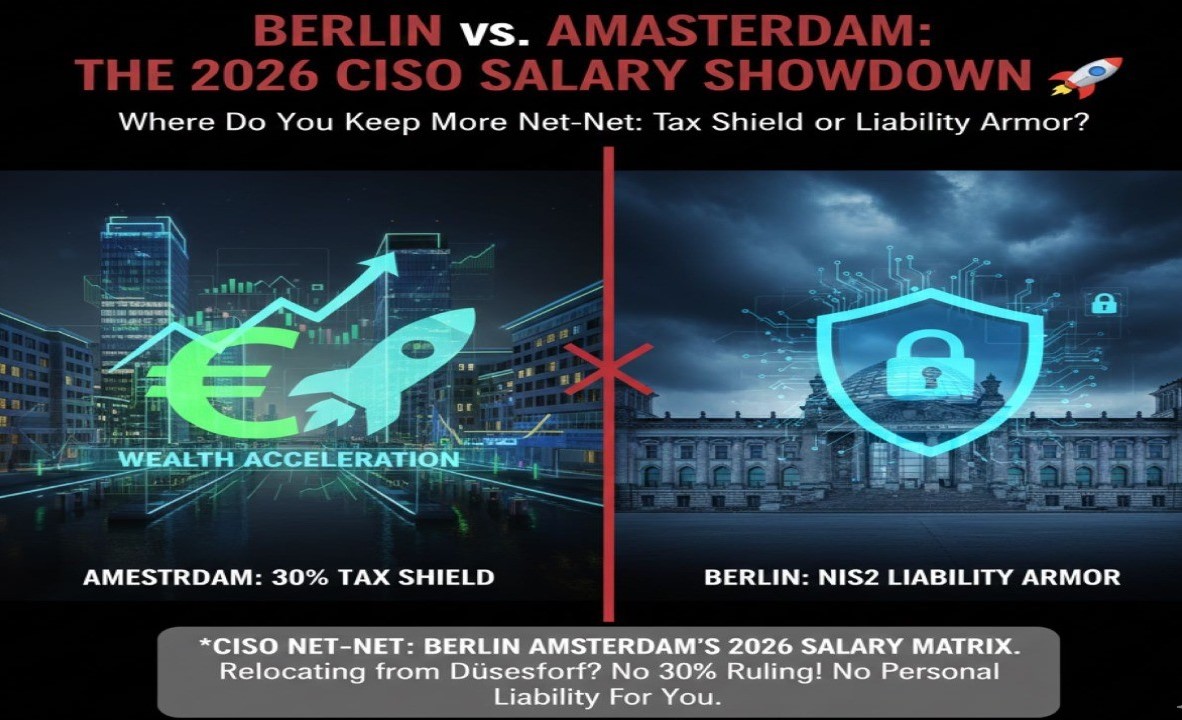
In 2026, the question facing senior cybersecurity leaders is no longer “Which city pays more?” but “Which city lets me keep more—safely?”
As NIS2 enforcement hardens across the EU, CISOs are discovering that gross salary figures are a vanity metric. What matters now is net-net wealth: take-home pay after tax regimes, housing pressure, insurance costs, and—most critically—personal regulatory liability.
Berlin and Amsterdam have emerged as the two dominant North-Western European hubs for regulated cybersecurity leadership. Berlin operates as the EU’s regulatory engine, driven by strict BSI and KRITIS oversight. Amsterdam has evolved into a cyber-insurance and multinational headquarters fortress, fueled by data centers, global firms, and the still-powerful 30% tax ruling.
This article breaks down which city actually wins for CISOs in 2026—financially, legally, and strategically.
What Salary Calculators and Recruiters Don’t Tell You
Most cost-of-living comparisons stop at rent and tax brackets. This analysis introduces a Regulation-Adjusted Net-Net Model, which accounts for three costs almost never quantified:
- Personal liability exposure under NIS2 Article 20
- Insurance gaps caused by Shadow AI exclusions
- Hidden housing friction unique to executive relocations
The result is a clearer answer to the real 2026 question:
“Where can I earn more without increasing my personal legal risk?”
This is why a €165,000 offer in Amsterdam can outperform a €175,000 offer in Berlin—or fail completely if the wrong clauses are missing.
The Net-Net Battle CISOs Actually Face
Why Gross Salary Is a Vanishing Metric in 2026
Across Europe, NIS2 has shifted compensation logic away from role seniority and toward risk absorption. This same dynamic is already visible in other regulated markets, such as Warsaw’s post-DORA banking surge, where compliance exposure—not coding skill—drove pay inflation (Warsaw DORA premium).
In Berlin and Amsterdam, CISOs are now evaluated on:
- Personal exposure under NIS2 Article 20
- Ability to pass regulator-led audits
- Governance maturity, especially around AI and supply-chain risk
The result: two cities with similar headline salaries, but radically different wealth outcomes.
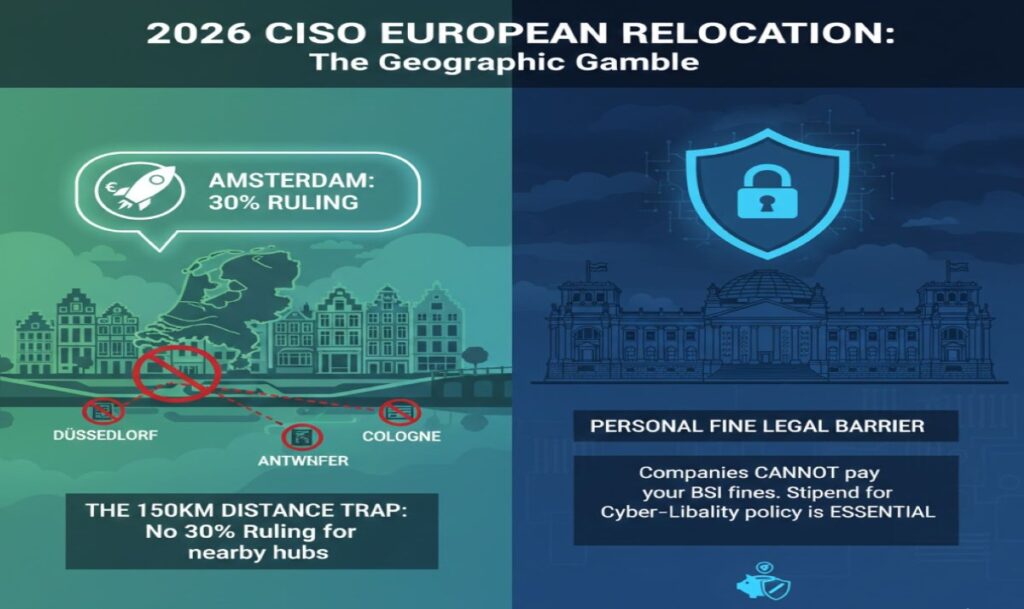
The Net-Net Battle: Amsterdam’s 30% Tax Shield vs. Berlin’s Liability Premiums
Amsterdam: The 30% Ruling as a Wealth Engine
For CISOs relocating from abroad, the Dutch 30% ruling remains the most powerful tax instrument in Europe. In 2026, it allows 30% of gross salary to be paid tax-free, dramatically increasing disposable income.
However, this advantage comes with hidden traps:
- Housing costs in Amsterdam-Zuid and Amstelveen regularly exceed €4,000/month
- Box 3 reforms now tax global assets for new arrivals
- Shadow AI governance failures are increasingly excluded by insurers
Despite these risks, expat CISOs still achieve higher short-term wealth acceleration in Amsterdam than in Berlin.
The 150km Distance Trap: It is a common misconception that all expats qualify for the 30% ruling. To be eligible, you must have lived more than 150 kilometers from the Dutch border for at least 16 out of the 24 months prior to your start date. This rule effectively excludes CISOs relocating from nearby hubs like Düsseldorf, Cologne, or Antwerp. If you are moving from these “Border Zones,” you must negotiate a higher base salary or a “Relocation Gross-up” to compensate for the lack of tax relief.
Berlin: The Liability-First Compensation Model
Berlin’s advantage is not tax efficiency—it is protection depth. German boards, facing aggressive BSI and KRITIS audits, increasingly offer liability stipends and stronger indemnity clauses.
This mirrors patterns seen in Paris, where regulatory pressure—not lifestyle—has driven salary premiums (Paris vs Berlin benchmark).
In Berlin:
- Liability stipends commonly reach 9–13% of base salary
- CISOs are expected to maintain personal cyber-liability riders
- Audit readiness is valued above growth velocity
The Personal Fine Legal Barrier: In Germany, a critical legal nuance often catches CISOs off guard: companies are generally prohibited by law from paying administrative fines levied personally against an individual for “gross negligence.” Because the BSI can hold senior leaders accountable under NIS2, a high salary is not enough. You need an explicit stipend to independently fund a Personal Cyber-Liability policy, which is currently the only legal mechanism to insulate your personal assets from regulatory fines in the German market.
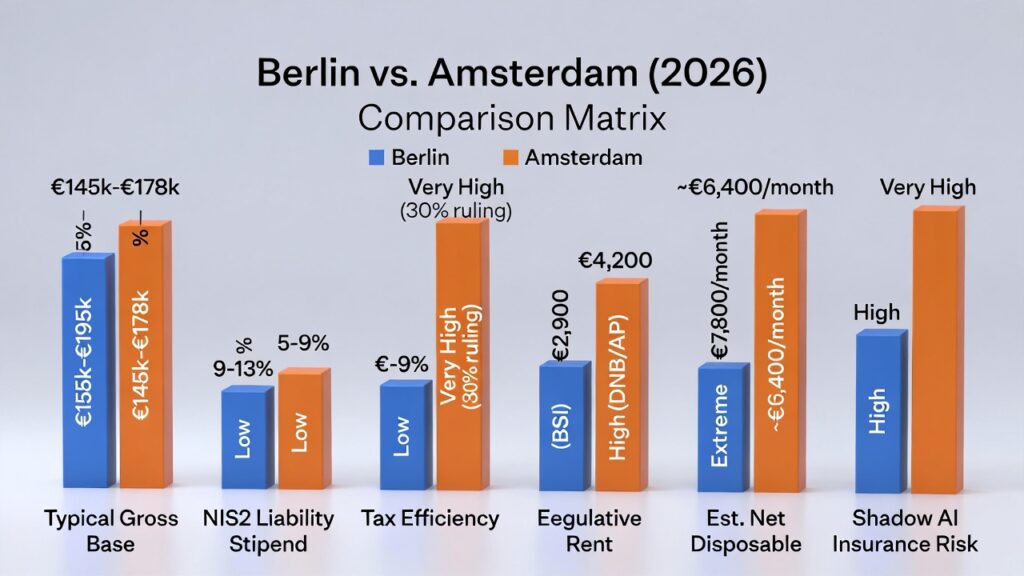
Comparison Matrix: Berlin vs. Amsterdam (2026)
| Dimension | Berlin | Amsterdam |
| Typical Gross Base | €145k–€178k | €158k–€195k |
| NIS2 Liability Stipend | 9–13% | 5–9% |
| Tax Efficiency | Low | Very High (30% ruling) |
| Executive Rent | €2,900 | €4,200 |
| Regulatory Pressure | Extreme (BSI) | High (DNB/AP) |
| Est. Net Disposable | ~€6,400/month | ~€7,800/month |
| Shadow AI Insurance Risk | High | Very High |
Based on the data above, here is the combined framework your HR and Board need to approve before you relocate:”
ACTION REQUIRED – Negotiating a 2026 CISO contract? Don’t leave your personal assets exposed to NIS2 fines. 🚀 DOWNLOAD THE 2026 CISO CAREER AUDIT (PDF)
Case Study: The Same CISO, Two Cities
Profile:
Senior CISO, €165,000 gross offer, relocating from outside the EU core.
Berlin Outcome:
- No tax shelter
- 11% liability stipend
- Strong Side-A D&O and legal defense coverage
- Net stability, lower lifestyle volatility
Amsterdam Outcome:
- 30% ruling applied
- Higher rent absorbs much of the tax advantage
- Insurance requires explicit AI governance declarations
- Higher short-term wealth, higher downside risk
Result:
Berlin optimizes career durability.
Amsterdam optimizes time-boxed wealth extraction.
The Shadow AI Liability Trap (Where Insurance Fails)
Amsterdam’s innovation velocity comes with a hidden cost. Insurers operating in the Netherlands now lead Europe in Shadow AI exclusions, a trend already harming B2B contractors elsewhere (Shadow AI liability trap).
In 2026:
- Undeclared AI tool usage can void personal coverage
- CISOs are expected to maintain usage declarations
- Personal cyber-liability riders are becoming mandatory
Berlin insurers are slower—but far less forgiving once audits begin.
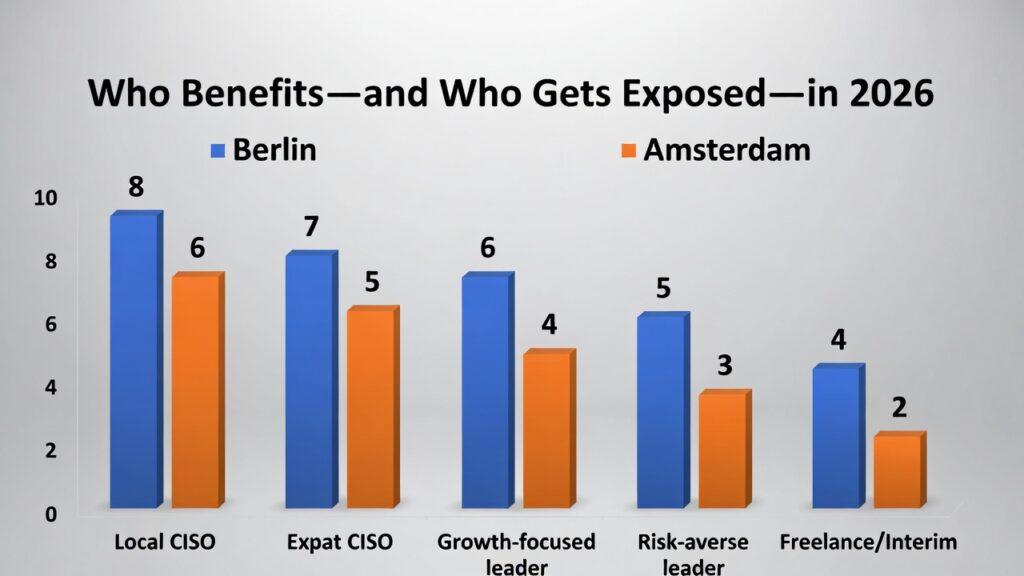
Who Benefits—and Who Gets Exposed—in 2026
| Profile | Berlin Outcome | Amsterdam Outcome |
| Local CISO | Strong long-term protection | Limited tax benefit |
| Expat CISO | Heavy tax burden | Maximum 5-year upside |
| Growth-focused leader | Slower | Faster |
| Risk-averse leader | Ideal | Dangerous |
| Freelance / Interim | Lower upside | Higher but fragile |
CoE Framing: How Centers of Excellence Choose Differently
From a Center of Excellence (CoE) perspective, the cities serve different mandates:
- Berlin functions as a Regulatory Control CoE—ideal for banks, utilities, and KRITIS entities
- Amsterdam operates as a Global Governance Scaling CoE—ideal for multinationals and platform firms
This mirrors how Warsaw became a DORA execution hub rather than a salary hub (Warsaw market baseline).
Why This Matters for CISOs Making a 2026 Move
In 2026, choosing the wrong city is no longer a lifestyle mistake — it is a career-risk decision.
- Berlin penalizes unprotected accountability.
- Amsterdam punishes unprepared housing and tax assumptions.
- Warsaw rewards mobility but shifts risk faster than contracts update.
The wrong choice doesn’t just reduce take-home pay.
It locks you into liability exposure for up to seven years after leaving a role.
This comparison exists to prevent that outcome.
Strategic Implications for 2026
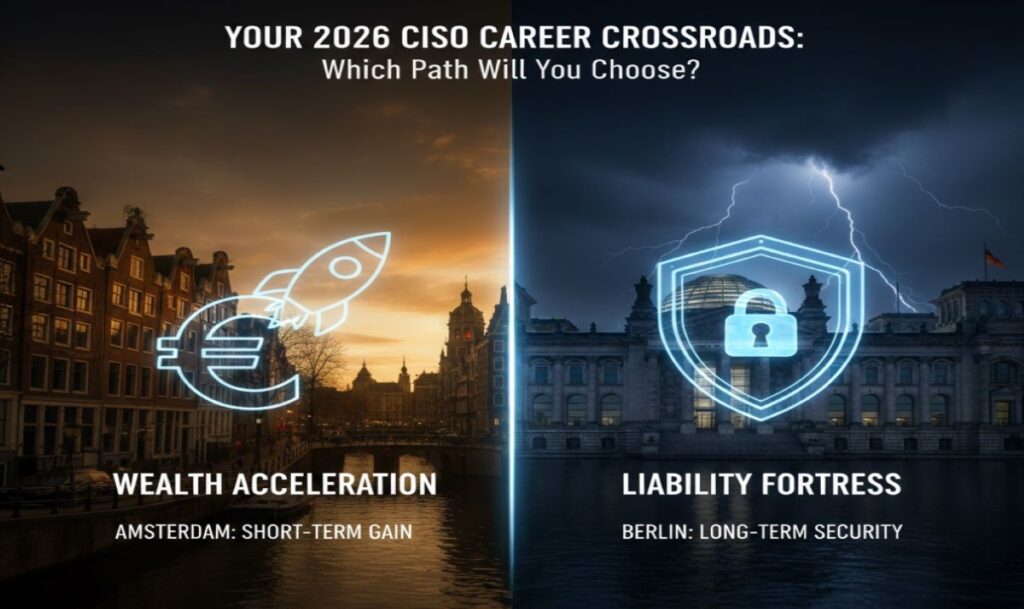
- Short-term wealth favors Amsterdam—only with perfect compliance
- Berlin offers superior downside protection
- Liability stipends will outpace base salary growth
- Shadow AI governance is now a compensation variable
- Mobility decisions must factor insurance portability
CISOs who fail to price personal risk into contracts repeat the same mistakes seen during the Bucharest-to-Warsaw regulatory shift.
What to Do Now (Action Plan)
- Audit your personal liability exposure using a city-specific lens
- Negotiate stipends explicitly (not buried in base pay)
- Secure Side-A and DIC coverage portability
- Align AI governance with insurer requirements
- Use structured negotiation frameworks (CISO stipend guide)
Key Takeaways (2026 CISO Reality)
- Gross salary is no longer a reliable comparison metric
- Liability stipends matter more than base pay in regulated roles
- Amsterdam favors expat CISOs with time-limited arbitrage
- Berlin favors long-term CISOs with strong indemnity protection
- Personal Cyber-Liability Riders are becoming mandatory, not optional
- Shadow AI governance failures can void coverage overnight
FAQ: Navigating CISO Risk, Pay, and Liability in 2026
1. Should I choose Berlin or Amsterdam if I plan to stay in the role for more than 10 years?
Ans-If your horizon is 10+ years, Berlin is structurally safer despite lower short-term net income. German regulatory enforcement under BSI and KRITIS is more predictable, indemnity norms are mature, and liability boundaries are better understood by boards. Amsterdam can outperform financially in the first 3–5 years due to the 30% ruling, but long-term exposure to tax law changes, housing inflation, and evolving insurer exclusions introduces compounding risk that erodes long-term stability.
2. Is a higher salary worth it if the liability stipend is missing?
Ans-No. A higher base salary without a clearly defined liability stipend is a negative trade-off in 2026. Under NIS2 Article 20, personal accountability is not theoretical. Without a stipend covering Side A D&O, Difference-in-Conditions (DIC), or a Personal Cyber-Liability Rider, you are effectively self-insuring regulatory risk. Over a multi-year horizon, one enforcement action or insurance denial can erase several years of salary gains.
3. What is the single biggest mistake CISOs make when negotiating contracts in 2026?
Ans-The most common and costly mistake is assuming corporate D&O insurance fully protects the individual. In practice, many policies prioritize entity survival and board protection. When interests diverge during regulatory enforcement or litigation, the CISO can be left uncovered. Failing to negotiate explicit individual protection — including Side A-only coverage or personal riders — exposes personal assets, even when compliance programs are in place.
4. If I can only negotiate one thing, should it be salary, stipend, or insurance language?
Ans-Insurance language. Salary and stipends are numbers; insurance clauses determine whether those numbers matter under stress. A well-drafted indemnification clause, explicit coverage for administrative fines where permissible, and clarity on Shadow AI exclusions provide protection that no base salary increase can offset. In 2026, CISOs should treat insurance language as a non-negotiable governance requirement, not a compensation detail.
5. How does Shadow AI realistically affect my personal liability?
Ans-Shadow AI has become one of the fastest ways to void coverage. Many insurers now exclude claims where unmanaged or undeclared AI tools were involved in decision-making or code generation. Even if the incident itself is unrelated to AI, discovery of Shadow AI usage can be used to deny claims on “due professional care” grounds. This makes proactive AI governance and documented controls a personal risk-management necessity, not just a technical best practice.
6. Is Amsterdam still worth it after the 30% ruling changes?
Ans-Yes, but only with timing discipline. The 30% ruling remains a powerful wealth accelerator in 2026, particularly for expat CISOs relocating from outside the 150km zone. However, its time-limited nature means Amsterdam works best as a defined phase (typically 3–5 years). CISOs should negotiate gross-up clauses and plan an exit or role transition before the benefit steps down, rather than assuming permanent advantage.
7. If you had to choose today, what would you prioritize: higher net pay or lower personal exposure?
Ans-Lower personal exposure. In 2026, career longevity and capital preservation outperform marginal income gains. A role that offers slightly lower net pay but clear liability boundaries, strong indemnity, and insurer-aligned governance enable confident decision-making and reduces burnout. CISOs who prioritize protection over short-term income are statistically more likely to remain in senior roles and avoid forced exits after regulatory events.
Final Takeaway
In 2026, Amsterdam makes CISOs richer faster—but only briefly and only with discipline.
Berlin makes CISOs safer longer—with slower, steadier wealth accumulation.
The winning city depends not on lifestyle preference, but on how much personal risk you are willing—and able—to carry under NIS2.
Those who calculate net-net reality will win. Those who chase gross numbers will not.
Sources & Regulatory References
- European Union — NIS2 Directive
https://eur-lex.europa.eu/eli/dir/2022/2555/oj - ANSSI (France) — Cybersecurity Governance Guidance
https://www.ssi.gouv.fr - BSI (Germany) — KRITIS Oversight & Audits
https://www.bsi.bund.de
AUTHOR BIO
Saameer Go is a senior technology journalist and analyst covering enterprise software, AI platforms, infrastructure, and EU technology regulation. With over 15 years of experience analyzing how policy, labor markets, and system architecture intersect, he focuses on long-term structural risk rather than short-term hype.
Legal Disclaimer, Transparency & AI Disclosure
Disclaimer: This article is provided for informational and educational purposes only and does not constitute financial, legal, tax, or professional career advice. The cybersecurity regulatory landscape (including NIS2 and KRITIS) is rapidly evolving; readers are strongly advised to consult with qualified legal counsel and tax professionals before entering into employment contracts or making international relocation decisions.
Figures cited, including the “150km Distance Trap” and typical liability stipends, are based on 2026 market projections and should be verified against current localized statutes. Neither the author nor Tech Plus Trends assumes liability for personal or professional decisions made based on this content.
Transparency Note: At Tech Plus Trends, we believe in radical transparency regarding our editorial process. This article was authored by Saameer Go using a Hybrid Intelligence Model:
- Human Expertise: All strategic insights, the “Net-Net Model” framework, and regulatory interpretations are the original work of the author, drawing on 15 years of industry experience.
- AI Assistance: Generative AI tools were used to synthesize large datasets, verify specific EU directive cross-references, and optimize the structure for scannability.
- Verification: Every fact, including Dutch tax rules and German BSI fine structures, has been manually verified by our editorial team to ensure accuracy and mitigate AI “hallucinations.”
- Conflict of Interest: Neither the author nor this publication has received compensation from any insurance providers or relocation agencies mentioned in this report.