


Across Europe’s cybersecurity market, one salary question keeps resurfacing in 2026: why does Berlin appear to be pulling ahead of Paris for NIS2-driven roles—despite France’s reputation for tougher regulation?
At first glance, the answer seems simple. German companies advertise higher gross salaries. Berlin has more open roles. Recruiters push the narrative that Germany is “winning” the cybersecurity talent war.
But that explanation is incomplete — and in some cases, misleading.
The real driver behind the widening pay gap is not lifestyle, cost of living, or startup culture. It is regulatory urgency, and more specifically, how NIS2 reshapes risk, liability, and hiring pressure differently in France and Germany.
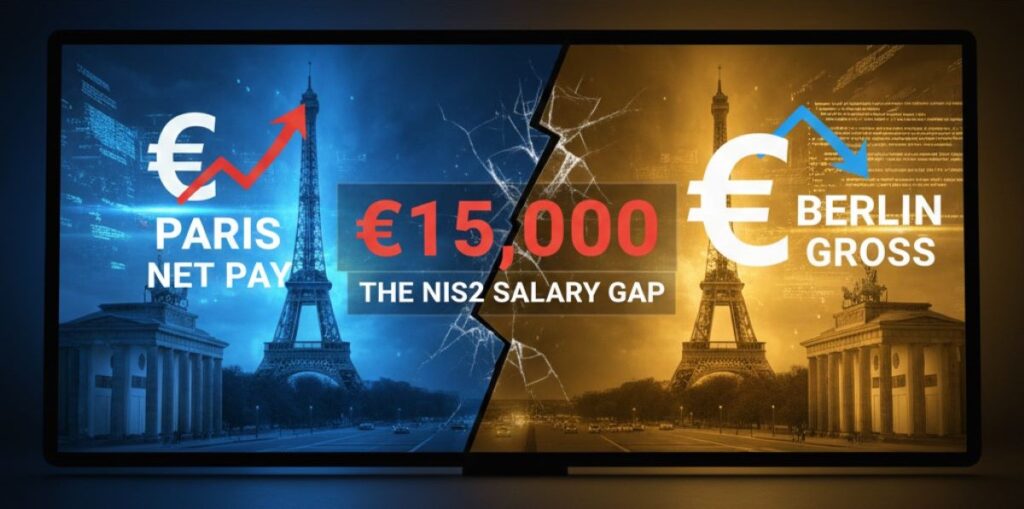
This article explains the NIS2 premium — why it exists, where it is highest, and why the same role can carry a €15,000 difference depending on which side of the Rhine you work on.
TL;DR — Key Takeaways
- The NIS2 salary premium is compliance-driven, not market hype
- Berlin currently leads on gross pay, driven by KRITIS enforcement pressure
- Paris is closing the gap through ANSSI-driven compliance depth and tax structuring
- The highest premiums are not for pentesters, but for compliance-heavy roles
- Freelancers and NIS2 specialists face a widening risk vs reward gap
What NIS2 Actually Covers (Scope Clarification)
NIS2 applies to Essential and Important Entities operating in sectors such as:
- energy, transport, banking, financial market infrastructure
- digital infrastructure, cloud services, managed IT
- healthcare, public administration, and large digital providers
For professionals, this matters because salary pressure follows legal exposure.
Roles supporting in-scope entities carry materially higher compliance risk — and pay.
Why NIS2 Changed Cybersecurity Salaries
NIS2 is not a “cybersecurity law” in the traditional sense. It is a governance and accountability directive.
Its impact on salaries comes from three forces:
- Mandatory coverage expansion — more sectors are regulated
- Management accountability — security decisions now sit closer to executive liability
- Audit-driven enforcement — compliance must be provable, not implied
This creates a demand shock, but not uniformly across Europe.
Countries with:
- faster enforcement culture, and
- stricter audit expectations
see earlier salary inflation for compliance-heavy roles.
That is why Berlin and Paris, despite both being Tier-1 tech hubs, are diverging.
The “NIS2 Premium” Explained
The NIS2 premium is the salary uplift paid for roles that directly reduce regulatory risk.
These roles include:
- NIS2 Compliance Architects
- GRC Leads
- Third-Party Risk Managers
- Incident Reporting Officers
- CISOs with regulated-entity exposure
Unlike general security engineering, these positions are:
- legally sensitive
- audit-facing
- difficult to replace
That scarcity is where the premium forms.
Berlin: Why Germany Is Winning the Salary War
Berlin’s edge comes from Germany’s KRITIS framework and how it intersects with NIS2.
KRITIS audits are binary: pass or fail. There is little tolerance for partial readiness. As NIS2 expands the number of regulated entities, German organizations are reacting defensively — by paying more for proven compliance experience.
This mirrors patterns already visible in DORA-driven banking roles across Central Europe, where audit readiness directly translated into higher contractor rates and salary bands
(see: https://techplustrends.com/dora-2026-audit-warsaw-banking-java-25/).
What That Means in Practice
- Berlin offers higher gross base salaries, especially for senior roles
- Companies pay a risk premium for candidates with audit history
- Freelance day rates spike sharply for “ready-for-audit” profiles
The same dynamic is visible in regulated B2B markets tied to DORA, where contractors with compliance credibility command significantly higher rates
(see: https://techplustrends.com/dora-2026-warsaw-banking-b2b-rates/).
Paris: How France Is Fighting Back
France’s advantage is not volume, but depth.
ANSSI enforces some of the strictest cybersecurity standards in Europe. Programs like Campus Cyber have concentrated compliance expertise around Paris, especially in:
- incident response governance
- supply-chain security
- certification-heavy environments
This drives demand for specialized, senior talent, even if total role volume is lower than Berlin.
The “French Catch-Up Effect”
While Berlin often leads on gross salary headlines, Paris is closing the gap through:
- higher premiums for compliance-heavy roles
- structured compensation packages
- tax optimization for inbound talent
This mirrors a broader migration pattern in regulated tech roles across Europe, where professionals follow compliance demand rather than pure salary listings
(see: https://techplustrends.com/bucharest-exodus-warsaw-dora-premium-300-euro/).
Salary Breakdown: Where the €15,000 Difference Appears
| Role (Mid–Senior) | Paris (Base Range) | Berlin (Base Range) | NIS2 Premium Driver |
| CISO / Head of Security | €115k–€145k | €120k–€155k | Personal accountability, D&O exposure |
| Security Architect | €85k–€105k | €90k–€110k | Supply-chain & NIS2 scope |
| Compliance Specialist | €70k–€90k | €75k–€95k | Fastest-growing role in 2026 |
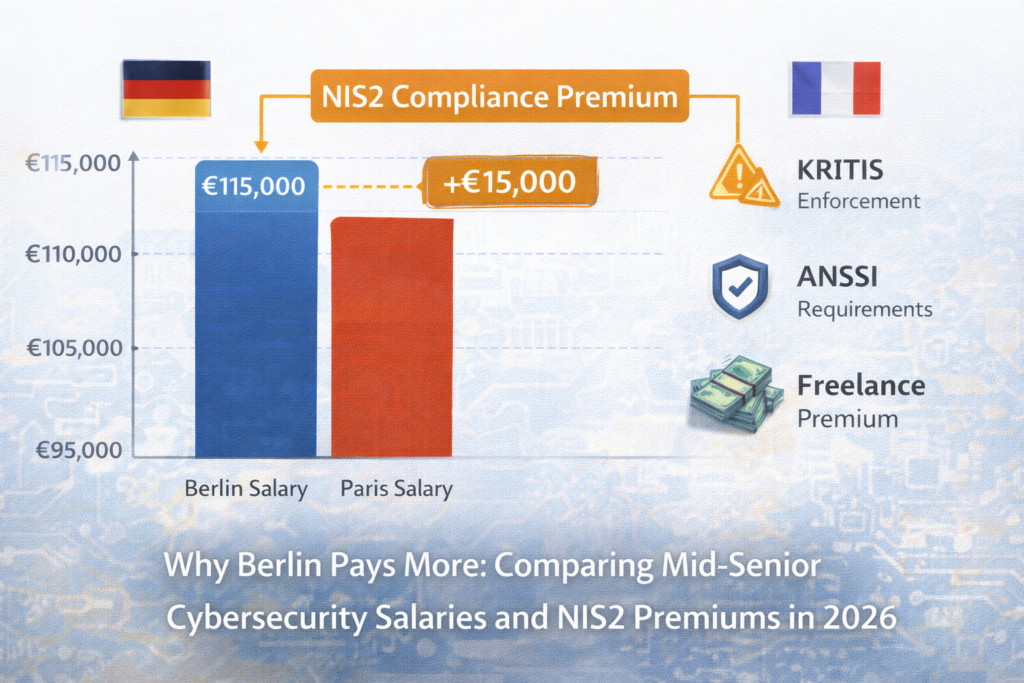
The €15,000 difference most often appears at the senior compliance and leadership level, where regulatory risk is highest.
The Net-Pay Duel: Why Paris Can Still Win
Gross salary tells only half the story.
France’s Impatriate Tax Regime allows qualifying foreign hires to exempt a portion of their compensation from income tax for up to eight years. For senior NIS2 roles, this can significantly narrow — or even reverse — Berlin’s apparent advantage.
Example: Senior NIS2 Compliance Architect
| Metric | Paris (Impatriate) | Berlin (Standard) |
| Gross Salary | €110,000 | €125,000 |
| Effective Tax Rate | ~18–22% | ~38–42% |
| Estimated Net Monthly | ~€6,100 | ~€5,900 |
| Liability Stipend | Often included | Often separate |
The result: higher take-home pay in Paris, despite lower gross.
Important: this applies only to professionals recruited from outside France.
Freelancers: Where the Real NIS2 Premium Lives
The most dramatic NIS2 premiums are no longer in permanent roles.
They are in freelance and interim contracts.
| Metric | Permanent Senior | Freelance NIS2 Specialist |
| Annual Gross / Revenue | €115k–€145k | €210k–€260k |
| Daily Rate | ~€550 | €1,050–€1,350 |
| Liability | Corporate | Personal |
| Risk | Lower | Much higher |
In Germany, KRITIS-driven urgency allows proven freelancers to push rates even higher. In France, interim NIS2 leads are often hired to build governance frameworks, then exit.
Higher pay comes with higher stakes — unmanaged practices (including Shadow AI use) can void insurance coverage entirely, a risk increasingly discussed among B2B contractors
(see: https://techplustrends.com/shadow-ai-liability-trap-b2b-contractors/).
Enforcement Timeline: When This Actually Bites
- 2024–2025: Hiring, preparation, internal assessments
- 2026: Formal audits, supervisory scrutiny, penalties
- 2027 onward: Mature enforcement, fewer exceptions
Salaries rise before enforcement peaks — not after.
Center of Excellence (CoE) Perspective
From a regulated entity’s Center of Excellence, cybersecurity salaries are not driven by talent scarcity alone.
They are driven by one question:
“Can this person stand in front of an auditor and defend our posture?”
Roles that reduce audit friction, reporting risk, and supervisory escalation are priced higher — regardless of location. Berlin currently pays more because enforcement pressure arrived earlier. Paris compensates with depth and structural incentives.
What That Means in Practice
- Higher gross base salaries in Berlin
- Faster rate inflation for compliance-proven profiles
- Significant freelance premiums for “ready-for-audit” specialists
This mirrors DORA-driven B2B markets, where contractors with regulatory credibility command outsized rates
(see: https://techplustrends.com/dora-2026-warsaw-banking-b2b-rates/).
Why This Matters in 2026 (Not 2024)
The salary spike is happening before enforcement peaks.
- 2024–2025: preparation and hiring
- 2026: audits, penalties, accountability
Organizations pay premiums now to avoid risk later.
That is why cybersecurity salaries are diverging unevenly — and why generic “salary checkers” are already outdated.
FAQs (NIS2, Salaries, Risk, and Career Decisions)
1. Does NIS2 legally force companies to pay higher cybersecurity salaries?
Ans-No. NIS2 does not mandate salaries or compensation levels.
However, it forces companies to internalize cyber risk at the management level. Once security failures can trigger regulatory scrutiny, executive accountability, and operational disruption, companies compete aggressively for professionals who can demonstrably reduce that risk. Salaries rise as a consequence of risk pricing, not legal obligation.
In short:
NIS2 doesn’t raise salaries — risk exposure does.
2. Why are compliance and GRC roles benefiting more than technical security roles?
Ans-Because NIS2 is primarily a governance and accountability directive, not a tooling mandate.
Technical roles (SOC, pentesting, cloud security) are essential, but they do not:
- interface directly with regulators,
- own incident reporting obligations, or
- design governance structures.
Compliance-heavy roles do all three. When audits, reporting deadlines, and executive accountability tighten, organizations pay a premium for professionals who can translate technical reality into regulator-safe documentation and decisions.
That is why GRC, compliance architects, and NIS2 transition leads are seeing the fastest salary growth.
3. Is the €15,000 Berlin–Paris salary difference guaranteed or universal?
Ans-No. It is not guaranteed, and it is not universal.
The €15,000 figure reflects:
- observed gross salary ranges,
- primarily at senior and compliance-heavy levels,
- during the 2025–2026 hiring window.
The gap can:
- shrink at mid-level roles,
- reverse on a net-pay basis, or
- disappear entirely for non-regulated sectors.
Think of it as a market signal, not a promise.
4. Why does Berlin appear to pay more gross salary than Paris?
Ans-Berlin’s advantage comes from enforcement timing and audit structure, not talent quality.
Germany’s KRITIS framework creates:
- binary audit outcomes (pass/fail),
- limited tolerance for partial readiness,
- high operational consequences for non-compliance.
As NIS2 expands the regulated population, German organizations respond by overpaying for proven audit resilience. This inflates gross salaries faster than in France, where compliance depth is higher but enforcement pacing is more structured.
5. How can Paris still win on take-home pay despite lower gross salaries?
Ans-Because gross salary ≠ net income.
France’s Impatriate Tax Regime allows qualifying foreign hires to:
- exempt a portion of compensation from income tax,
- for up to eight years,
- when recruited from outside France.
For senior NIS2 roles, this can:
- significantly reduce effective tax rates,
- offset higher cost of living,
- and result in higher monthly net income than Berlin.
This advantage applies only under specific conditions and must be evaluated case by case.
6. Are freelancers really earning more from NIS2 than permanent employees?
Ans-Yes ,but they also carry much higher personal risk.
Freelance NIS2 specialists earn more because they:
- absorb short-term regulatory pressure,
- are hired for urgent compliance milestones,
- and exit once risk is stabilized.
However, freelancers often face:
- personal liability exposure,
- stricter insurance scrutiny,
- and zero corporate indemnity.
Higher pay reflects risk transfer, not just expertise.
7. Does NIS2 increase personal liability for CISOs and security leaders?
Ans-Indirectly, yes — but not automatically.
NIS2 strengthens expectations around:
- due diligence,
- incident reporting accuracy,
- and governance oversight.
In response, some organizations:
- renegotiate CISO contracts,
- include liability stipends,
- or bundle management liability insurance.
This is a market reaction, not a statutory mandate — and it applies mainly to regulated entities.
8. Should professionals move cities purely for the NIS2 salary premium?
Ans-Not blindly.
The NIS2 premium makes sense only if:
- your role directly supports regulated entities,
- your experience aligns with compliance and governance,
- and your net-pay and risk profile improves.
For purely technical roles, lifestyle, long-term growth, and specialization may matter more than short-term salary deltas.
9. Will the NIS2 salary premium last beyond 2026?
Ans-The spike is temporary. The baseline uplift is permanent.
- 2024–2026: premium driven by urgency and preparation
- Post-2026: salaries stabilize at a higher floor
Once compliance frameworks mature, scarcity decreases — but cybersecurity pay will not revert to pre-NIS2 levels in regulated sectors.
10. What is the single biggest mistake professionals make when evaluating NIS2-driven offers?
Ans-Focusing only on gross salary.
The real decision variables are:
- net income,
- liability exposure,
- insurance coverage,
- role sustainability after audits concludes.
In the NIS2 era, the best-paid professionals are not those who earn the most — but those who manage risk the best.
Final Takeaway
Berlin may be winning the NIS2 salary war on paper, but Paris is fighting back with:
- compliance depth
- structured compensation
- tax efficiency
The real winners are not cities, but professionals who understand where regulation meets money.
In the NIS2 era, cybersecurity pay is no longer about skills alone.
It is about who carries the risk — and who gets paid to absorb it.
Sources (Official & Regulatory)
- European Union — NIS2 Directive (Directive (EU) 2022/2555)
https://eur-lex.europa.eu/eli/dir/2022/2555/oj - ANSSI (France) — Cybersecurity Governance & Regulation
https://www.ssi.gouv.fr/en/regulation/ - BSI (Germany) — KRITIS Oversight and NIS2 Implementation
https://www.bsi.bund.de/EN/Themen/Kritische-Infrastrukturen/kritische-infrastrukturen_node.html
AUTHOR BIO
Saameer Go is a senior technology journalist and analyst covering enterprise software, AI platforms, infrastructure, and EU technology regulation. With over 15 years of experience analyzing how policy, labor markets, and system architecture intersect, he focuses on long-term structural risk rather than short-term hype.
Transparency Note & Disclaimer
Transparency Note: This analysis is part of techplustrends.com’s ongoing “EU Regulatory Impact” series. The salary data, tax comparisons, and day-rate projections for 2026 are based on a synthesis of current job market listings, EU-wide recruitment trends following the NIS2 and DORA implementations, and official tax guidelines from ANSSI (France) and BSI (Germany). Figures are intended to illustrate market trends and “Information Gain” regarding the NIS2 premium; they do not represent a guarantee of earnings.
Disclaimer: The information provided in this article is for educational and informational purposes only and does not constitute legal, financial, or tax advice. While we strive for accuracy, regulatory landscapes such as NIS2 are subject to national interpretation and frequent updates.
* Tax Arbitrage: Tax benefits, such as the French Impatriate Regime, are highly dependent on individual circumstances and residency history. * Liability: Discussions regarding CISO personal liability and insurance stipends are market observations and should be verified with qualified legal counsel or insurance professionals. * Risk: Freelance “Mercenary” roles carry significantly higher personal and professional risk. techplustrends.com and its authors are not liable for any career or financial decisions made based on this content.