

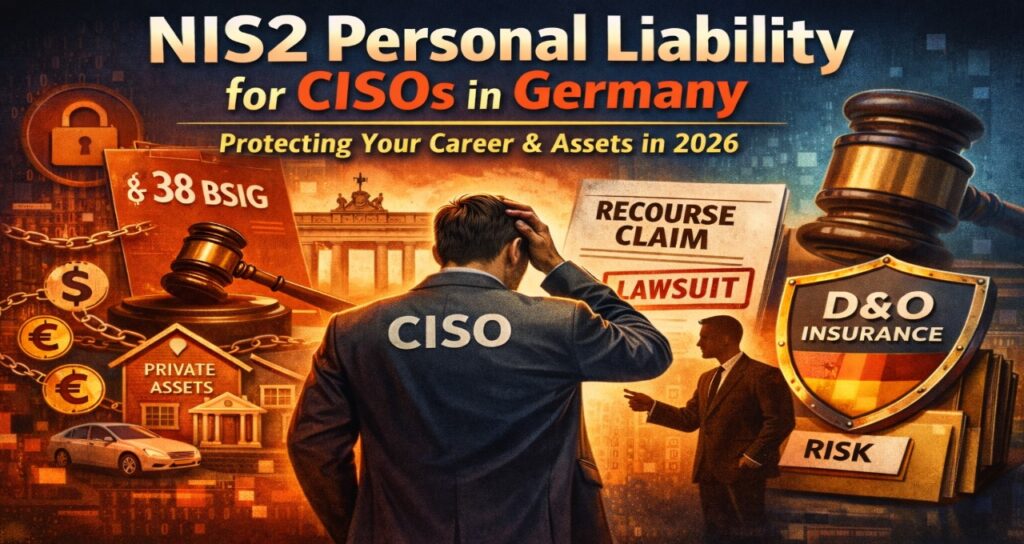
Why German CISOs Are Losing Sleep in 2026
If you’re a CISO in Germany today, you’re probably asking a question that would have sounded paranoid just two years ago:
“If something goes wrong, can I personally be sued?”
Since December 6, 2025, this is no longer theoretical. The German NIS2 Implementation Act (NIS2UmsuCG) is now fully in force, and with it comes a sharp shift in how cybersecurity responsibility is enforced.
From my conversations with CISOs, insurers, and German IT-law specialists, one thing is clear: the real danger in 2026 isn’t the regulator knocking—it’s your own company coming after you after the fine is paid.
Now that the law is live, I’ll walk you through where the personal liability risk really sits, why most insurance policies fail CISOs, and what you must do before and after the March 6, 2026 BSI registration deadline to protect yourself.
Why Your Company’s Cyber Insurance Doesn’t Protect You
Let’s start with the most common—and most dangerous—assumption.
Corporate Cyber Insurance ≠ Personal Protection
When leadership says, “We’re insured,” they’re talking about the company, not you.
Corporate cyber insurance typically covers:
- Incident response and forensics
- Notification and recovery costs
- Business interruption losses
What it almost never covers:
- Your personal legal defense
- Internal recourse claims
- Administrative fines passed back to individuals
That gap is supposed to be filled by D&O (Directors & Officers) insurance. But in Germany, that safety net is full of holes.
§38 BSIG Explained: Where CISOs Actually Stand in 2026
This is where nuance matters—and where most online guides get it wrong.
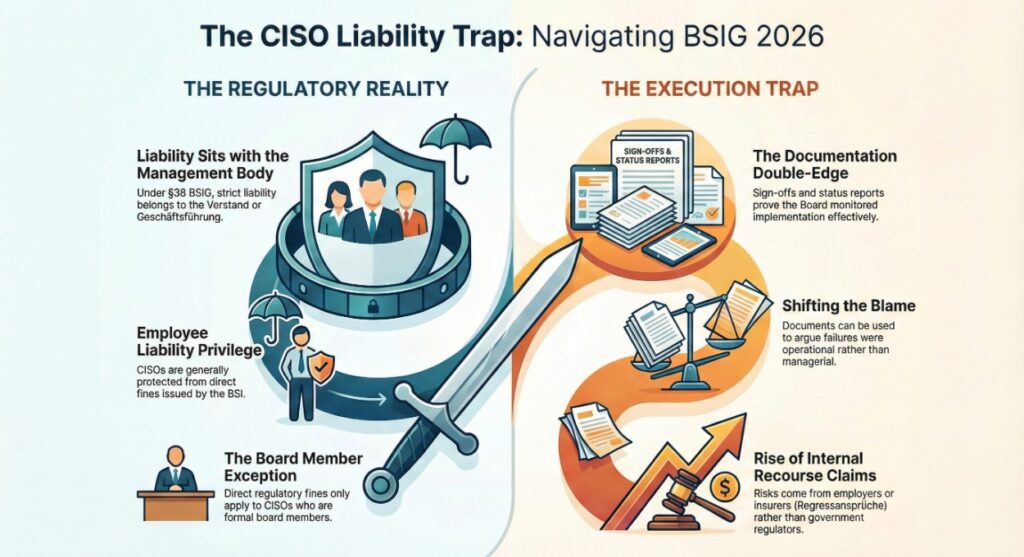
Under §38 of the updated BSI Act (BSIG), strict liability sits with the “Management Body” (Leitungsorgan)—the Vorstand or Geschäftsführung.
Critical Legal Reality (2026)
- A CISO is not directly fined by the BSI unless they are a formal board member
- Most CISOs benefit from the employee liability privilege (Arbeitnehmerhaftungsprivileg)
- But this does not protect you from internal recourse claims
The “Execution Trap”
Here’s what’s happening in practice:
The Board must now prove it monitored implementation. To do that, it asks the CISO for:
- Implementation sign-offs
- Status reports
- Risk acceptance confirmations
If a breach occurs, those same documents can be used to argue:
“We monitored. The CISO executed. The failure was operational.”
That’s how recourse claims (Regressansprüche) are built—not by regulators, but by your own employer or their insurer.
The D&O Insurance Problem Nobody Mentions
In reviewing German D&O policies over the past year, one pattern stands out: cyber exclusions.
Many standard D&O policies:
- Exclude cyber-related governance failures
- Share legal defense limits with the CEO and CFO
- Do not explicitly name the CISO as an insured person
As of early 2026, only a small minority of German mid-cap firms carry D&O policies that clearly cover individual CISOs for NIS2-related defense costs.
This is why many CISOs are renegotiating compensation and protection clauses alongside pay—especially when comparing risk-adjusted outcomes using benchmarks like cybersecurity net pay trends across Europe in 2026.
CISO Liability Protection: What Actually Works
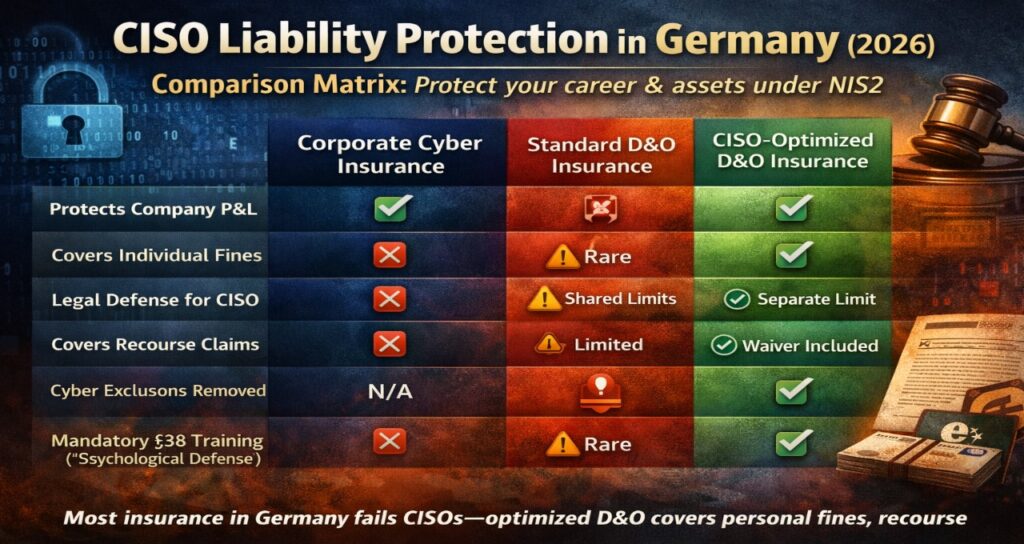
The biggest mistake German CISOs make is assuming their company’s “Cyber Insurance” covers their personal legal fees or fines. It almost never does.
| Feature | Corporate Cyber Insurance | Standard D&O Insurance | CISO-Optimized D&O (Recommended) |
| Primary Goal | Protects the company’s P&L after a breach. | Protects directors from shareholder lawsuits. | Protects the individual from NIS2 recourse. |
| Individual Fines | Never covered. | Rarely covered for non-board members. | Covered (via specific CISO endorsement). |
| Legal Defense | For the company only. | Shared limit (CEO/CFO get it first). | Separate Limit for the CISO. |
| Recourse Claims | Insurance company can sue you for negligence. | Covers you if the company sues you. | Includes Recourse Waiver for simple negligence. |
| Cyber Exclusions | N/A | Common (must be removed). | Explicitly covers “Cyber Governance” failures. |
The Regulatory Premium: Why CISOs Are Renegotiating Pay
NIS2 has quietly introduced a new compensation layer: personal liability exposure.
In Germany, senior CISOs are increasingly negotiating:
- Dedicated legal defense coverage
- Separate D&O limits
- Annual liability stipends (€5k–€10k)
If you’re not sure how those negotiations actually work in practice, this guide on how to negotiate a NIS2 personal liability stipend as a German CISO breaks down the tactics that are succeeding in 2026.
Germany vs. Other EU Countries: Why Jurisdiction Matters
Not all NIS2 implementations are equally strict.
Germany’s law goes further than the directive by emphasizing implementation oversight, while other countries remain more governance-focused. You can see this clearly when comparing Germany to Eastern European approaches outlined in how NIS2 compliance differs between Poland and Romania in 2026.
This jurisdiction gap is one reason some CISOs are reassessing where the risk-to-reward ratio still makes sense—especially when comparing Germany with France’s more protective governance framework, explained in France’s 2026 cybersecurity impatriate tax and regulatory environment.
The 2026 CISO 90-Day Personal Action Plan
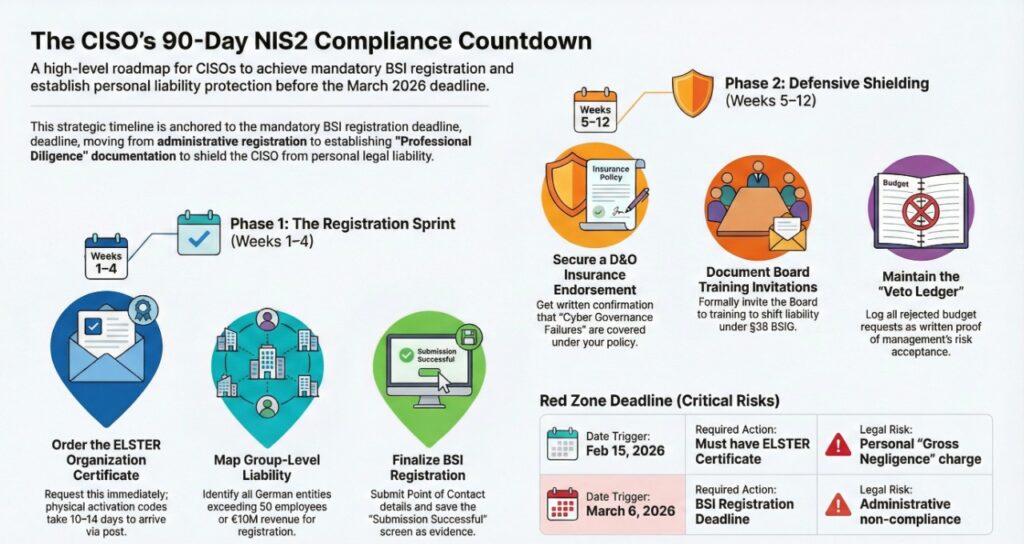
This timeline is pinned to the March 6, 2026 mandatory BSI registration deadline.
Phase 1: The “Registration Sprint” (Weeks 1–4: February)
- Day 1: Order the ELSTER Certificate. Do not use a personal one. You need an ELSTER Organization Certificate.
- Warning: The activation code is sent via physical post (Snail Mail) and can take 10–14 days. Without this, you cannot log into the “Mein Unternehmenskonto” (MUK).
- Week 2: Map Group-Level Liability. Identify every legal entity (Tochtergesellschaft) in Germany that hits the 50 employees / €10M revenue threshold. Each must be registered or accounted for.
- Week 3: Setup the MUK. Once the ELSTER letter arrives, activate the Mein Unternehmenskonto (MUK) and link it to the BSI Registration Portal.
- Week 4: Finalize BSI Registration. Submit the mandatory “Point of Contact” and sector details.
Pro-Tip: Save the “Submission Successful” screen as a PDF. This is your first piece of evidence for your “Professional Diligence” file.
Phase 2: The “Contractual Shield” (Weeks 5–8: March)
- Policy Audit: Hand the D&O Audit Checklist (from earlier) to Legal.
- Individual D&O Endorsement: Demand a written confirmation from the insurer that your specific role is covered for “Cyber Governance Failures” under NIS2.
- Liability Limit Check: Verify that your legal defense costs are not shared in a single pool with the CEO and CFO. In a major breach, they will drain that pool first.
- Board Training Protocol: Under §38 BSIG, the board must be trained. Document your formal invitation to the Board for their “Mandatory NIS2 Management Training.” If they decline, your liability shifts; if you never invited them, the liability stays with you.
Phase 3: The “Defensive Documentation” (Weeks 9–12: April & Beyond)
- The “Veto” Ledger: Create a formal internal log for every security project or budget request that was rejected or down-prioritized.
Legal Insight: In a German court, a verbal “no” from the CFO does not exist. You need a written risk-acceptance sign-off from the management body.
- 24-Hour Reporting Drills: NIS2 requires an “Early Warning” within 24 hours. Run a tabletop exercise specifically for this deadline. If you miss this window, it is considered per se negligence in 2026.
- External Audit Baseline: If you don’t have ISO 27001, perform a NIS2 Gap Assessment with an external party. Their report serves as “expert evidence” that you were acting in good faith.
The “March 6th” Red Zone
If you are reading this after February 15, 2026, and you do not have an ELSTER certificate: Call your legal counsel immediately. You are in the “Red Zone” where administrative delays could lead to a personal “Gross Negligence” charge before you even have a chance to register.
The “Emergency” Checklist for 2026
Before you sign off on any 2026 security audits, verify:
- Separate Limits: Does your D&O policy have a dedicated pot of money for you, or will the CEO’s legal fees drain it first?
- Psychological Defense: Are you attending the Mandatory Management Training required by §38 BSIG? Failing to attend this training is considered per se negligence in German courts.
- The “Veto” Record: If you are forced to accept a risk (e.g., skipping a patch for a critical system), did you file a “Professional Dissent” memo?
NIS2 Personal Liability in Germany: The 2026 Professional FAQ
1. Can I be personally fined by the BSI as a CISO?
Answer: No, the BSI (Federal Office for Information Security) issues administrative fines to the company, not the individual CISO. However, under §38 BSIG (BSI Act), the company is legally obligated to seek recourse from you if your “gross negligence” led to the fine. Your personal risk isn’t the regulator; it’s your own employer’s internal legal team or their insurance company suing you to recover their losses.
2. Does my company’s “Cyber Insurance” protect my private bank account?
Answer: Critical Distinction: No. Corporate Cyber Insurance covers the company’s recovery costs (forensics, notification, ransom). To protect your private assets (car, house, savings), you need D&O (Directors & Officers) Insurance.
- The 2026 Trap: Many standard D&O policies in Germany now have “Cyber Exclusions.” You must verify that your role is specifically named as an “Insured Person” and that “Cyber-related management failures” are explicitly covered.
3. What is the difference between “Simple” and “Gross” Negligence in Germany?
Answer: In the context of NIS2, German courts generally view the following as Gross Negligence (Grobe Fahrlässigkeit):
- Failing to attend the mandatory NIS2 management training required by §38 BSIG.
- Ignoring a “Critical” BSI security advisory for more than 30 days without a documented reason.
- Failing to report a “Significant Incident” within the 24-hour early warning window. Simple errors (e.g., a single misconfigured firewall rule) are usually “Simple Negligence” and are often covered by contractual liability limits.
4. Can I sign a “Liability Waiver” to protect myself?
Answer: Legal Reality: Under the German implementation of NIS2, management cannot waive liability claims in advance if they are found to be in breach of their “Duty of Care.” Any “hold harmless” agreement that tries to bypass §38 BSIG may be found legally void in a German court. Your best protection is not a waiver, but a Contractual Indemnity for legal defense costs and a Recourse Limitation for simple negligence.
5. What happens if my Board refuses the budget I need for NIS2 compliance?
Answer: This is your primary “Exculpation” (defense) strategy.
- The Protocol: You must document the risk, the required budget, and the consequences of denial in a formal “Security Risk Memo.”
- The Result: If the Board rejects the budget, the liability legally shifts from the “Implementing Body” (You) to the “Decision-Making Body” (The Board). If you don’t have a written record of this rejection, you are assumed to have accepted the risk as “manageable.”
6. Are CISOs in Poland or France safer than in Germany?
Answer: The “Jurisdiction Gap”: Yes. Germany’s implementation of NIS2 (§38 BSIG) uses stricter language, requiring management to “implement” measures, whereas the EU Directive only requires they “approve” them. This makes German CISOs more vulnerable to technical implementation lawsuits than their peers in the Netherlands or France, where the focus remains on “Governance” rather than “Hands-on implementation, as seen in compensation and risk comparisons like Paris vs. Berlin cybersecurity salary premiums under NIS2.
What This Means for You: The CISO’s New Standard
In 2026, being a CISO in Germany is no longer just a technical leadership role. It is a personally exposed legal position. The regulator’s fine hits the company, but the personal danger comes afterward when boards and insurers look for a scapegoat under §38 BSIG.
The winning CISOs in 2026 won’t just be the best at defense; they will be the best at contractual insulation and documentation discipline. If you can’t produce documented risk memos, budget requests, and training records, the liability shift will happen fast.
Your next move isn’t more security tech—it’s a legal audit.
Download the 2026 CISO Policy Audit Checklist (PDF)
Don’t wait for a breach to find out your “Cyber Insurance” leaves you personally exposed. Use this checklist to audit your D&O policy and negotiate the protections you deserve.
This is why many CISOs are now comparing not just salaries, but risk-adjusted outcomes, including analyses like Paris vs. Berlin cybersecurity salaries under the NIS2 premium.
.
Sources & Regulatory References
European Union — NIS2 Directive (Directive (EU) 2022/2555)
https://eur-lex.europa.eu/eli/dir/2022/2555/oj
German Federal Office for Information Security (BSI) https://www.bsi.bund.de/EN/Home/home_node.html
German BSI Act (BSIG), §38 (as amended by NIS2UmsuCG)
https://www.bsi.bund.de/SharedDocs/Downloads/EN/BSI/Act/BSI_Act.pdf
ENISA — Cybersecurity Skills & Workforce Reports
https://www.enisa.europa.eu/topics/cybersecurity-skills
German Federal Ministry of the Interior (BMI)
https://www.bmi.bund.de/EN/topics/it-digital-policy/cyber-security/cyber-security-node.html
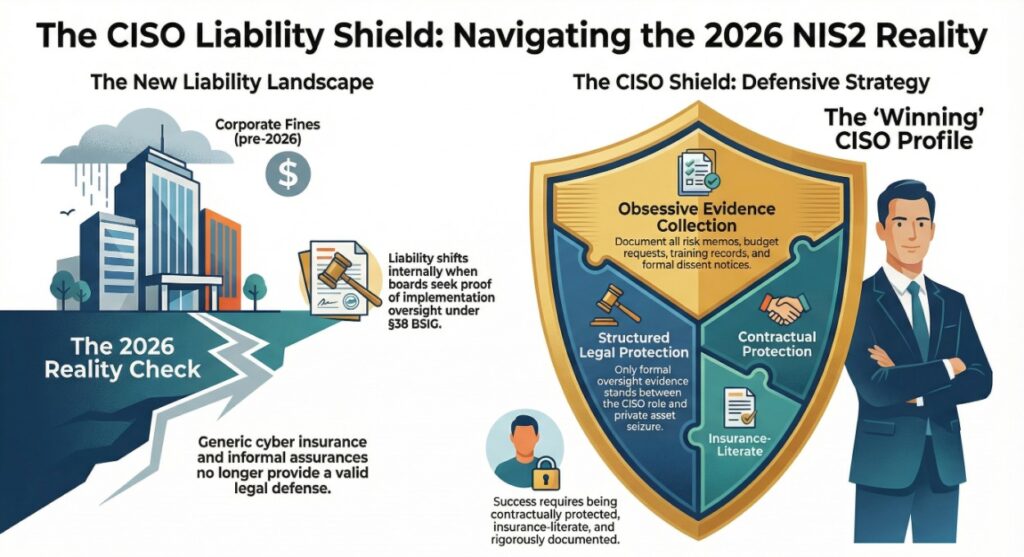
Final Takeaway – 2026 Reality Check
In 2026, NIS2 has fundamentally changed the risk profile of being a CISO in Germany. The regulator will fine the company—but the personal danger comes afterward, when boards and insurers look for proof that they “monitored implementation” under §38 BSIG. If you can’t produce documented risk memos, budget requests, training records, and dissent notices, liability can shift internally—fast.
The winning CISOs in Germany aren’t just strong technically. They are contractually protected, insurance-literate, and obsessively documented. Hope, informal assurances, and generic cyber insurance are no longer defenses. Only structured legal protection and evidence of oversight stand between your role and your private assets.
About the Author
Saameer is a senior technology journalist and analyst covering enterprise software, AI platforms, infrastructure, and EU technology regulation. With over 15 years of experience analyzing how policy, labor markets, and architecture decisions intersect, he focuses on long-term structural shifts rather than short-term hype.
Legal & Regulatory Disclaimer
Notice: The information provided in this article is for general informational and educational purposes only. It does not, and is not intended to, constitute legal, financial, or insurance advice.
As of February 4, 2026, the German NIS2 Implementation Act (NIS2UmsuCG) and the revised BSI Act (§38 BSIG) are active laws with strict enforcement. Legal interpretations of “gross negligence” and “management implementation duties” can vary significantly based on specific corporate structures and case law. Readers should not act upon this information without seeking professional counsel from a qualified Fachanwalt für IT-Recht (Specialist IT Lawyer) or a licensed insurance broker specializing in D&O and Cyber-risk. Use of any checklists or templates provided is at the user’s own risk.
AI Transparency Note (2026 Compliance)
Transparency Disclosure: This content was developed through a collaborative partnership between a human expert and an Artificial Intelligence (Gemini).
In alignment with the EU AI Act (Article 50) transparency requirements for 2026:
- Human Oversight: All legal dates (e.g., the March 6, 2026 registration deadline), regulatory references (§38 BSIG), and financial benchmarks have been reviewed and verified for factual accuracy by the human author.
- AI Assistance: Generative AI was utilized to synthesize complex regulatory frameworks, optimize SEO scannability, and structure the comparison matrices.
- Editorial Responsibility: The human author maintains full editorial responsibility for the final opinions, strategic advice, and conclusions presented in this guide.