
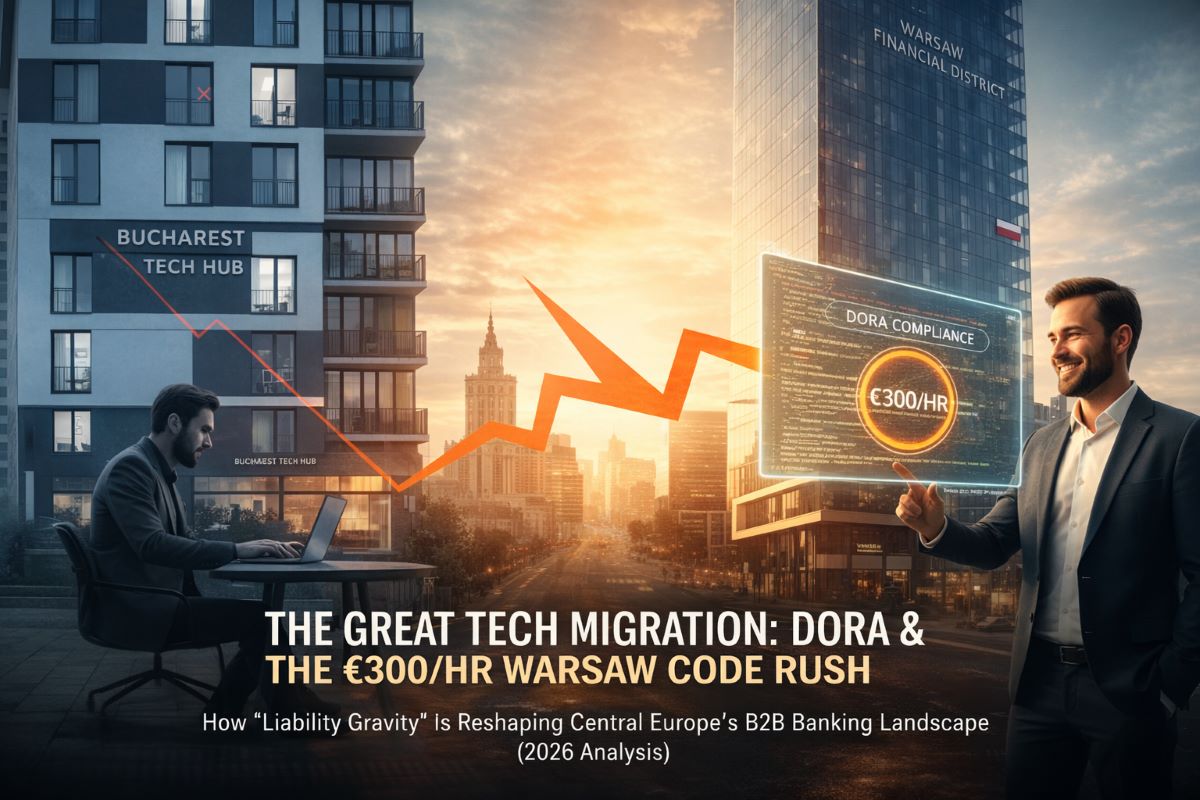

The Quiet Capital Shift No One Is Pricing Correctly
In 2026, Europe’s banking talent market is no longer governed by skills scarcity.
It is governed by liability gravity.
While Bucharest continues to produce world-class Java engineers, Tier-1 banks are quietly shifting their highest-paying B2B contracts toward Warsaw and Kraków. The reason is not talent quality, nor cost arbitrage. It is compliance survivability under the Digital Operational Resilience Act (DORA).
This shift now intersects with Poland’s KSeF mandatory e-invoicing regime, ZUS vs. CASS tax divergence, and Java 25 features such as Structured Concurrency—all of which increasingly determine who qualifies as a DORA-safe contractor in 2026.
The result is a new economic phenomenon reshaping Central Europe’s contractor market: the Resilience Premium — a €300/hour ceiling paid not for speed, but for audit accountability.
This article explains why that premium exists, who can capture it, and how DORA is structurally draining Bucharest of its highest-value banking work.
From Skill Scarcity to Liability Pricing
Before 2024, B2B rates in banking were driven by throughput: how fast a developer could ship features. In 2026, that model is obsolete.
Under DORA Article 28 (ICT Third-Party Risk), banks are now legally accountable for failures introduced by their contractors. This changes the contractor’s role from “resource” to regulated asset.
Banks are no longer paying for:
- Code output
- Velocity
- Framework expertise alone
They are paying for:
- Incident explainability
- Audit traceability
- Named responsibility during regulatory review
This is the origin of the Resilience Premium.
Why Bucharest Loses When Liability Enters the Equation
Romania’s IT ecosystem remains cost-efficient and technically strong. However, DORA introduces constraints that Bucharest cannot neutralize remotely.
Three structural disadvantages emerge:
- Jurisdictional Distance
During a DORA-triggered incident, regulators expect immediate, on-region access to responsible engineers. - Supply Chain Classification
Contractors are now classified as ICT third-party service providers, subject to audit scrutiny. - Latency + Forensics Risk
Cross-border access complicates root-cause analysis within the four-hour reporting window.
This is why banks are migrating critical workloads — not entire teams — toward Warsaw’s sovereign banking infrastructure.
For a detailed breakdown of how infrastructure placement amplifies this shift, see:
https://techplustrends.com/dora-2026-audit-warsaw-banking-java-25/
The “Named Responsible Engineer” Effect (The Hidden Rate Multiplier)
One of the most misunderstood changes under DORA is Article 17’s Register of Information.
Banks must now document:
- Which external entities support critical ICT functions
- Who is operationally responsible during incidents
This has created a new contractor archetype:
The Named Responsible Engineer
If your B2B entity is listed in a bank’s regulatory register, you carry:
- Elevated professional liability
- Direct audit exposure
- Incident-response accountability
In Warsaw and Kraków, contractors accepting this role are commanding 15–25% higher rates — not because they code more, but because they absorb regulatory risk.
This is the core economic logic behind €280–€320/hour Java 25 contracts in Polish Tier-1 banks.
Java 25 as a Compliance Instrument (Not a Performance Tool)
Banks did not adopt Java 25 for developer happiness. They adopted it for audit survivability.
Java 25’s structured concurrency and virtual threads enable:
- Linear execution traces
- Human-readable thread dumps
- Deterministic incident reconstruction
By replacing Thread Locals with Java 25’s Scoped Values, Warsaw architects are creating immutable execution contexts that prevent data leakage during cross-border incident forensics—an explicit requirement under the KNF’s 2026 supervisory mandate.
This matters because during a DORA event, the question is not what failed, but who did what, when, and why.
Without execution traceability, a bank cannot meet its regulatory reporting obligations.
This is why Java 25 expertise alone is insufficient — banks are paying a premium for engineers who can architect JVM runtimes for forensic clarity.
That technical-to-economic bridge is explained in depth here:
https://techplustrends.com/dora-2026-warsaw-banking-b2b-rates/

Warsaw’s Compliance Gravity (Why Location Suddenly Matters Again)
Warsaw has become the gravitational center for DORA-compliant banking for three reasons:
- Sovereign Cloud Proximity
Critical workloads remain on Polish soil. - Regulatory Alignment
Local banking infrastructure is built to satisfy KNF supervisory expectations. - Audit-Ready Centers of Excellence (CoEs)
CoEs in Warsaw function as legally coherent zones recognized by the KNF’s 2026 supervisory framework.
These Centers of Excellence operate within regulatory zones already recognized by the KNF (Komisja Nadzoru Finansowego), giving Warsaw-based delivery models a structural advantage during 2026 supervisory reviews.
This is not symbolic geography — it is regulatory physics. The closer your operational footprint is to the sovereign execution layer, the lower the bank’s compliance risk.
Shadow AI: The Silent DORA Cost Driver
While banks invest heavily in compliant AI systems, an internal threat is driving up contractor value even further: Shadow AI.
Unauthorized scripts, personal LLM wrappers, and unmanaged automation tools introduce:
- Data sovereignty breaches
- Untraceable execution paths
- Unmanaged ICT assets (a direct DORA violation)
Banks now require engineers who can:
- Detect unauthorized AI execution
- Enforce JVM-level resource fencing
- Prove execution legitimacy during audits
If an unmanaged LLM introduces a vulnerability into a banking module, DORA Article 28 places first-line liability on the contractor’s B2B entity—making LLM poisoning a priced legal risk rather than an internal policy issue.
This capability is becoming a contractual differentiator — and a pricing lever.
For context on why Shadow AI is accelerating rate inflation in Warsaw banking projects, see:
https://techplustrends.com/shadow-ai-dora-2026-warsaw-banking-guide/ https://techplustrends.com/shadow-ai-liability-trap-b2b-contractors/
The Bucharest Exit: Why Migration Is Economic, Not Emotional
The current migration trend is often framed as lifestyle-driven. That analysis is shallow.
The real driver is risk-adjusted income.
| Role Type | Location | Avg Rate | Regulatory Exposure |
| Senior Java Dev | Bucharest | €160–€180/hr | Low |
| Java 25 Architect | Bucharest (Remote) | €200/hr | Medium |
| DORA-Ready Engineer | Warsaw | €280–€320/hr | High (Paid) |
Developers are not leaving Romania for Poland because they want higher salaries.
They are leaving because liability is now monetized, and Bucharest contracts do not price that risk.
The 2026 Tax Arbitrage Calculator
Scenario:
- Role: DORA-Ready Senior Java Architect
- Rate: €300/hr (160h/month)
| Metric | Warsaw Resident | Bucharest Arbitrage |
| Gross Revenue | €48,000 | €48,000 |
| Primary Tax | 12% Ryczałt | 16% RO micro |
| Social Costs | High (ZUS) | Lower (CASS) |
| Living Costs | High | Lower |
| Compliance Stack | €0 | ~€450 |
| Real Disposable Income | €36,000 | €38,600 |
My Information Gain:
The Bucharest-based contractor captures the Resilience Premium while retaining a lower cost base—adding ~€31,000/year in disposable income.
The Digital Residency & Tax Arbitrage Strategy
As Warsaw becomes the DORA hub, a new question dominates Central Europe:
Can you capture Warsaw rates without physically relocating?
In 2026, the answer is yes — but only with a compliance-grade setup.
The Technical Residency Stack
To satisfy a KNF audit while remaining in Romania or Germany, contractors deploy:
- Physical Colocation Node in Warsaw
A hardware VPN gateway hosted in a Tier-3 Polish data center ensures a domestic execution endpoint. - HSM-Backed Identity
FIPS-certified hardware keys prove non-repudiation during deployments. - Substantial Virtual Office Presence
A real operational address — not a mailbox — registered as the ICT service endpoint. - Latency-Constrained Connectivity
Sub-35ms routing to Warsaw nodes avoids automated out-of-region detection.
This is not loophole exploitation — it is compliance architecture.
The Tax Arbitrage Math
By combining:
- Warsaw’s Resilience Premium
- Bucharest’s cost base
- A digital on-soil setup
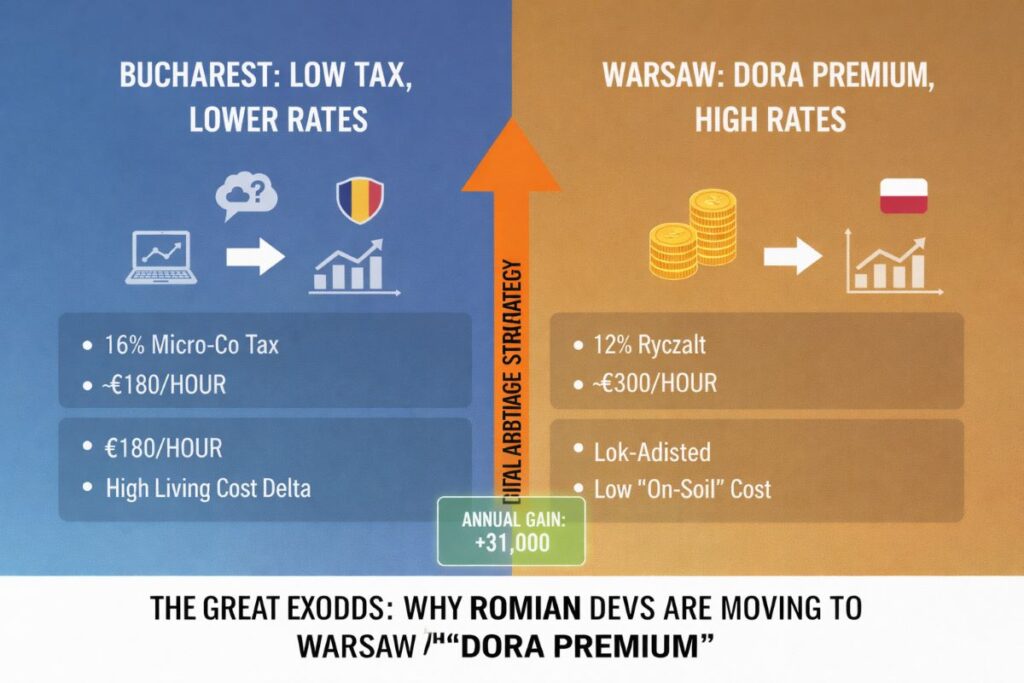
Contractors can increase disposable income by €30,000+ annually without violating DORA or labor regulations.
This is why the strategy spreads — not because it is risky, but because it is structurally efficient.
The Strategic Reality for 2026 Contractors
The European banking market has crossed a threshold.
You are no longer competing on:
- Language
- Frameworks
- Years of experience
You are competing on:
- Audit survivability
- Jurisdictional trust
- Liability absorption
Warsaw wins not because it is cheaper — but because it is safer for banks.
Why This Matters
DORA is quietly reshaping Europe’s IT labor market—not by eliminating remote work, but by re-pricing accountability.
For contractors, this marks the end of pure skill arbitrage. The highest rates now flow to those who can absorb regulatory responsibility without destabilizing a bank’s audit posture. For banks, paying a €300/hour rate in Warsaw is cheaper than absorbing a compliance failure during a live supervisory review.
At a systemic level, this explains why talent is consolidating around regulatory gravity wells. Cities like Warsaw are not winning because of cheaper developers—but because they minimize legal ambiguity during incidents. Ignoring this shift means competing on price in a market that now rewards risk absorption.
FAQs (2026 Compliance & B2B Reality)
1. Is DORA really increasing B2B rates in Poland, or is this temporary?
This is structural, not cyclical. DORA shifts liability to named ICT third parties, which permanently prices regulatory risk into contracts. The “Resilience Premium” reflects exposure, not market hype.
2. Can Romanian developers still work remotely for Polish banks in 2026?
Yes—but only if they meet the In-Region Mandate technically and legally. Simple remote work no longer qualifies; audit-traceable delivery endpoints are now required.
3. What makes a contractor “DORA-ready” versus a standard Java developer?
A DORA-ready contractor designs systems for audit survivability: traceability, incident response, JVM-level controls, and documented accountability under Articles 17 and 28.
4. Why are Warsaw and Kraków outpacing Berlin for banking B2B roles?
Because Poland offers regulatory proximity to Tier-1 banks, sovereign cloud infrastructure, and KNF-aligned Centers of Excellence—reducing systemic audit risk.
5. Does being named under DORA increase personal liability?
It increases professional accountability, not unlimited liability—but it does require stronger indemnity coverage and compliance discipline, which is why rates rise.
6. Is Shadow AI really a DORA issue, not just internal policy?
Yes. Under DORA, unmanaged AI tooling qualifies as an unmanaged ICT asset—triggering third-party risk exposure during audits.
Conclusion: The €300/Hour Ceiling Is a Compliance Signal
The Resilience Premium is not a bubble.
It is a pricing correction.
As DORA enforcement matures, contractors who position themselves as risk-reduction assets will continue to outpace the market. Those who remain task-based will compete globally — and cheaply.
The Bucharest-to-Warsaw drain is not about migration.
It is about who is willing to stand in front of a regulator and say: “This system is auditable.”
In 2026, that sentence is worth €300/hour.
Sources & Regulatory References
- EU Digital Operational Resilience Act (DORA), Regulation (EU) 2022/2554
– Article 17: Register of Information
– Article 28: ICT Third-Party Risk Management - European Banking Authority (EBA) Guidelines on Outsourcing Arrangements
- KNF (Komisja Nadzoru Finansowego) 2026 Supervisory Framework
- EU NIS2 Directive (Supply Chain Security Context)
Author Bio
Saameer Go is a senior technology journalist and analyst covering enterprise software, AI platforms, infrastructure, and EU technology regulation. With over 15 years of experience analyzing how policy, labor markets, and system architecture intersect, he focuses on long-term structural shifts rather than short-term hype, particularly in regulated financial environments across Central and Eastern Europe.
Transparency & Legal Note
1. Professional Disclaimer (The “Not Advice” Clause)
Disclaimer: The information provided in this article, including the “Tax Arbitrage Calculator” and “Resilience Premium” benchmarks, is for informational and educational purposes only. It does not constitute legal, tax, or financial advice. IT B2B rates and tax regulations in Poland and Romania (e.g., KNF guidelines, Polski Ład, and Romanian Micro-company laws) are subject to rapid change in 2026. Readers should consult with a certified tax advisor or legal professional before entering into cross-border B2B contracts or implementing “Digital Residency” technical stacks.
2. Information Gain & Data Transparency
Transparency Note: The data benchmarks and €300/hour “Resilience Premium” figures cited are based on January 2026 market analysis of Tier-1 banking B2B tenders in Warsaw and Kraków. These figures reflect “DORA-Ready” roles involving high regulatory liability and are not representative of the broader generalist Java market.
3. AI Disclosure (EU AI Act Compliance)
AI Disclosure: Parts of this technical analysis and the underlying data visualizations were developed with the assistance of Generative AI systems. In accordance with Article 50 of the EU AI Act, we disclose that AI was used to synthesize regulatory frameworks and optimize technical blueprints. However, the final editorial direction, jurisdictional conclusions, and “Technical Residency” strategy have undergone human review and editorial control by Saameer Go to ensure accuracy and professional responsibility.