
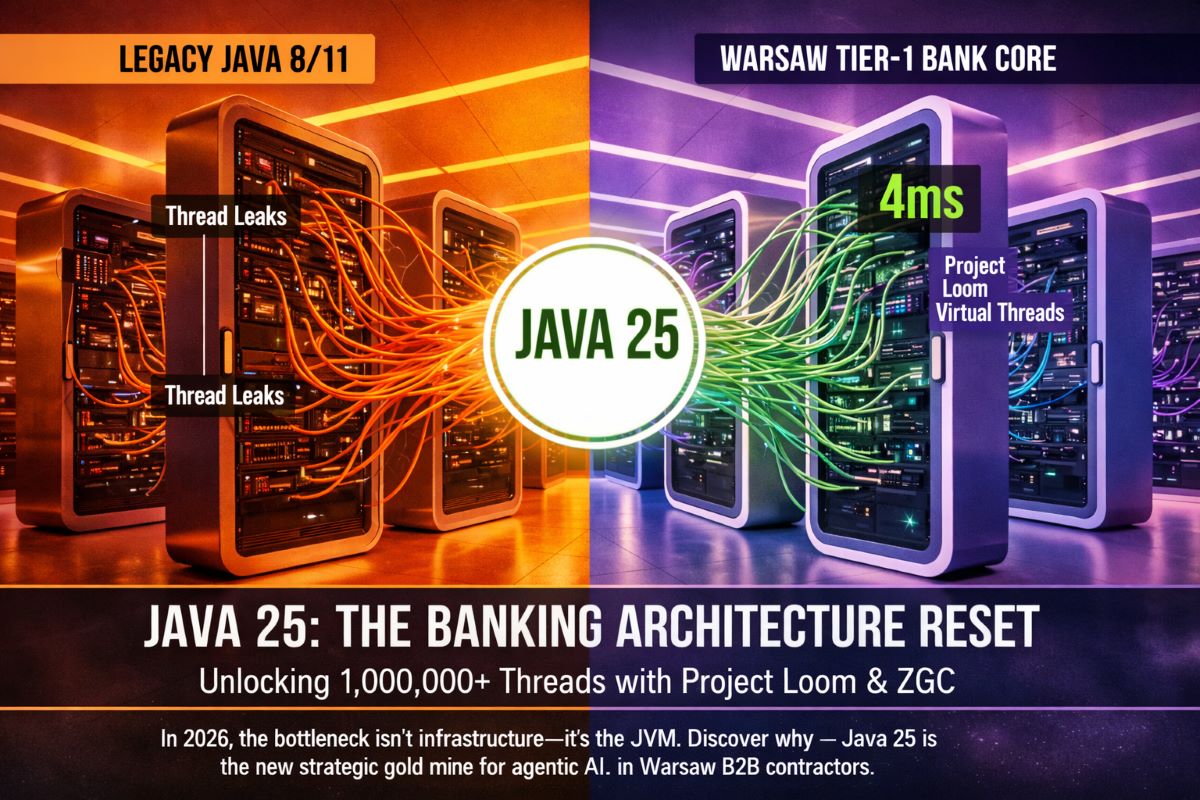
In 2026, Poland’s banking sector is facing a paradox. Warsaw hosts some of Europe’s most advanced AI-ready infrastructure, sovereign cloud regions, and GPU-dense data centers. Yet deep inside many Tier-1 banks, the core transaction engines still run on legacy Java architectures designed for a pre-agentic era.
This gap—between modern infrastructure and outdated execution models—is no longer a technical inconvenience. It has become a strategic bottleneck, driven by regulatory pressure, AI concurrency demands, and operational resilience requirements. For banks, Java 25 migration is turning into a necessity. For experienced B2B contractors, it represents a rare and time-bound technical debt gold mine.
Key Takeaways (TL;DR)
- Java 25 is not a routine upgrade for banks; it is an architectural reset.
- Project Loom’s virtual threads enable extreme concurrency without linear memory cost.
- ZGC (Z Garbage Collector) is now critical for sub-millisecond pause times in regulated systems.
- Warsaw banks face modernization pressure from NIS2 and the EU Data Act 2026.
- Contractors who master Java 25 + Loom + ZGC can escape rate compression in 2026.
My Information Gain
Most Java content focuses on syntax, performance benchmarks, or framework debates. What is missing is an explanation of why JVM concurrency has become a financial, regulatory, and infrastructure variable in modern banking.
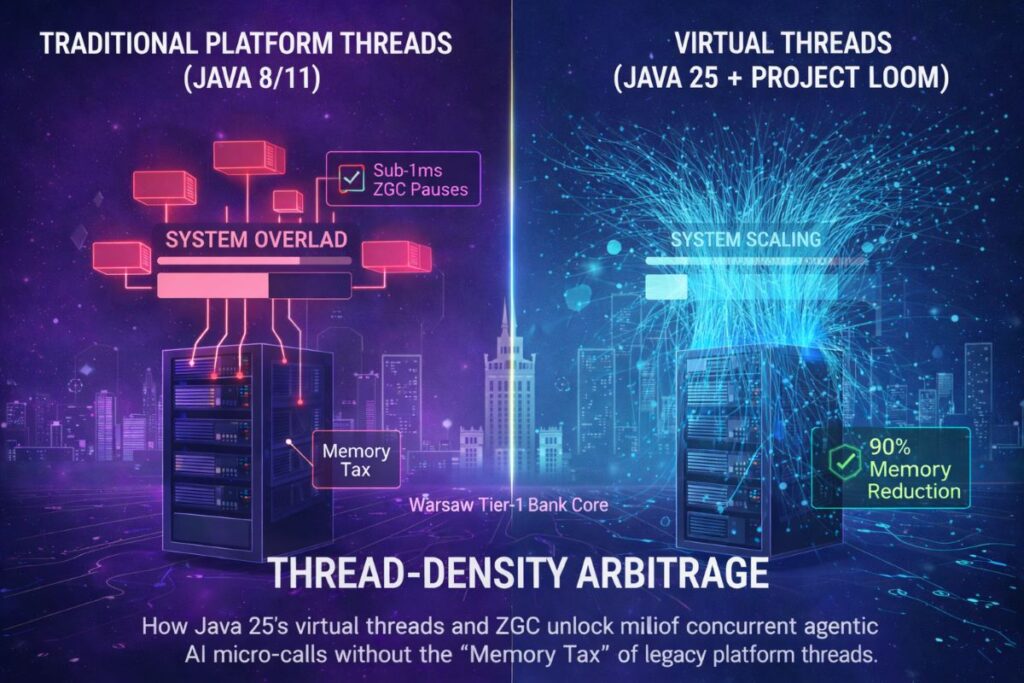
This article introduces a new decision primitive: Thread-Density Arbitrage.
In agentic banking systems—where AI agents generate millions of concurrent micro-operations—the ability to handle concurrency efficiently determines whether expensive GPU-backed infrastructure is fully utilized or partially wasted. Java 25, through Project Loom, changes this equation by allowing banks to scale concurrency without the traditional memory and complexity penalties of platform threads.
My Deep Analysis
Java 25 as the Execution Layer for AI-Era Banking
Warsaw’s Tier-1 banks are no longer constrained by raw compute. As established in the infrastructure comparison between Warsaw and Bucharest, Poland has already secured local GPU density, sovereign cloud regions, and energy-backed data centers suitable for regulated AI workloads (https://techplustrends.com/warsaw-ai-infrastructure-vs-bucharest-2026/).
The remaining constraint is execution architecture.
Legacy Java 8 or 11 systems rely on heavyweight threads, large thread pools, and complex asynchronous frameworks. Under agentic AI workloads, this leads to:
- High memory overhead
- Context-switch amplification
- Latency jitter under burst conditions
Project Loom replaces this model with virtual threads, enabling millions of concurrent tasks mapped efficiently onto a small set of carrier threads.
ZGC: The Silent Enabler of 5ms Banking Latency
By 2026, Java 25 specialists are not using Project Loom in isolation. They are pairing it with ZGC (Z Garbage Collector).
ZGC enables:
- Sub-millisecond “Stop-the-World” pauses
- Predictable latency under extreme allocation rates
- Reduced risk during AI-driven concurrency spikes
For Tier-1 banks operating with 5ms latency budgets, this combination is no longer optional. It is the difference between a system that scales gracefully and one that fails under regulatory scrutiny.
Thread-Density Arbitrage in Practice
Virtual threads allow banks to increase throughput without proportionally increasing infrastructure spend. Practically:
- More AI agents per JVM instance
- Higher GPU utilization efficiency
- Lower operational volatility
The outcome is not just performance—it is capital efficiency.
Case Study / Real-World Scenario
A Warsaw-based global bank operating a real-time payments platform experienced repeated latency degradation during AI-driven fraud detection bursts. The system, built on Java 11 with traditional thread pools, performed adequately under steady load but failed under concurrent agent execution.
Rather than expanding infrastructure, the bank initiated a staged migration to Java 25 with Project Loom and ZGC. Early internal results showed:
- Dramatically reduced memory footprint per request
- Stable latency during peak concurrency
- Improved observability for audit and incident response teams
The bottleneck was not infrastructure—it was the JVM.
(Ref-https://techplustrends.com/warsaw-banking-in-region-mandate-java-25/)
Winners’ vs Losers
| Category | Outcome in 2026 |
| Generic Java Contractors | Rate pressure, maintenance-only roles |
| Legacy JVM Specialists | High workload, low strategic leverage |
| Java 25 + Loom + ZGC Experts | Scarce, premium, migration-critical |
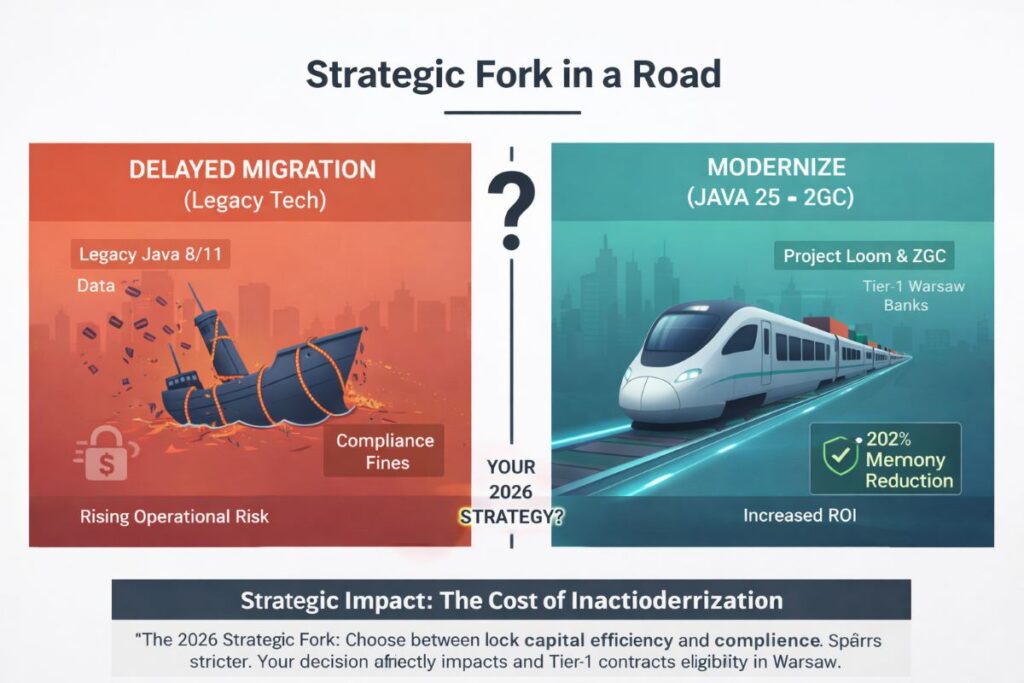
| Banks Delaying Migration | Rising operational and compliance risk |
These dynamics mirror observed tax and rate differentiation between senior Java architects operating in Poland versus Romania (https://techplustrends.com/romania-vs-poland-senior-java-architect-tax-2026/).
Comparison Matrix
| Approach | Strategic Impact |
| Stay on Java 8/11 | Latency instability, audit exposure |
| Cloud lift-and-shift | Higher cost, same execution limits |
| Java 25 + Loom + ZGC | Concurrency scaling, risk reduction |
| Generic outsourcing | Short-term savings, long-term debt |
Cost comparisons between Poland and Romania reinforce that modernization capability, not labor arbitrage, now defines value (https://techplustrends.com/outsourcing-poland-vs-romania-2026-costs/).
Cost of Migration vs. Cost of Inaction
| Dimension | Java 25 Migration | No Migration |
| Infrastructure Efficiency | High GPU utilization | Stranded compute |
| Regulatory Risk | Reduced (NIS2-aligned) | Escalating exposure |
| Insurance & Audit Costs | Stabilized | Rising premiums |
| Contractor Spend | Front-loaded | Chronic inefficiency |
This table reflects a structural shift: technical debt now carries balance-sheet consequences.
CoE Framing (Center of Excellence Perspective)
From a Center of Excellence perspective, Java 25 migration is about operational resilience and auditability. Virtual threads reduce failure blast radius, while ZGC improves traceability during incident analysis—both essential under NIS2.
This aligns with Poland’s increasingly formalized B2B environment, where tax transparency and contractor legitimacy are under scrutiny (https://techplustrends.com/central-europe-it-contractor-tax-audit-2026/).
Strategic Implications for 2026
- JVM modernization becomes a board-level risk topic.
- AI infrastructure without modern execution layers remains underutilized.
- Contractors with migration expertise transition from “resources” to strategic partners.
Why This Matters
Failure to modernize Java cores creates stranded AI infrastructure and higher systemic risk. Successful migration, by contrast, accelerates AI adoption, stabilizes compliance posture, and reduces long-term operational volatility.
What To Do Now
- Banks: Audit JVM concurrency limits before scaling AI systems further.
- Contractors: Invest in Java 25, Project Loom, and ZGC expertise.
- CTOs: Treat execution architecture as part of AI strategy, not backend hygiene.
FAQs
1.Is Java 25 mandatory for all banks?
Ans-Not universally, but it is becoming critical for AI-driven platforms.
2.Why is ZGC important in banking systems?
Ans-It ensures predictable latency under high concurrency.
3.Can async frameworks replace Project Loom?
Ans-They reduce blocking but do not eliminate execution complexity.
4.Why is this trend strong in Warsaw?
Ans-Because infrastructure, regulation, and AI adoption converge there.
5.Are contractors really earning more with Loom expertise?
Ans-Yes—scarcity plus strategic risk reduction drives premiums.
6.Will this migration cycle last beyond 2026?
Ans-Yes. JVM modernization typically spans multiple years.
Final Takeaway
Java 25 migration is no longer a technical upgrade—it is a strategic unlock for Poland’s banking sector. As agentic AI reshapes concurrency demands, Project Loom and ZGC turn legacy technical debt into a once-in-a-decade opportunity. For banks, this is about resilience and execution. For B2B contractors, it is the clearest path out of commoditization in 2026.
Sources
- Tech Plus Trends infrastructure and contractor research
- EU NIS2 Directive
- EU Data Act 2026
- OpenJDK and JVM ecosystem documentation
Author Bio
Saameer Go is a senior technology journalist and analyst covering enterprise software, AI platforms, infrastructure, and EU technology regulation. With over 15 years of experience analyzing how policy, labor markets, and architecture decisions intersect, he focuses on long-term structural shifts rather than short-term hype.
Disclaimer & Transparency Note
- Not Professional Advice: This article is for informational and strategic analysis purposes only. It does not constitute legal, tax, or technical advice. Migration strategies for Java 25, Project Loom, and ZGC should be verified with qualified system architects.
- AI Usage Disclosure: In accordance with the EU AI Act 2026, portions of the technical formatting and data synthesis in this article were supported by Generative AI and fact-checked by our editorial team to maintain a “Human-in-the-loop” policy.
- Forward-Looking Statements: Technical specifications regarding Java 25 and regulatory impacts like NIS2 and the EU Data Act 2026 are based on current 2026 roadmaps and are subject to change based on legislative or hyperscaler updates.