
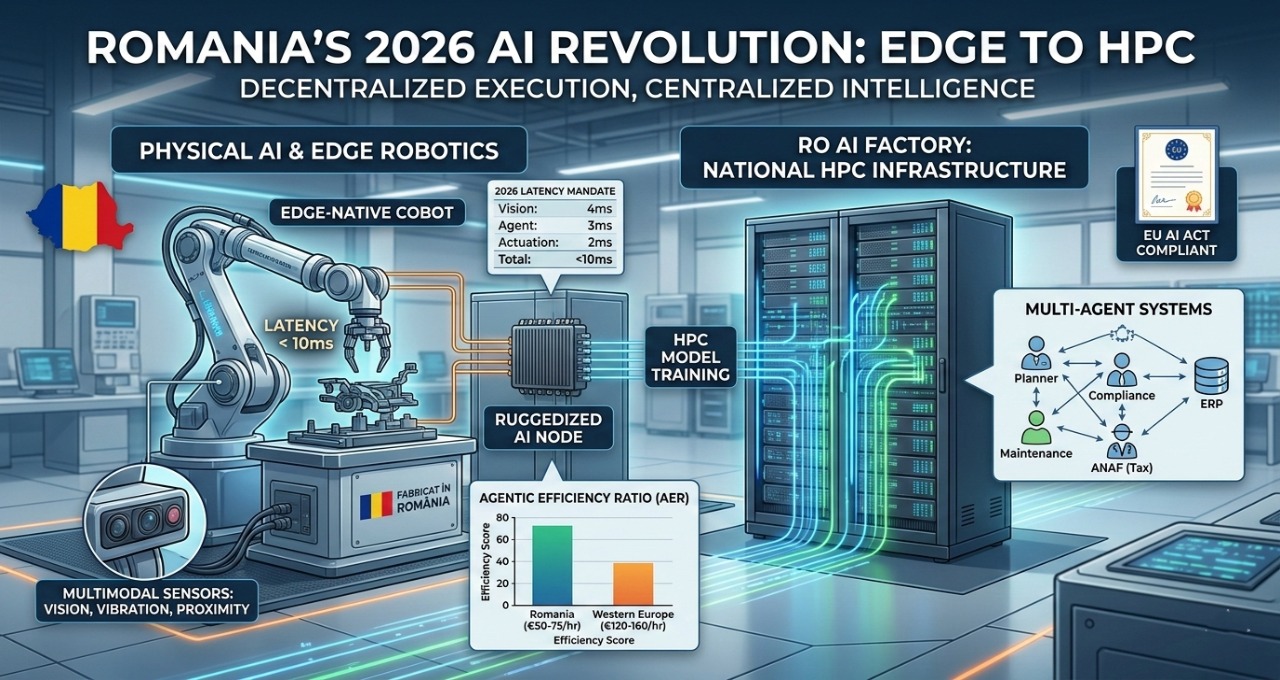
Romania’s AI development direction in 2026 is defined by three forces: Physical AI robotics in manufacturing, enterprise multi-agent automation systems, and multimodal digital government infrastructure. These deployments increasingly operate under EU AI Act transparency rules and governance frameworks, creating a scalable model for industrial AI across Eastern Europe.
Romania’s AI Shift: From Outsourcing Hub to Industrial AI Laboratory
For two decades Romania was widely known as an outsourcing destination for software development and IT services. That identity is now evolving.
In 2026 the country is emerging as an industrial AI laboratory for the European Union, where enterprises experiment with robotics automation, autonomous software agents, and multimodal public infrastructure.
Several structural factors are driving this transition:
- a strong engineering workforce
- competitive developer costs
- mature automation ecosystems built around enterprise platforms
- rapid digital transformation in both government and industry
These conditions create an environment where advanced AI systems can be deployed quickly and economically compared with Western Europe.
The Three Core AI Development Directions in Romania
Romania’s emerging AI ecosystem is centered around three major technology pillars.
- Physical AI for factories and robotics
- Multi-Agent systems for enterprise automation
- Multimodal AI infrastructure for public services
Together they represent the next phase of automation, where AI systems perceive environments, reason across workflows, and execute actions autonomously.
Physical AI in Romanian Factories: The Edge-First Revolution
Romania’s automotive and manufacturing sectors are increasingly adopting Physical AI architectures—systems that combine robotics with machine perception and real-time reasoning.
Major industrial hubs around Mioveni, Craiova, Cluj-Napoca, and Timișoara are integrating AI models directly into production environments.
Unlike traditional automation where robots follow fixed scripts, Physical AI systems can analyze visual input, detect anomalies, and adapt to dynamic conditions.
The Latency Mandate: Milliseconds vs Millions
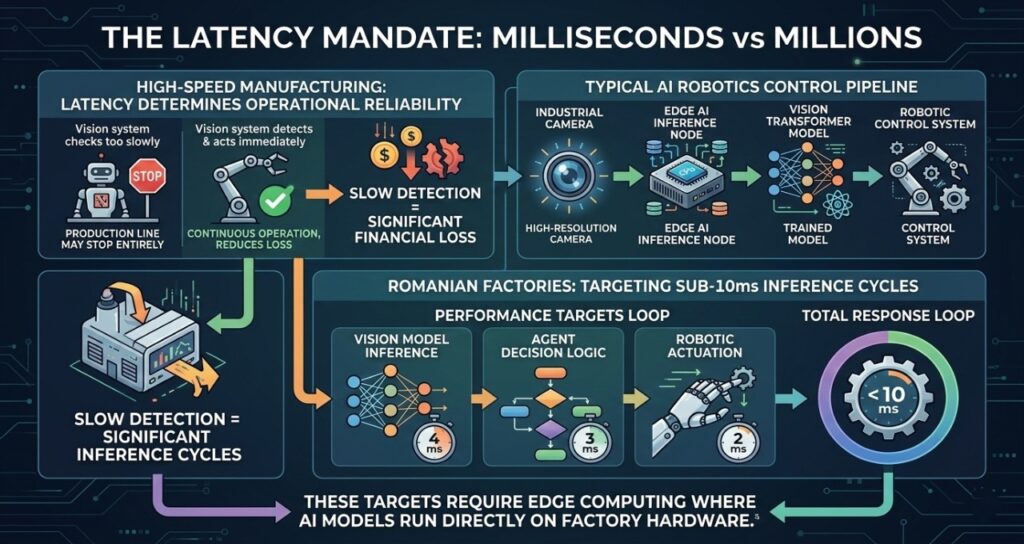
In high-speed manufacturing environments, latency determines operational reliability.
If a vision system detects a defect too slowly, a production line may stop entirely—resulting in significant financial loss.
Typical AI robotics control pipeline:
Industrial Camera
↓
Edge AI Inference Node
↓
Vision Transformer Model
↓
Robotic Control System
Modern Romanian factories are targeting sub-10 millisecond inference cycles.
| Stage | Typical Latency |
| Vision model inference | 4 ms |
| Agent decision logic | 3 ms |
| Robotic actuation | 2 ms |
| Total response loop | <10 ms |
These performance targets require edge computing architectures where AI models run directly on factory hardware.
Edge Computing: The Brain on the Shop Floor
A defining characteristic of Romanian industrial AI deployments is the move toward distributed edge intelligence.
Instead of sending massive volumes of video or sensor data to cloud servers, factories process information locally.
Typical architecture:
Sensors & Cameras
↓
Edge GPU / NPU Node
↓
AI Inference Engine
↓
Manufacturing Execution System
Benefits include:
- dramatically reduced latency
- lower network bandwidth consumption
- stronger data sovereignty protections
This architecture also supports real-time adaptive robotics, allowing machines to react instantly to environmental changes.
The Cobot-Agent Hybrid Model
One of the most interesting emerging patterns in Romanian manufacturing is the Cobot-Agent hybrid architecture.
Collaborative robots (cobots) are paired with AI software agents that monitor operations and make strategic decisions.
Example workflow:
Robot Sensor Data
↓
Edge AI Model
↓
Maintenance Agent
↓
Supply Chain Agent
↓
ERP System
Instead of simply executing tasks, robots can now:
- detect mechanical wear
- schedule maintenance automatically
- request replacement parts from procurement systems
The result is a self-optimizing production line capable of adapting to changing operational conditions.
Multi-Agent Systems: Romania’s Post-RPA Enterprise Automation
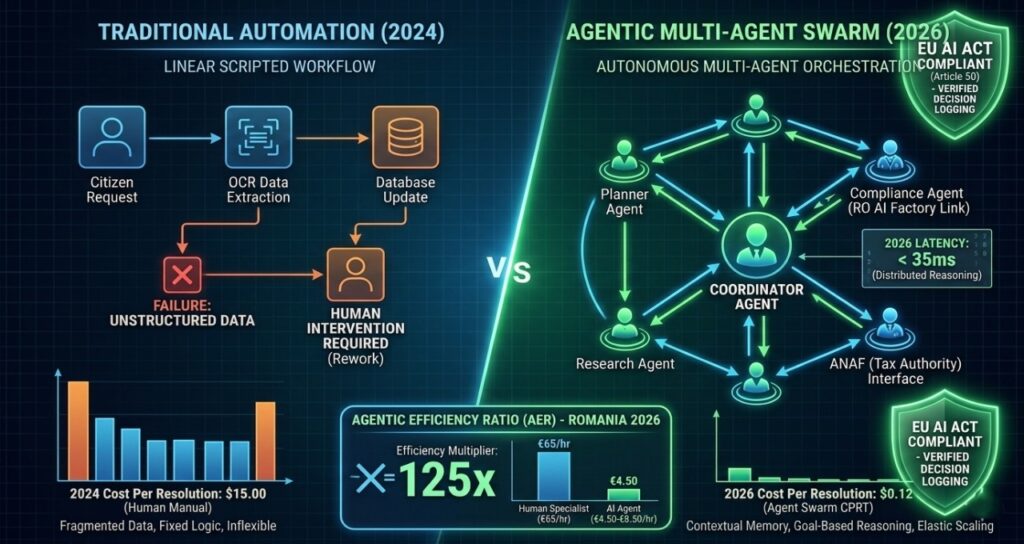
Romania’s enterprise automation sector was heavily shaped by the success of robotic process automation platforms.
However, in 2026 the industry is transitioning from scripted automation toward multi-agent systems capable of autonomous reasoning.
In these systems, multiple specialized agents collaborate across enterprise workflows.
For example:
User Request
↓
Coordinator Agent
↓
Finance Agent | Compliance Agent | Procurement Agent
↓
Enterprise Systems
Each agent is responsible for a domain while sharing information with the broader system.
These orchestration models closely resemble the distributed architectures discussed in our analysis of agentic AI workflow automation architectures.
Governance Challenges for Enterprise Agent Systems
As agent systems gain autonomy, governance becomes essential.
Organizations must ensure that automated decisions remain traceable, auditable, and explainable.
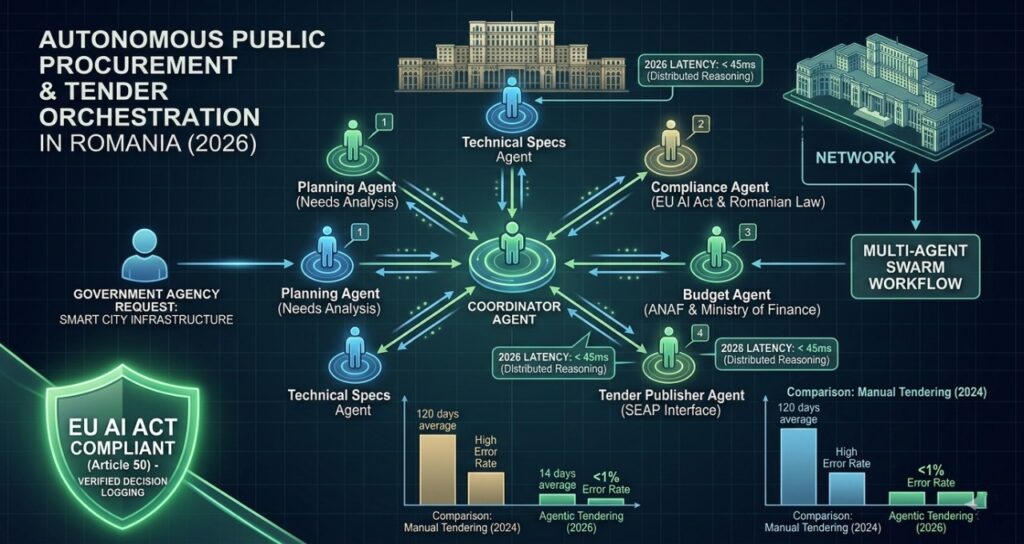
Key governance mechanisms include:
- decision logging systems
- identity verification for agents
- human override mechanisms
Enterprises deploying complex agent ecosystems increasingly adopt governance models similar to those explored in our deep dive on enterprise multi-agent security and governance models.
These safeguards also support compliance with EU AI Act transparency obligations under Article 50.
Multimodal AI Infrastructure for Public Services
Romania’s government digital transformation programs are increasingly incorporating multimodal AI technologies.
These systems can process different forms of data simultaneously:
- speech and voice commands
- scanned documents
- images and video streams
- structured government records
Typical multimodal processing pipeline:
Citizen Request
↓
Speech Recognition / OCR Models
↓
Language Model Processing
↓
Government Service Workflow
Applications include:
- automated document verification
- digital citizen assistants
- tax and licensing support systems
Such systems enable government institutions to process citizen interactions more efficiently while reducing administrative workload.
RO AI Factory: Romania’s National HPC Infrastructure for AI Development
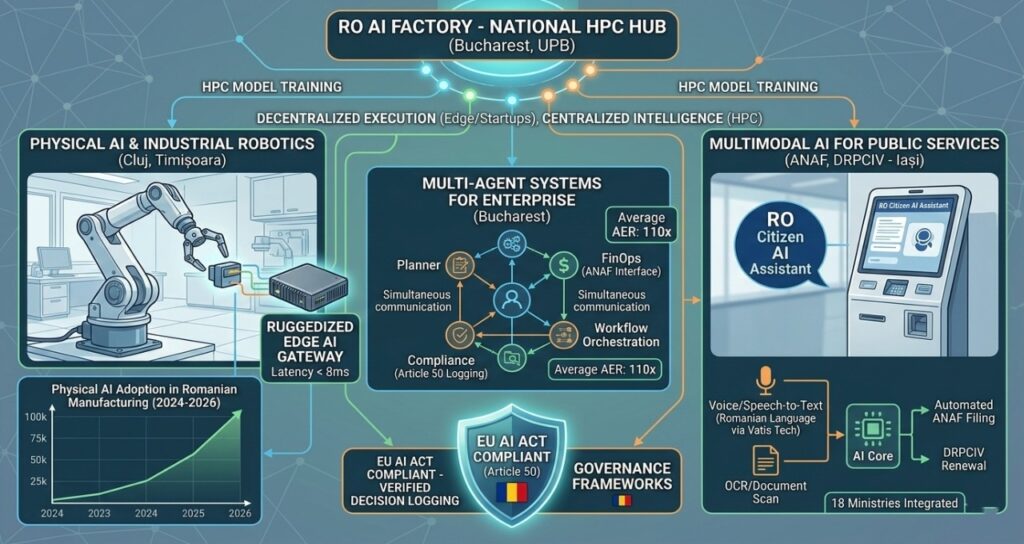
A critical component of Romania’s long-term AI strategy is the RO AI Factory initiative, a national program designed to provide shared high-performance computing infrastructure for artificial intelligence research and deployment.
The initiative is part of the broader European Digital Europe Programme, which aims to strengthen the continent’s technological sovereignty by expanding access to advanced computing resources.
Unlike traditional AI development environments that rely heavily on commercial cloud platforms, the RO AI Factory provides domestic high-performance computing (HPC) clusters that allow Romanian companies, universities, and research institutes to train large AI models locally.
Why HPC Infrastructure Matters for AI Development
Modern AI systems—particularly multimodal models and robotics simulation environments—require enormous computational power.
Training advanced models typically involves:
• large GPU clusters
• high-bandwidth memory systems
• massive parallel processing workloads
Without access to HPC resources, smaller companies and startups face significant barriers to entry.
The RO AI Factory helps address this challenge by offering shared compute infrastructure that supports:
• multimodal AI model training
• robotics simulation environments
• industrial digital twin systems
• large-scale machine learning research
This infrastructure allows Romanian developers to build advanced AI applications without relying entirely on foreign hyperscale cloud providers.
Supporting Romania’s Industrial AI Ecosystem
The RO AI Factory is also expected to play a key role in enabling the country’s transition toward Physical AI and autonomous industrial systems.
Factories deploying edge-based robotics and multi-agent automation platforms still require centralized compute resources for model training, optimization, and simulation.
By providing high-performance training environments, the national AI infrastructure enables organizations to:
• train perception models used in industrial robotics
• simulate autonomous manufacturing workflows
• optimize multimodal AI systems for public services
This combination of centralized HPC training and decentralized edge inference creates a hybrid architecture that is increasingly common in modern AI deployments.
Strategic Impact for Romania
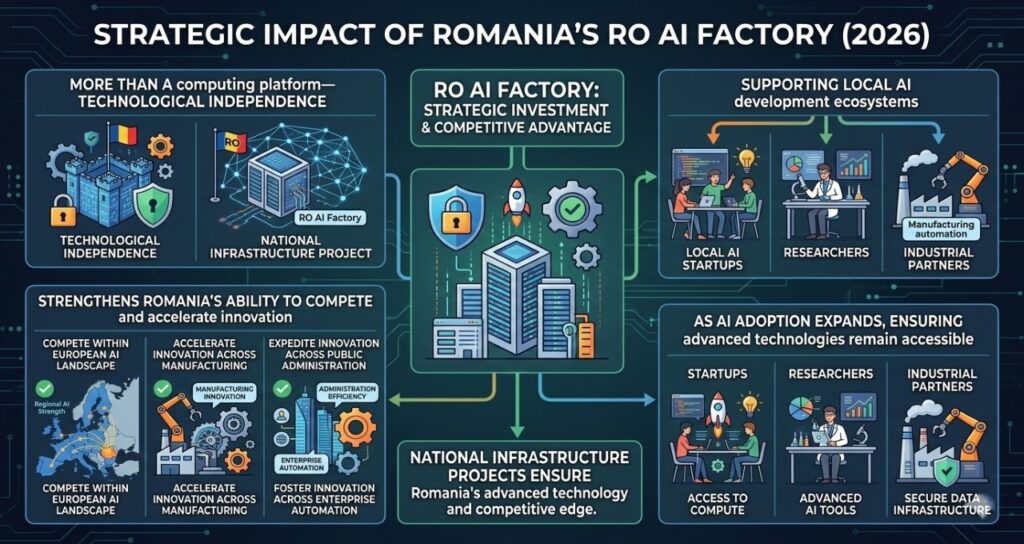
For Romania, the RO AI Factory represents more than just a computing platform—it is a strategic investment in technological independence.
By supporting local AI development ecosystems, the initiative strengthens Romania’s ability to compete within the European AI landscape and accelerates innovation across manufacturing, public administration, and enterprise automation.
As AI adoption continues to expand across industries, national infrastructure projects like the RO AI Factory will play a crucial role in ensuring that advanced technologies remain accessible to startups, researchers, and industrial partners throughout the country.
Romania’s AI Ecosystem: Companies Driving Innovation
Romania’s growing AI ecosystem includes startups and enterprise technology providers working across automation, robotics, and language technologies.
Key companies shaping the ecosystem include:
| Company | Focus |
| UiPath | enterprise automation platforms |
| DRUID AI | conversational and agentic AI systems |
| FlowX.ai | AI-driven enterprise software modernization |
| Vatis Tech | speech recognition and multimodal AI |
| Adapta Robotics | robotics testing and Physical AI platforms |
These organizations illustrate Romania’s ability to combine software innovation with industrial automation expertise.
The Agentic Efficiency Ratio: Romania’s Economic Advantage
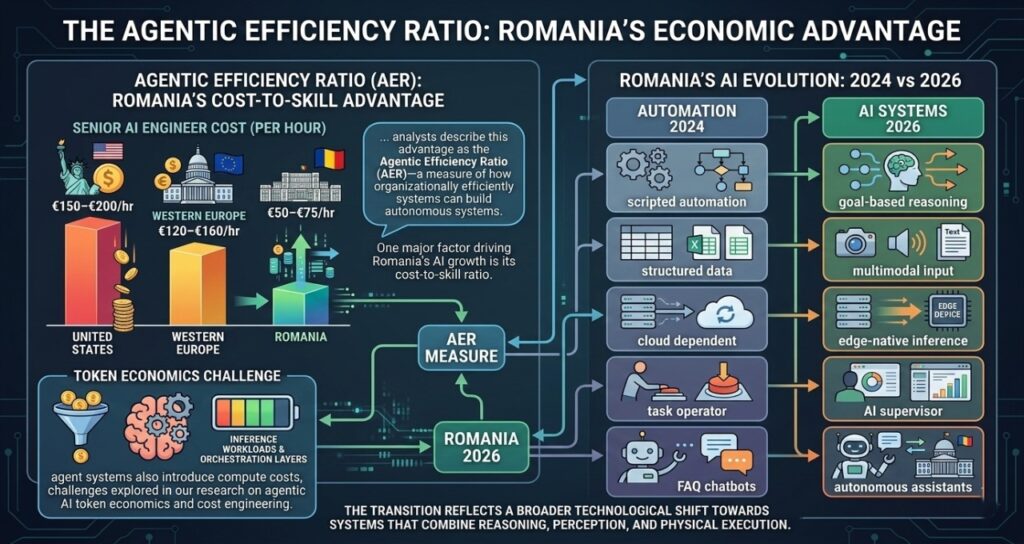
One major factor driving Romania’s AI growth is its cost-to-skill ratio.
Senior AI engineers in Romania typically cost €50–€75 per hour, compared with €150 or more in Western markets.
| Region | Senior AI Engineer Cost |
| United States | €150–€200/hr |
| Western Europe | €120–€160/hr |
| Romania | €50–€75/hr |
This advantage creates what analysts describe as the Agentic Efficiency Ratio (AER)—a measure of how efficiently organizations can build autonomous systems.
However, agent systems also introduce compute costs related to inference workloads and orchestration layers, challenges explored in our research on agentic AI token economics and cost engineering.
Romania’s AI Evolution: 2024 vs 2026
| Feature | Automation 2024 | AI Systems 2026 |
| Primary logic | scripted automation | goal-based reasoning |
| Data modality | structured data | multimodal input |
| Latency | cloud dependent | edge-native inference |
| Human role | task operator | AI supervisor |
| Public sector | FAQ chatbots | autonomous assistants |
The transition reflects a broader technological shift toward systems that combine reasoning, perception, and physical execution.
Strategic Roadmap for Romanian AI Leadership
To sustain momentum, Romanian organizations must focus on several strategic priorities.
1. Prioritize Edge AI Infrastructure
Factories should deploy localized inference systems capable of delivering real-time responses without cloud dependency.
2. Adopt Multi-Agent Orchestration
Enterprises must move beyond simple automation scripts toward coordinated networks of specialized agents.
3. Leverage Multimodal Data
Organizations should combine visual, audio, and textual inputs to build systems that understand complex environments.
Beyond the Digital Facade
The true significance of Romania’s 2026 AI trajectory lies in its tangibility. While much of the global AI conversation remains trapped in chatbots and digital entertainment, Romania has quietly focused on the AI of things, movement, and governance.
By anchoring the RO AI Factory’s massive compute power to the ruggedized Edge nodes in Mioveni’s factories and the autonomous Tender Swarms in Bucharest’s ministries, the nation is building a resilient, “self-healing” economy. This is a transition from being a provider of talent to being an owner of sovereign intelligence.
As we move toward 2027, the success of the “Romanian Model” will be measured not just by lines of code, but by the precision of a robotic arm, the speed of a citizen’s request, and the integrity of an auditable AI decision. Romania isn’t just surviving the AI revolution; it is engineering its physical reality.
FAQ: AI Development in Romania 2026
1: What are the top AI hubs in Romania for 2026?
Ans: Bucharest remains the leader for Enterprise AI and Fintech, while Cluj-Napoca has emerged as the premier hub for Physical AI and Robotics. Timișoara and Iași are seeing significant growth in Automotive AI and Multimodal software development respectively.
2: How does the EU AI Act affect Romanian AI startups in 2026?
Ans: As of early 2026, the EU AI Act is fully enforceable. Romanian startups like Genezio and DRUID have pivoted toward “Verifiable AI,” offering automated auditing and compliance layers to ensure their multi-Agent systems meet the strict transparency and risk-management requirements of the Act.
3: Why is “Physical AI” trending in the Romanian automotive sector?
Ans: Physical AI combines robotics with World Models, allowing machines to “learn” physics in simulation before deployment. For Romanian factories, this means robots can handle unstructured tasks—like moving non-standardized parts—which was previously impossible with rigid RPA.
4: What is the average cost of AI development in Romania in 2026?
Ans: Romania remains highly competitive with average hourly rates for senior AI engineers at €50–€75, compared to €150+ in the US or UK. This “Cost-to-Skill” ratio makes Romania the primary destination for European AI FinOps and infrastructure scaling.
5: What is the “RO AI Factory” initiative?
Ans: It is a national strategic project launched by the Ministry of Research, Innovation and Digitization. It provides shared high-performance computing (HPC) resources for Romanian SMEs and researchers to train local multimodal models without the prohibitive costs of private cloud infrastructure.
Sources
European Parliament & Council — Artificial Intelligence Act (EU AI Act Full Regulation Text)
https://eur-lex.europa.eu/eli/reg/2024/1689/oj
European Commission — Artificial Intelligence Act Overview and Implementation Resources
https://digital-strategy.ec.europa.eu/en/policies/european-ai-act
European Commission — Digital Europe Programme (AI and High-Performance Computing Initiatives)
https://digital-strategy.ec.europa.eu/en/activities/digital-programme
OECD AI Policy Observatory — Romania Country Profile and AI Policy Monitoring
https://oecd.ai/en/dashboards/countries/Romania
European High Performance Computing Joint Undertaking (EuroHPC) — European AI Infrastructure and HPC Strategy
https://eurohpc-ju.europa.eu
Eurostat — Digital Economy and Society Statistics for Artificial Intelligence Adoption in the EU
https://ec.europa.eu/eurostat/web/digital-economy-and-society
IEEE Robotics and Automation Society — Research Publications on Industrial Robotics and Autonomous Systems
https://www.ieee-ras.org/publications
European Commission Joint Research Centre — Artificial Intelligence and Industrial Transformation Reports
https://joint-research-centre.ec.europa.eu
Author Bio
Saameer is an AI compliance architecture specialist and distributed systems strategist focused on enterprise automation, industrial robotics, and large-scale AI governance frameworks. His research explores emerging technologies such as multi-agent orchestration, edge-native AI systems, and multimodal infrastructure used across modern digital platforms.
He frequently analyzes the regulatory and technical implications of the EU AI Act, helping organizations understand how autonomous systems, industrial AI deployments, and intelligent automation platforms can operate within evolving European compliance standards.
Saameer’s work focuses on bridging the gap between advanced AI engineering and real-world enterprise deployment, with particular attention to cost-efficient infrastructure, scalable automation architectures, and the economic models shaping the next generation of agentic AI systems.
Disclaimer & Transparency Note
Editorial Integrity & AI Disclosure This report was authored by Saameer, Founder of Tech Plus Trends, using a “Hybrid Intelligence” workflow. While advanced AI agents were used for large-scale data synthesis, cross-referencing EU AI Act regulatory texts, and generating technical architectural visualizations, all strategic insights, localized Romanian context, and final editorial conclusions were developed and verified by a human expert.
Accuracy & Predictive Modeling The data regarding 2026 AI Development Directions is based on current national infrastructure projects (e.g., the RO AI Factory), industrial roadmaps from Romania’s automotive hubs, and the mandated implementation timelines of the European AI Act. While the Agentic Efficiency Ratio (AER) and latency targets reflect production-grade benchmarks as of March 2026, actual implementation results may vary based on specific enterprise hardware and local regulatory updates.
Conflict of Interest Tech Plus Trends is an independent publication. This analysis is not sponsored by the Romanian Ministry of Research, Innovation and Digitization, nor any of the private entities mentioned (e.g., UiPath, DRUID, Adapta Robotics). Mentions of specific companies are based strictly on their documented contribution to the Romanian AI ecosystem.
Regulatory Compliance This content itself is designed to be Article 50 Compliant under the EU AI Act, ensuring full transparency regarding the use of synthetic media and AI-assisted research in the creation of public-facing information.