
Note: This guide was updated in 2026 to reflect mandatory KSeF production rules, Polish labor reclassification powers (PIP), and the shift toward agentic, orchestration-driven RPA inside Shared Service Centers.
Why This Matters Now
In 2026, Poland’s Shared Service Centers (SSCs) are no longer debating whether to automate. That decision was made years ago. The real question today is which automation model can survive regulatory pressure, labor constraints, and scale requirements at the same time.
With more than 1,500 SSCs operating across Warsaw, Kraków, Wrocław, and Gdańsk, Poland remains Europe’s operational backbone for finance, HR, procurement, and IT services. But the environment has fundamentally changed:
- KSeF e-invoicing is now live production, not a future project
- The National Labour Inspectorate (PIP) can reclassify B2B contractors through immediate administrative decisions
- Hiring has slowed while workload volume continues to rise
Automation in Poland is no longer about efficiency gains.
It is about operational continuity and governance under constraint.
This is why generic “best RPA tools” lists fail Polish managers in 2026. The decision is no longer about features. It is about control, compliance readiness, talent availability, and long-term cost exposure.
Information Gain: Why RPA in Poland Is No Longer About Bots
Most RPA content still frames automation as task replacement. That framing is now outdated.
According to ABSL (Association of Business Service Leaders), Polish SSCs operate at a mean automation rate of ~21.2%, with finance-heavy centers exceeding 30%. The bottleneck is no longer ambition. It is governance.
Automation has shifted from centralized RPA teams to Citizen Developer models, where accountants, analysts, and HR professionals build and maintain workflows themselves. This decentralization increases speed—but introduces new risks around compliance, auditability, and lifecycle ownership.
This shift mirrors what we see across enterprise software more broadly, where AI systems are no longer passive tools but active operational participants. We analyzed this transformation through the lens of the silicon-based workforce, where AI systems increasingly behave like coworkers rather than software features
(https://techplustrends.com/silicon-based-workforce-ai-coworkers/).
In Poland, RPA is now part of that same evolution. The differentiator in 2026 is not how many bots you deploy—it is how well you orchestrate exceptions when automation breaks.
Deep Analysis: From Task Automation to Orchestration
The Agentic Shift Inside Polish SSCs
In 2026, RPA platforms are judged less on task automation and more on orchestration layers.
Polish SSC managers increasingly face unstructured exceptions:
- Failed KSeF invoices
- Regulatory mismatches
- Vendor data inconsistencies
- Cross-system handoff errors
Traditional RPA scripts struggle here. This is where agentic workflows emerge—systems that coordinate tasks, evaluate context, and escalate judgment-critical decisions to humans.
We see the same pattern across other domains:
- Autonomous purchasing systems negotiating transactions end-to-end
(https://techplustrends.com/agentic-commerce-auto-shopper-era/) - Self-healing software platforms detecting and correcting failures automatically
(https://techplustrends.com/gpt-5-2-codex-self-healing-software-2026/)
In 2026, the leaderboard is no longer about bots; it’s about orchestration.
UiPath’s Autopilot and Power Automate’s Copilot are now the primary interfaces Polish managers use to handle unstructured exceptions—workflows traditional RPA used to fail at.
The 2026 RPA Leaderboard for Polish Shared Service Centers
Why UiPath Still Dominates — But No Longer Uncontested
UiPath remains the default choice in Poland for structural reasons:
- Deep Warsaw and Kraków presence
- Strong academic pipelines (AGH, SGH, technical universities)
- Mature enterprise tooling for regulated environments
However, 2026 introduces new pressure points:
- Licensing scrutiny from global HQs
- Developer salary inflation
- Governance risks from thousands of citizen-built automations
This mirrors a broader platform shift across tech ecosystems, where long-term value is driven by integration and control, not raw capability
(https://techplustrends.com/chatgpt-atlas-vs-google-chrome-ai-browser/).
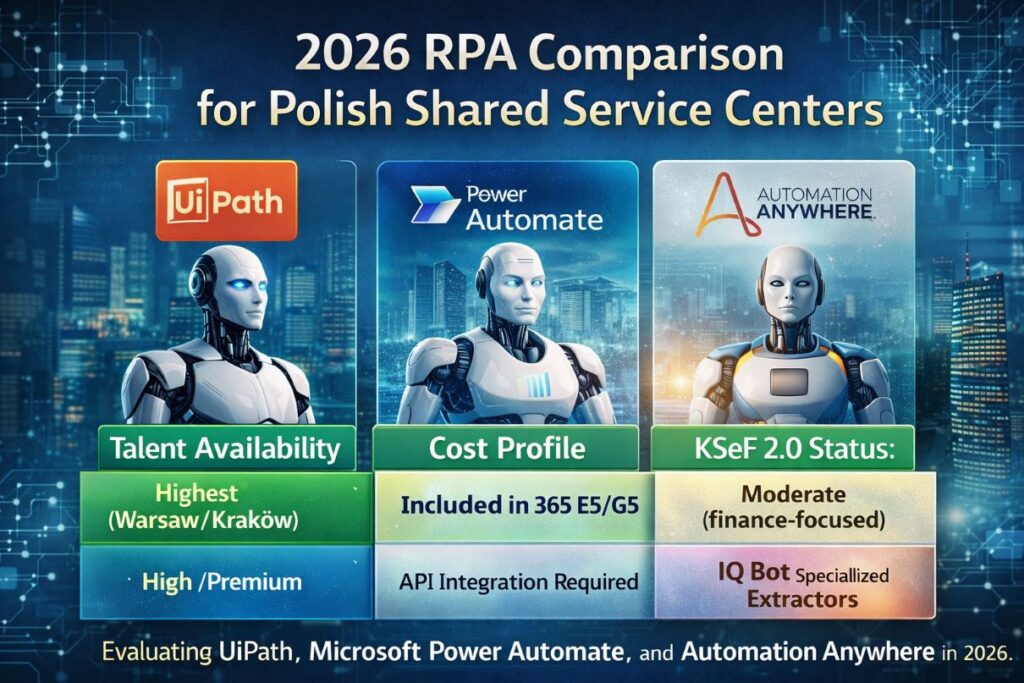
Core Comparison Matrix (2026 Edition)
| Feature / Platform | UiPath | Microsoft Power Automate | Automation Anywhere |
| Best Fit | Enterprise hyper-automation | Citizen developers / M365 | Cloud-native, AI-heavy workflows |
| Talent Availability | Highest (Warsaw/Kraków) | High, rapidly expanding | Moderate, finance-centric |
| KSeF 2.0 Status | Native FA(3) connectors | API-based integration | IQ Bot XML extraction |
| Governance Model | Centralized, deep | Tiered, citizen-centric | Cloud-first, strict |
| Cost Profile | High / premium | Low–mid (bundled in E5/G5) | Mid / per-bot |
| Agentic Capability | Autopilot orchestration | Copilot workflows | AI digital workers |
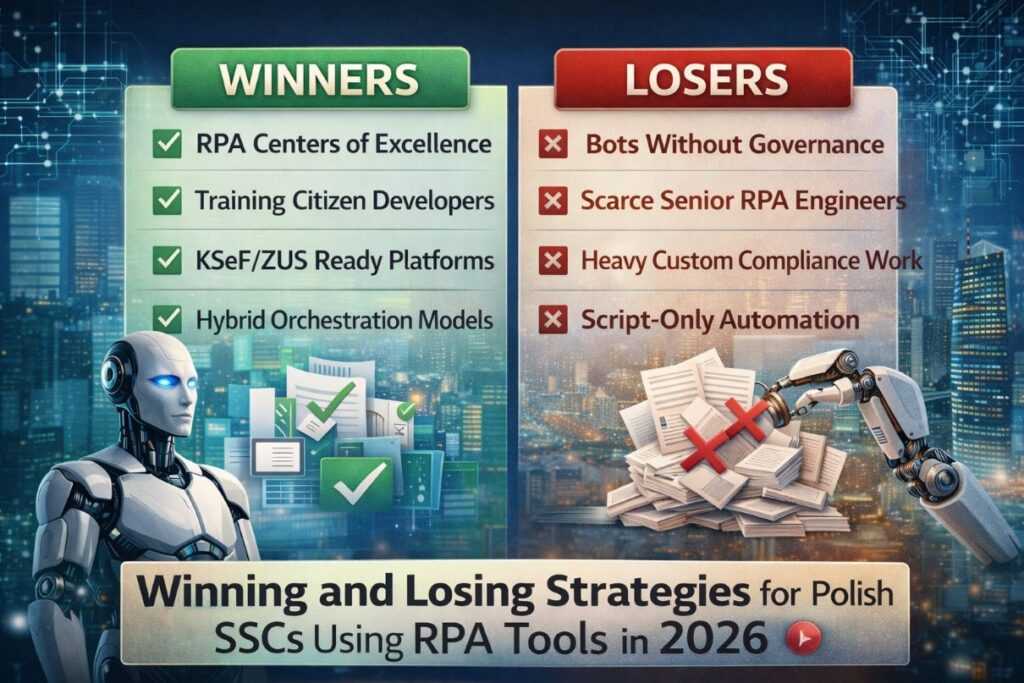
Mandatory Section: Winners vs Losers in Poland’s RPA Transition
| Winners | Losers |
| SSCs with formal RPA Centers of Excellence | Teams deploying bots without governance |
| Firms training citizen developers | SSCs reliant on scarce senior RPA engineers |
| Platforms with native KSeF/ZUS readiness | Tools requiring heavy custom compliance work |
| Hybrid orchestration models | Script-only, single-bot automation |
The CoE Reality: Governance Beats Speed
In Poland, RPA success is increasingly tied to Center of Excellence (CoE) design.
The most resilient SSCs neither centralize all development nor fully decentralize it. They create guardrails:
- Approved automation patterns
- Compliance enforcement (KSeF, ZUS)
- Bot ownership and lifecycle management
- Risk auditing instead of micromanagement
This governance-first mindset mirrors how large-scale AI systems are deployed in regulated environments, where accountability matters more than novelty
(https://techplustrends.com/inside-the-1-billion-disney-openai-sora-deal-how-sora-will-stream-on-disney-in-2026/).
The Hidden Cost of Bot Maintenance in Poland
In 2026, the true cost of RPA in Poland is not licensing—it is talent.
A senior UiPath developer in Kraków now earns nearly the same as a Java architect. This creates a strategic fork:
- Buy a powerful platform requiring scarce specialists
- Or adopt a platform that empowers non-technical staff
This mirrors broader cost recalculations when comparing Poland with other nearshore hubs
(https://techplustrends.com/outsourcing-poland-vs-romania-2026-costs/).
Regulatory Gravity: KSeF, ZUS, and Labor Risk
As of February 1, 2026, KSeF is a live production environment for large taxpayers (>200M PLN turnover). Automation errors are now fiscal events.
Simultaneously, the Polish National Labour Inspectorate (PIP) can reclassify B2B contractors via administrative decisions with immediate enforceability. Appeals do not delay ZUS obligations. For SSC managers, this is the single largest budget risk in 2026.
This regulatory cascade mirrors cybersecurity governance shifts across Central Europe, where compliance obligations increasingly propagate through supply chains
(https://techplustrends.com/techplustrends-com-nis2-compliance-poland-romania-2026/).
What To Do Now
- Audit existing automations for KSeF production readiness
- Identify workflows safe for citizen developer ownership
- Establish or reinforce a formal RPA CoE
- Evaluate orchestration and exception handling, not bot speed
- Factor labor law reclassification risk into automation ROI
Final Takeaway
The RPA conversation in Poland has matured.
In 2026, success is no longer about choosing the most powerful tool. It is about choosing the most governable system.
As automation becomes embedded in tax reporting, financial controls, and labor-sensitive workflows, Polish SSCs that treat RPA as **infrastructure—not experimentation—**will quietly outperform the rest.
Sources
ABSL Poland reports; vendor documentation (UiPath, Microsoft, Automation Anywhere); Polish Ministry of Finance (KSeF); National Labour Inspectorate (PIP); industry analysis and prior Tech Plus Trends reporting.
Download the Full 2026 Strategic Brief: 👉 SSC_RPA_Decision_Brief_Poland_2026.pdf
Author Bio
Saameer Go is a technology writer and analyst focused on enterprise automation, AI platforms, and European tech infrastructure. His work examines how regulation, labor markets, and software architecture intersect inside real operating environments, with a particular focus on Central and Eastern Europe.