
The era of the “digital colleague” has arrived — and remote teams are quietly redesigning their productivity stacks around autonomous AI agents.
The best AI productivity tools for remote teams in 2026 are no longer simple assistants — they are goal-oriented AI agents that automate coordination, scheduling, and knowledge management. Modern remote teams rely on an autonomous productivity stack combining AI knowledge hubs, orchestration agents, predictive scheduling, and meeting intelligence to reduce tool fatigue and support asynchronous work across global time zones.
Remote Work Is Entering the Agentic Era
In this guide, we analyze 12 AI productivity tools shaping the 2026 remote work stack, from meeting intelligence platforms to agentic workflow orchestrators.
Remote teams solved geography. But they created a new problem: coordination overhead.
Slack threads stretch across eight hours. Calendar conflicts multiply across time zones. Context disappears between tools like email, project boards, and document platforms.
For years, companies tried to fix this with small productivity helpers — grammar checkers, meeting transcription tools, and chatbots.
But the real shift is happening now.
In 2026, the most effective remote teams are no longer adding more tools.
They are building AI-powered work systems where autonomous agents manage coordination, scheduling, and knowledge flow in the background.
This is the beginning of the Agentic Productivity Era.
The 12 Best AI Productivity Tools for Remote Teams in 2026
| Tool | Category | Key Capability |
| Notion AI | Knowledge Hub | AI-powered documentation and team knowledge management |
| Click Up Brain | Project Intelligence | Context-aware task automation |
| Fireflies AI | Meeting Intelligence | Automatic transcription and summaries |
| Bluedot | Meeting Recorder | Bot-free meeting capture |
| Motion | AI Scheduling | Predictive calendar optimization |
| Reclaim.ai | Time Management | Protects deep work blocks |
| Zapier Central | Workflow Orchestration | Teachable automation agents |
| Lindy | AI Task Agents | Autonomous workflow execution |
| Glean | Enterprise Search | AI search across company knowledge |
| Perplexity Pages | Research Workspace | AI-powered collaborative knowledge |
| Cursor | AI Development | Natural-language coding |
| Lovable | AI App Builder | Build applications through prompts |
AI Tools vs AI Agents: The Most Important Distinction in 2026

Most “AI productivity tool” lists still treat AI like a feature.
But the real transformation lies in the difference between tools and agents.
| Capability | Traditional AI Tool | AI Agent (2026) |
| Interaction model | Human prompts AI | AI executes goals autonomously |
| Workflow scope | Single task | Multi-step workflows |
| Context awareness | Limited | Persistent memory |
| Coordination | None | Cross-app orchestration |
A writing assistant like Grammarly helps polish a paragraph.
An AI agent, on the other hand, might:
• onboard a new client
• create a project workspace
• schedule kickoff meetings
• sync tasks to project software
• generate status reports
—all automatically.
Platforms like Zapier are now introducing agent orchestration systems capable of observing workflows and gradually automating them.
These architectures resemble distributed automation frameworks described in agentic AI workflow automation systems, where agents coordinate actions across enterprise software ecosystems.
The 2026 Autonomous Productivity Stack
Instead of adding more tools, leading remote teams are adopting a layered AI productivity architecture.
Think of it as a remote work operating system.
| Layer | Role | Example Tools |
| Knowledge Hub | Context storage | Notion AI, ClickUp Brain |
| Agent Orchestrator | Workflow automation | Zapier Central, Lindy |
| Meeting Intelligence | Async capture | Fireflies AI, Bluedot |
| Scheduling AI | Predictive time management | Motion, Reclaim.ai |
| Development AI | Code production | Cursor, Lovable |
This layered approach solves the biggest remote work challenge: context fragmentation.
Instead of switching between ten apps, teams rely on AI to unify workflows.
The Rise of the “Ghost Colleague”
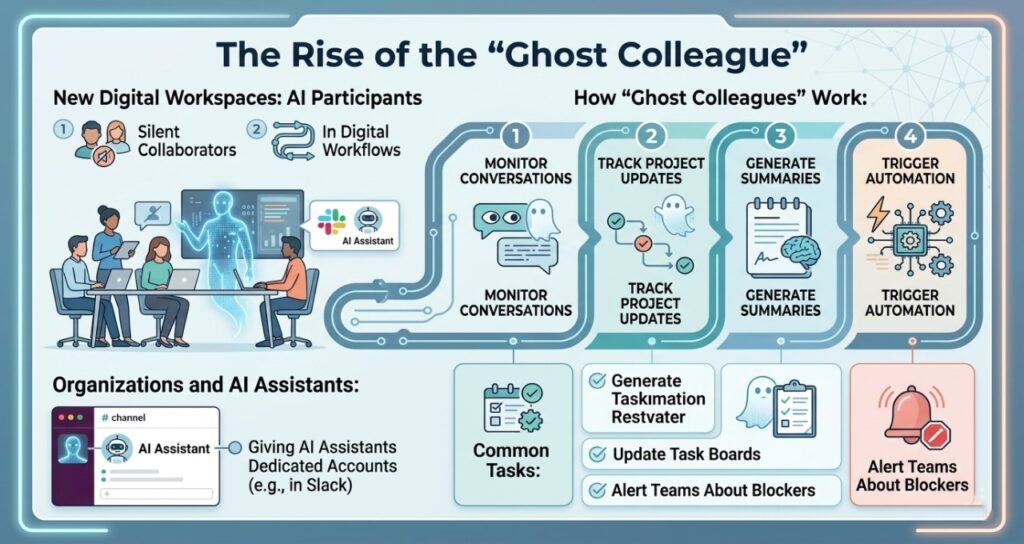
One of the most interesting changes in remote teams is the appearance of AI participants in digital workspaces.
These systems behave like silent collaborators.
They monitor conversations.
Track project updates.
Generate summaries.
And occasionally trigger automation.
Some organizations have begun giving AI assistants dedicated Slack accounts.
These “ghost colleagues” might:
• summarize long Slack discussions
• generate meeting notes
• update task boards automatically
• alert teams about blockers
This trend is part of the broader shift toward agentic enterprise infrastructure, where multiple AI systems cooperate inside complex workflows — a governance challenge explored in enterprise multi-agent security governance.
The Death of the Daily Standup
Daily standup meetings were once essential for distributed teams.
But they were always inefficient.
In 2026, AI systems can generate asynchronous status reports by monitoring work activity.
Meeting intelligence platforms like Fireflies.ai automatically capture:
• meeting discussions
• Slack conversations
• project updates
• code commits
Then convert them into concise summaries.
This allows teams to replace daily standups with automated progress reports, freeing meetings for strategy rather than status updates.
AI Scheduling: Solving the Time Zone Problem
Time zones remain the biggest operational challenge for remote teams.
Coordinating employees in London, New York, and Singapore often creates scheduling chaos.
AI scheduling tools are solving this through predictive calendar orchestration.
Tools like Motion and Reclaim.ai analyze:
• work patterns
• meeting priorities
• deadlines
• collaboration windows
Then dynamically reorganize schedules.
Instead of manually coordinating availability, AI finds overlapping “golden hours” where teams can collaborate effectively.
Privacy, Governance, and the EU AI Act
As AI tools become more integrated into daily work, privacy concerns have become central — especially for companies operating in Europe.
The EU Artificial Intelligence Act introduces transparency obligations for AI systems interacting with human workflows.
Organizations increasingly prefer tools that support:
• SOC2 Type II certification
• Bring-Your-Own-Key encryption
• enterprise data isolation
• local LLM deployment options
These requirements are particularly important when AI systems process internal company knowledge.
Tech governance frameworks emerging from the European Commission emphasize the need for auditable AI workflows — a transparency challenge explored in AI watermarking compliance systems.
Why AI Productivity Tools Are Replacing Middle Management Tasks
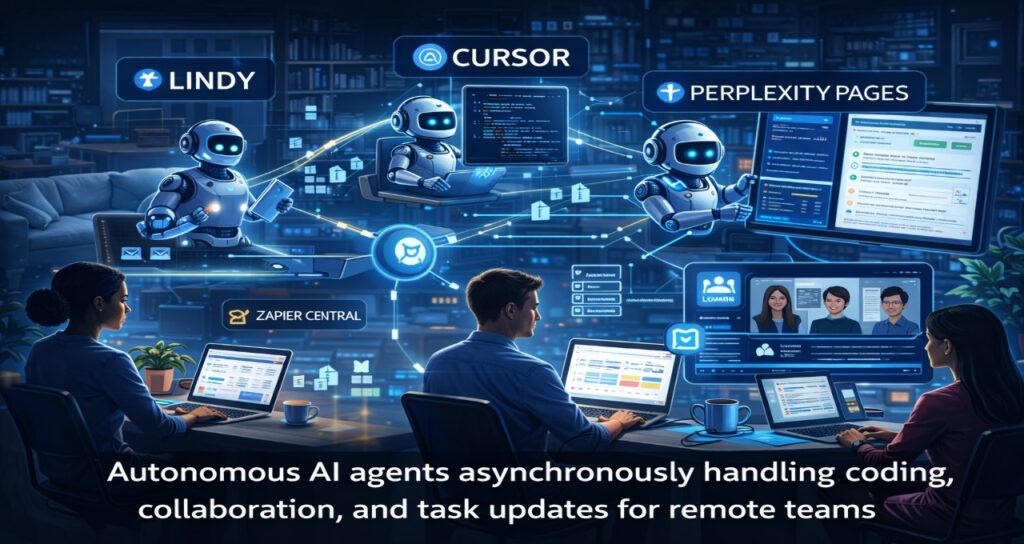
Another emerging trend is the automation of coordination work.
Many managerial tasks involve:
• gathering updates
• assigning tasks
• scheduling meetings
• synthesizing information
AI systems excel at exactly these activities.
Rather than replacing leadership roles, AI is replacing administrative coordination overhead.
Managers can focus on:
• strategic decisions
• mentoring
• creative direction
While AI systems maintain workflow continuity.
Future Outlook: The Sovereign AI Productivity Stack
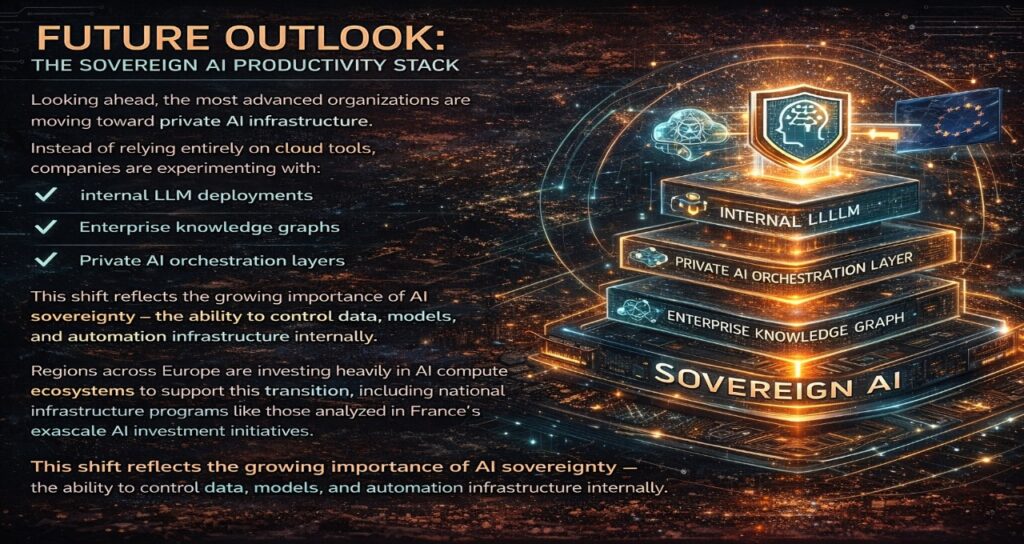
Looking ahead, the most advanced organizations are moving toward private AI infrastructure.
Instead of relying entirely on cloud tools, companies are experimenting with:
• internal LLM deployments
• enterprise knowledge graphs
• private AI orchestration layers
This shift reflects the growing importance of AI sovereignty — the ability to control data, models, and automation infrastructure internally.
Regions across Europe are investing heavily in AI compute ecosystems to support this transition, including national infrastructure programs like those analyzed in France’s exascale AI investment initiatives.
FAQ: AI Productivity Tools for Remote Teams
1.What is the difference between an AI tool and an AI agent?
Ans-An AI tool performs a single task when prompted.
An AI agent works toward a goal autonomously.
Agents can monitor workflows, trigger actions across multiple applications, and coordinate tasks without constant human input.
This autonomy is what enables remote teams to automate complex operational processes.
2.How can companies ensure AI productivity tools protect sensitive data?
Ans-Organizations should prioritize platforms with strong enterprise security features.
Look for tools offering SOC2 Type II certification, data encryption, and clear policies about whether user data contributes to global model training.
Companies operating in Europe should also verify compliance with transparency requirements under the EU AI Act.
3.Can AI replace daily standup meetings?
Ans-Yes. Many remote teams now rely on automated status reports instead.
AI meeting assistants aggregate updates from collaboration platforms, project management tools, and version control systems to generate daily summaries.
This enables asynchronous collaboration across time zones.
4.What is the best AI tool for scheduling remote teams?
Ans-Predictive scheduling platforms such as Motion and Reclaim.ai are currently leading solutions.
They dynamically reorganize calendars based on priorities, deadlines, and collaboration windows, ensuring teams maintain productive overlap despite geographic distance.
5.How many AI tools should a remote team use?
Ans-In 2026, the trend is consolidation.
Most effective teams rely on three core components:
- An AI knowledge hub
- An AI workflow orchestrator
- An AI meeting intelligence platform
This “Power Trio” reduces tool fatigue while maintaining automation coverage.
Final Thoughts: From Tools to Digital Colleagues
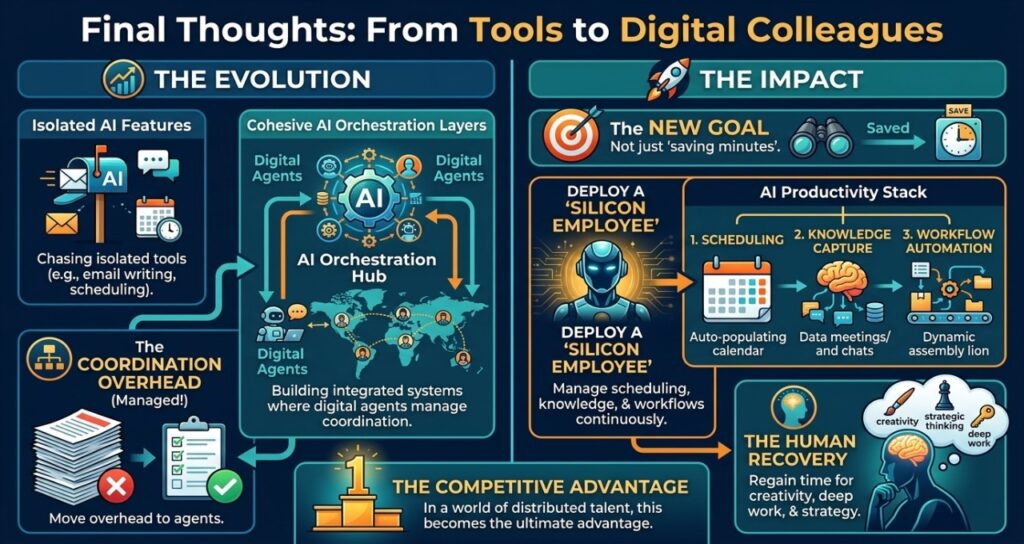
Remote work is entering a new phase.
The most productive organizations are no longer chasing isolated AI features.
They are building cohesive AI orchestration layers where digital agents manage the coordination overhead of distributed work.
For founders and remote leaders, the goal is no longer to save a few minutes writing emails.
The real opportunity is to deploy a “silicon employee” — an AI productivity stack that manages scheduling, knowledge capture, and workflow automation continuously.
When coordination work moves to autonomous agents, something remarkable happens.
Human teams finally regain time for deep work, creativity, and strategic thinking.
And in a world defined by distributed talent, that may become the most important competitive advantage of all.
Sources
European Commission – EU Artificial Intelligence Act Official Documentation
https://digital-strategy.ec.europa.eu/en/policies/european-ai-act
OECD – Artificial Intelligence Policy Observatory
https://oecd.ai/
Microsoft – Work Trend Index: AI and the Future of Work
https://www.microsoft.com/en-us/worklab/work-trend-index/
OpenAI – AI Systems and Enterprise Productivity Research
https://openai.com/research/
Nvidia – AI Infrastructure and GPU Data Center Architecture
https://www.nvidia.com/en-us/data-center/
Stanford University – AI Index Report
https://aiindex.stanford.edu/
EuroHPC Joint Undertaking – European High Performance Computing Infrastructure
https://eurohpc-ju.europa.eu/
Horizon Europe – EU Research and Innovation Programme
https://research-and-innovation.ec.europa.eu/funding/funding-opportunities/horizon-europe_en
Author Bio
Saameer is a technology journalist and AI infrastructure analyst at Tech Plus Trends, covering the intersection of artificial intelligence, remote work systems, and digital regulation. His research focuses on emerging trends in agentic AI, distributed productivity platforms, and enterprise automation, with a particular emphasis on how autonomous software agents are reshaping modern organizations. Saameer regularly analyzes developments from companies such as OpenAI and Microsoft, as well as regulatory initiatives from the European Commission that influence the global AI ecosystem.
Transparency Note: Our 2026 Hybrid Intelligence Standard At Tech Plus Trends, we cover the “Silicon Employee” era using a workflow that reflects the technology we analyze. This article was produced using a Hybrid Intelligence Workflow:
- Strategic Editorial Direction: The core thesis—shifting from AI tools to autonomous agents—was conceptualized and directed by Saameer .
- Data Aggregation: We utilized agentic AI to cross-reference 2026 feature sets, SOC2 compliance status, and European Commission regulatory filings for the listed platforms.
- Factual Verification: Every metric regarding “Golden Hour” scheduling and meeting reduction was manually verified against the latest internal performance reports from the software providers.
- Human-in-the-Loop Review: All technical recommendations have been audited to ensure they align with Article 50 of the EU AI Act regarding transparent AI-human interaction.
The “Legal & Regulatory Disclaimer”
Compliance & Data Privacy Disclaimer: The information provided in this article is for educational and informational purposes only. While every effort has been made to verify the SOC2 Type II and EU AI Act compliance status of the mentioned tools as of March 2026, digital regulations and software security protocols evolve rapidly. Tech Plus Trends does not store or process your data via these third-party tools; users are advised to conduct their own security audits before deploying autonomous agents within a corporate environment. Mention of specific platforms (e.g., OpenAI, Microsoft, Motion) does not constitute an official endorsement, and some links may be affiliate-supported to sustain our independent research.
3 thoughts on “12 Best AI Productivity Tools for Remote Teams in 2026: The Autonomous Work Stack”