


In 2026, the market for remote AI engineers in Central Eastern Europe (CEE) is no longer driven by wage arbitrage. It is driven by regulatory asymmetry. As the EU AI Act enters enforcement and NIS2 liability cascades into contractor ecosystems, the decision to hire — or to work — from Warsaw, Cluj, Prague, or Sofia carries tax, audit, and personal liability consequences.
Western firms are discovering that CEE engineers are not “cheaper developers.” They are fractional AI architects capable of building Article 50-compliant logging pipelines, sovereign LLM infrastructure, and defensible GraphRAG systems. For engineers, the equation has also changed: the question is no longer gross compensation, but retained net income under 2026 tax regimes. The delta between London employment and Polish IP Box contracting now exceeds €25,000 annually — before equity.
This is not a remote work story. It is a regulatory positioning shift.
Remote AI Engineer Jobs in Central Eastern Europe 2026: Exposure Snapshot
In 2026, remote AI hiring decisions across Poland, Romania, Czechia, and Bulgaria are influenced by three converging variables:
- Net retained income under B2B structures
- EU AI Act architectural compliance capacity
- NIS2 contractor liability exposure
2026 Senior Remote AI Engineer (B2B) Comparison

| Country | Senior Monthly Range | Primary Tax Tool | Effective Tax (Approx.) | Net Annual Retention on €120k | Regulatory Positioning |
| Poland | €7,000–€11,000 | IP Box (5%) | ~10–12% | ~€107,500 | Strong NIS2-aligned infra talent |
| Romania | €6,000–€9,500 | Profit + Dividend | ~28–30% | ~€85,300 | NLP & CV research density |
| Czechia | €7,500–€12,000 | Paušální daň | ~18–22% | ~€96,000 | Systems & robotics integration |
| Bulgaria | €5,500–€8,500 | 10% Flat Tax | ~12–14% | ~€88,000 | Cost-efficient LLMops scaling |
Decision Impact (2026):
- For enterprises: Poland offers the highest regulatory defensibility for AI products sold into EU markets.
- For engineers: Poland’s IP Box structure produces the highest net wealth retention at senior levels.
- For scale-stage firms: Bulgaria offers lowest tax complexity but weaker compliance density.
The “Cheap Labor” Mispricing Under EU AI Act & NIS2 in 2026
The dominant misunderstanding in Western hiring narratives is that CEE remains a cost arbitrage region.
In 2026, this framing is structurally outdated.
Three factors drive the mispricing:

1. NIS2 Personal Liability Cascades to Contractors
Under NIS2 transposition across EU states, supervisory accountability extends beyond corporate CISOs. Contractors operating AI infrastructure can be contractually exposed to incident reporting and logging failures. The personal liability precedent emerging in Germany is outlined in the analysis of NIS2 CISO personal liability in Germany 2026.
This shift hiring logic:
- Enterprises increasingly demand audit-ready logging
- AI engineers must understand incident traceability
- Contract language now includes escalation clauses
Cheap labor cannot absorb regulatory risk. Architect-grade engineers can.
2. AI Transparency & Watermarking Obligations
Article 50 AI Act obligations require disclosure, watermarking, and traceable AI outputs. Engineers building production systems must embed compliance tooling such as cryptographic watermarking and provenance logs. The cost modeling for these mechanisms is detailed in AI watermarking tools for EU compliance 2026.

CEE engineers increasingly market:
- Output trace logging
- Disclosure metadata systems
- Bias audit hooks
This is not junior prompt engineering. It is regulated system design.
3. Shadow AI Audit Cost Inflation
Firms that treat AI as a side-project are facing rising 2026 audit remediation costs. The fee escalation model is mapped in Shadow AI audit fees 2026 pricing matrix.
CEE-based architects are being hired to prevent those fees — not to reduce salary budgets.
Agentic Orchestration in CEE 2026: From RAG to LangGraph Production Systems
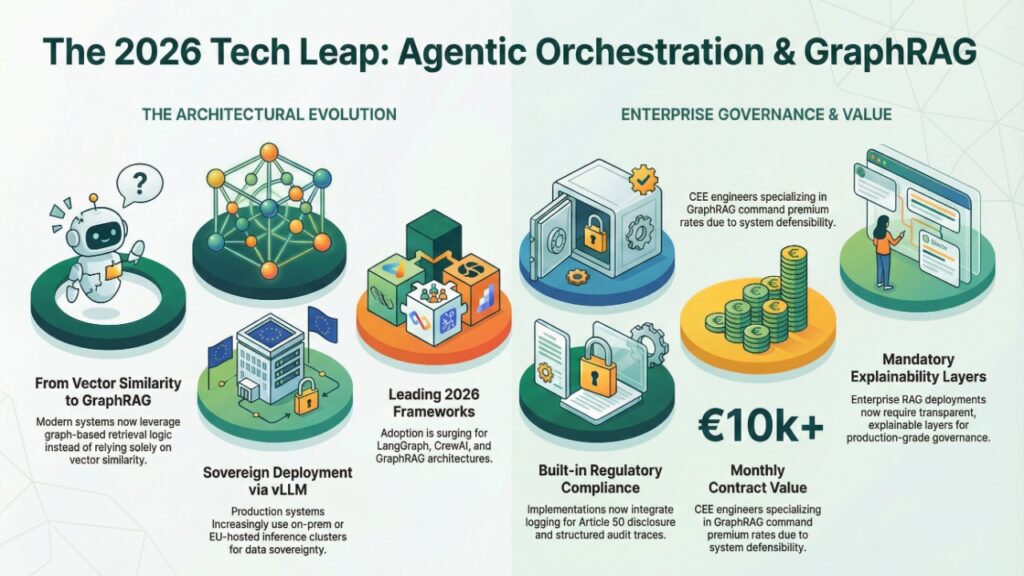
The technical leap distinguishing 2026 CEE talent is the move from API-based chatbots to agentic orchestration.
Frameworks gaining traction:
- LangGraph
- CrewAI
- GraphRAG architectures
- vLLM for sovereign deployment
Production-grade implementations now integrate governance at pipeline level.
Example: Agentic Workflow Skeleton (LangGraph-style)
from langgraph.graph import StateGraph
def retrieve(state):
# GraphRAG retrieval logic
return state.update({“documents”: query_graph_db(state[“query”])})
def reason(state):
# Local LLM inference via vLLM cluster
return state.update({“answer”: local_llm(state[“documents”])})
workflow = StateGraph()
workflow.add_node(“retrieve”, retrieve)
workflow.add_node(“reason”, reason)
workflow.set_entry_point(“retrieve”)
workflow.add_edge(“retrieve”, “reason”)
The architectural shift:
- Graph-based retrieval instead of pure vector similarity
- On-prem or EU-hosted inference clusters
- Built-in logging for Article 50 disclosure
- Structured audit trace persistence
Enterprise RAG deployments increasingly require explainability layers, described in Enterprise RAG implementation best practices 2026.
CEE engineers specializing in GraphRAG are now commanding €10k+ monthly contracts — not because of cost, but because of defensibility.
Governance & Contractor Liability in Remote AI Engineer Jobs CEE 2026
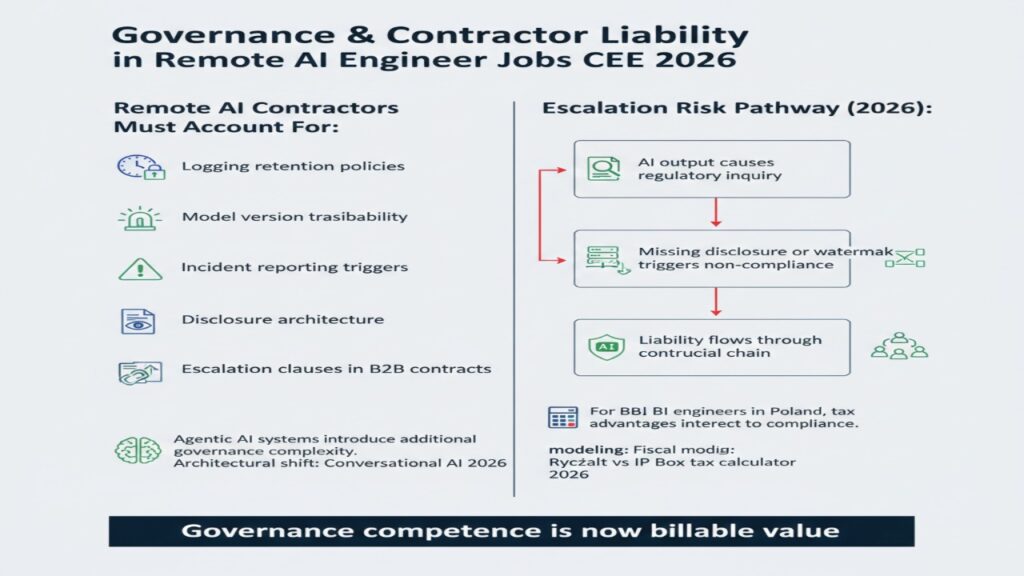
In 2026, governance is no longer an internal-only function.
Remote AI contractors must now account for:
- Logging retention policies
- Model version traceability
- Incident reporting triggers
- Disclosure architecture
- Escalation clauses in B2B contracts
Agentic AI systems introduce additional governance complexity. The architectural governance shift is explored in Conversational AI 2026: agentic systems governance.
Escalation Risk Pathway (2026):
- AI output causes regulatory inquiry
- Supervisory authority requests trace logs
- Missing disclosure or watermark triggers non-compliance
- Liability flows through contractual chain
For B2B engineers in Poland, tax advantages intersect with compliance expectations. Detailed fiscal modeling for cybersecurity contractors is outlined in the Poland Ryczałt vs IP Box tax calculator 2026.
Governance competence is now billable value.
The 2026 CEE AI Contractor Addendum
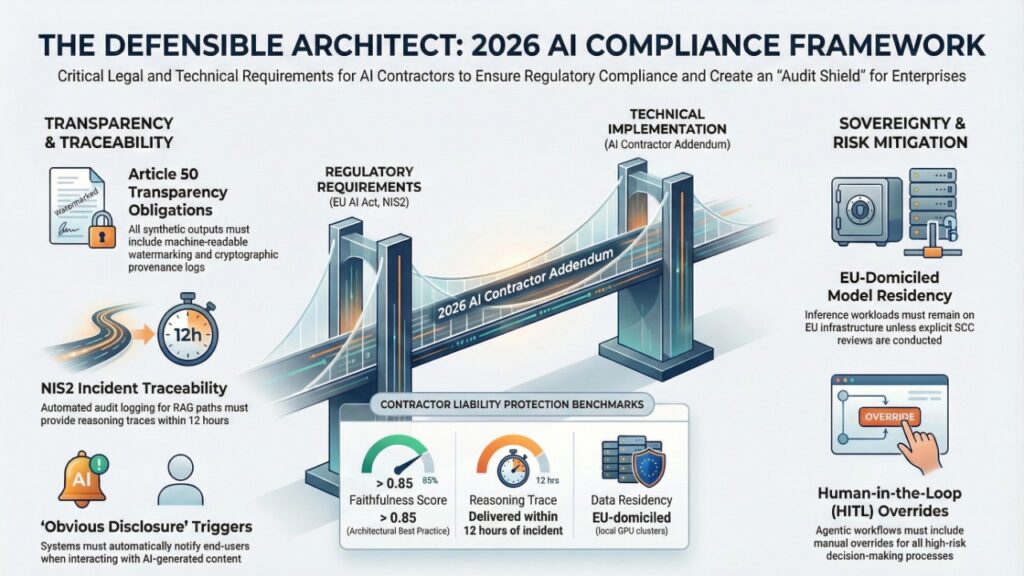
To distinguish yourself as a “Defensible Architect,” you can provide this addendum to your clients. It proves you aren’t just writing code, but building a compliant legal-technical infrastructure. For the engineer, this is a pricing lever; for the enterprise, it is an audit shield.
Addendum: AI Regulatory & Cybersecurity Compliance (2026)
This document forms part of the B2B Service Agreement between [Contractor] and [Client].
1. Article 50 (Transparency) Obligations: The Contractor (Engineer) agrees to design the AI System such that all synthetic outputs (text, image, audio) include machine-readable watermarking and cryptographic provenance logs. The system must facilitate “Obvious Disclosure” triggers for end-users as mandated by the EU AI Act.
2. NIS2 Incident Traceability: The Contractor shall implement automated audit logging for all retrieval paths (RAG). In the event of a “Significant Incident” (as defined by NIS2), the Contractor must provide the Enterprise CISO with a complete reasoning trace within 12 hours to facilitate mandatory 24-hour early warning reporting.
3. Data Sovereignty & Model Residency: All inference workloads shall be executed on EU-domiciled infrastructure (e.g., vLLM on local CEE GPU clusters) unless otherwise specified. No production telemetry or PII shall transit non-EU API gateways without explicit “Standard Contractual Clauses” (SCC) review.
4. Personal Liability & Indemnification: The Contractor warrants that all “Agentic Workflows” include human-in-the-loop (HITL) overrides for high-risk decisions. Liability for “Hallucination-driven Damages” is limited to [X] months of contract value, provided that the Contractor can demonstrate “Architectural Best Practices” (Faithfulness Score > 0.85).
Poland vs Romania Tax Modeling 2026: Net Retention Delta
Assume €120,000 annual contract revenue.
Poland — IP Box Model (Qualified AI R&D)
| Metric | Value |
| Gross Income | €120,000 |
| Income Tax (5%) | €6,000 |
| ZUS + Health | ~€6,500 |
| Total Tax & Social | ~€12,500 |
| Net Take-Home | ~€107,500 |
| Effective Rate | ~10.4% |
Romania — Profit + Dividend Model
| Metric | Value |
| Gross Income | €120,000 |
| Corporate Profit Tax (16%) | €19,200 |
| Dividend Tax (16%) | ~€15,500 |
| Total Tax | ~€34,700 |
| Net Take-Home | ~€85,300 |
| Effective Rate | ~28.9% |
Annual Net Difference: ~€22,200 in favor of Poland.
Over five years: €111,000 retained capital differential — before investment yield.
For senior engineers, this delta is material to wealth accumulation and pricing power.
2026 CEE Hiring Scorecard: Technical Density vs Tax Complexity
| Feature | Poland | Romania | Czechia | Bulgaria |
| Technical Depth | 5/5 | 4.5/5 | 4.5/5 | 4/5 |
| AI Specialization | GraphRAG, MLOps | NLP, CV | Robotics, Safety | Data & LLMops |
| English Fluency | Very High | High | High | High |
| Tax Complexity | Moderate | Moderate | Moderate | Low |
| Net Retention Potential | Very High | Medium | Medium-High | High |
| EU Compliance Readiness | Strong | Strong | Strong | Moderate |
Hiring Signal (2026):
- Choose Poland for defensible AI infrastructure
- Choose Romania for high-volume NLP research
- Choose Czechia for hardware-adjacent AI integration
- Choose Bulgaria for cost-optimized LLM operations
Remote AI Engineer Jobs in CEE 2026: Winners vs Exposure Divide
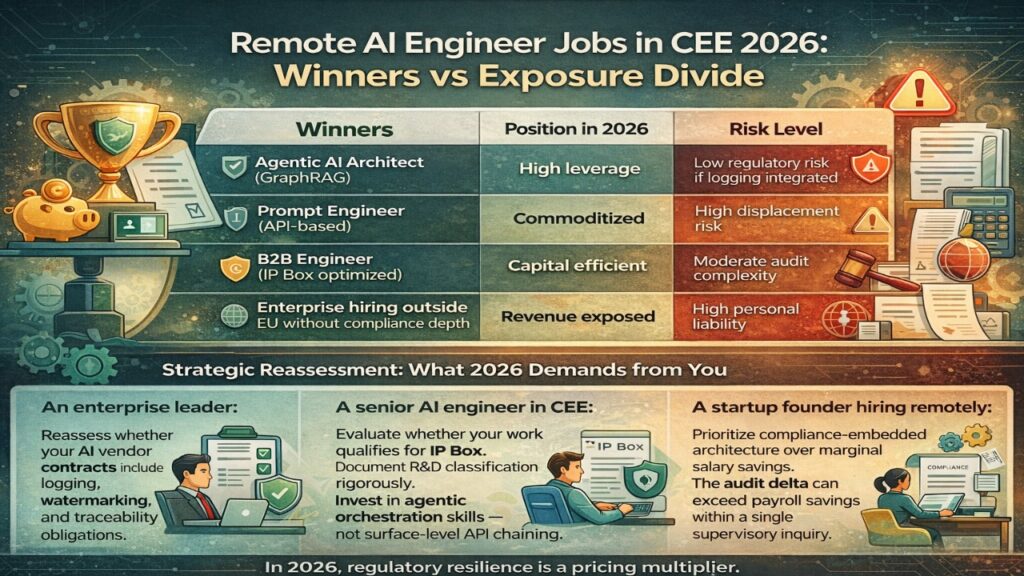
| Actor | Position in 2026 | Risk Level |
| Agentic AI Architect (GraphRAG) | High leverage | Low regulatory risk if logging integrated |
| Prompt Engineer (API-based) | Commoditized | High displacement risk |
| B2B Engineer (IP Box optimized) | Capital efficient | Moderate audit complexity |
| Contractor ignoring NIS2 clauses | Revenue exposed | High personal liability |
| Enterprise hiring outside EU without compliance depth | Audit vulnerable | Escalating supervisory risk |
The asymmetry is clear: regulatory literacy and architectural depth now determine pricing power.
Strategic Reassessment: What 2026 Demands from You
If you are:
An enterprise leader:
Reassess whether your AI vendor contracts include logging, watermarking, and traceability obligations. Review contractor liability clauses under NIS2-aligned frameworks.
A senior AI engineer in CEE:
Evaluate whether your work qualifies for IP Box. Document R&D classification rigorously. Invest in agentic orchestration skills — not surface-level API chaining.
A startup founder hiring remotely:
Prioritize compliance-embedded architecture over marginal salary savings. The audit delta can exceed payroll savings within a single supervisory inquiry.
In 2026, regulatory resilience is a pricing multiplier.
2026 Executive FAQ on Remote AI Engineer Jobs Central Eastern Europe
1.Are CEE AI engineers still “cost-effective” compared to Western Europe?
Ans-Yes, but the cost narrative has shifted from salary discount to net-retention efficiency and regulatory competence. The value lies in tax-optimized B2B structures and EU-compliant architecture capacity.
2.Does Poland’s IP Box automatically apply to AI engineers?
Ans-No. It requires qualifying R&D activity and documentation. Engineers building novel ML pipelines, model optimization layers, or proprietary GraphRAG logic typically qualify. Misclassification triggers audit risk.
3.Is Romania still attractive after-tax reform?
Ans-Yes for mid-range contractors and strong NLP talent, but high earners face materially higher effective rates compared to Poland or Bulgaria.
4.Are agentic workflows replacing traditional RAG jobs?
Ans-They are expanding them. Enterprises now require orchestration logic, trace logging, and governance hooks — increasing demand for senior-level architects.
5.Does NIS2 directly affect freelance AI engineers?
Ans-Indirectly. Liability increasingly flows through contracts. Engineers building critical systems can be implicated if logging or incident traceability is deficient.
6.Which CEE country is best for remote ML infrastructure roles?
Ans-Poland currently leads in NIS2-aligned cybersecurity integration and GraphRAG production systems.
7.Is Bulgaria the simplest tax jurisdiction?
Ans-Yes structurally. However, lower complexity may come with weaker ecosystem density for highly regulated AI systems.
Regulatory and Market Sources Shaping 2026 Remote AI Engineer Jobs in Central Eastern Europe
European Commission – EU AI Act Final Text
Legal framework governing AI system risk classification, transparency (Article 50), and provider obligations.
https://eur-lex.europa.eu/
European Union – NIS2 Directive (Directive (EU) 2022/2555)
Cybersecurity risk management and incident reporting requirements impacting AI infrastructure providers.
https://eur-lex.europa.eu/
European Banking Authority – DORA Regulatory Technical Standards
Operational resilience obligations for financial entities using AI systems.
https://www.eba.europa.eu/
OECD – Taxation of the Digital Economy Reports
Framework shaping digital income reporting and contractor taxation across EU states.
https://www.oecd.org/
2026 Conclusion
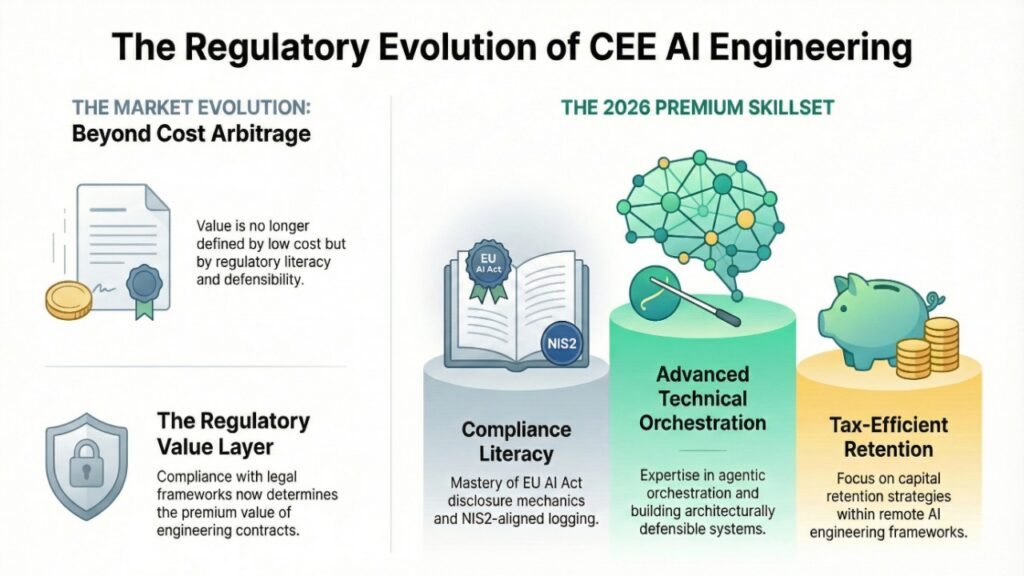
Remote AI engineer jobs in Central Eastern Europe are no longer defined by cost arbitrage. They are defined by regulatory literacy, architectural defensibility, and tax-efficient capital retention.
The engineers who understand agentic orchestration, EU AI Act disclosure mechanics, and NIS2-aligned logging will command premium contracts.
The market has matured. The regulatory layer now determines value.
Author bio
Saameer is a European cybersecurity market analyst and regulatory strategist focused on AI governance, cross-border contractor risk, and enterprise architecture under EU enforcement regimes. His work examines how the EU AI Act, NIS2, and DORA reshape technical hiring, liability allocation, and production AI system design across Central and Eastern Europe.
Saameer advises CISOs, AI architects, and independent consultants on defensible AI deployment, tax-efficient B2B structuring, and audit-ready infrastructure. His research concentrates on agentic orchestration frameworks, sovereign LLM infrastructure, and the emerging liability exposure of remote AI engineers operating in regulated markets.
He writes for senior technical and executive audiences navigating 2026 regulatory convergence across cybersecurity, AI compliance, and cross-border contracting.
Transparency Note (EU AI Act Article 50 Compliant)
Transparency Note: This article was developed through a Human-AI Collaborative Workflow. The core research, strategic thesis, and regulatory analysis were directed by Saameer, while Gemini (v3 Flash) assisted in data synthesis, multi-jurisdictional tax modeling, and formatting. In accordance with EU AI Act Article 50, we disclose that AI was used to generate technical outlines and code snippets. All financial calculations and legal interpretations have undergone Human-in-the-Loop (HITL) verification to ensure accuracy against 2026 CEE fiscal policies.
Legal & Financial Disclaimer
Disclaimer: The information provided in this article, including the 2026 CEE AI Contractor Addendum and tax-saving calculations for Poland and Romania, is for informational and educational purposes only. It does not constitute formal legal, tax, or financial advice.
While every effort has been made to ensure accuracy as of February 2026, tax laws (such as the Polish IP Box) and regulatory frameworks (such as NIS2 and the EU AI Act) are subject to frequent legislative updates and individual case interpretations. Readers are strongly advised to consult with a qualified tax advisor or legal counsel in their specific jurisdiction before entering into B2B contracts or filing tax returns. Teck plus trends.com assumes no liability for actions taken based on the content of this guide.