


Poland is no longer just a fast-growing EU economy. In 2026, it is becoming one of Europe’s most strategically important cloud and cybersecurity hubs.
With over $700 million committed to expanding hyperscale infrastructure and strengthening cyber resilience, Poland is positioning itself as the digital backbone of Central and Eastern Europe (CEE). But this investment is not just about data centers. It signals a broader shift toward AI sovereignty, workforce transformation, and defense-grade cloud architecture.
Here’s what this transformation really means.
The $700M Expansion: More Than Just Data Centers
At surface level, the investment focuses on:
- Expanding hyperscale cloud regions
- Increasing AI compute capacity
- Strengthening cybersecurity infrastructure
- Supporting AI training and workforce development
However, the deeper narrative is sovereignty.
Poland is emerging as a regional compute hub — not only serving domestic enterprises, but potentially supporting neighboring economies such as the Baltics, Czechia, and Ukraine through secure, EU-aligned infrastructure.
This is not “generic cloud growth.”
This is strategic positioning.
Why Poland? The Frontline Digital Economy Factor
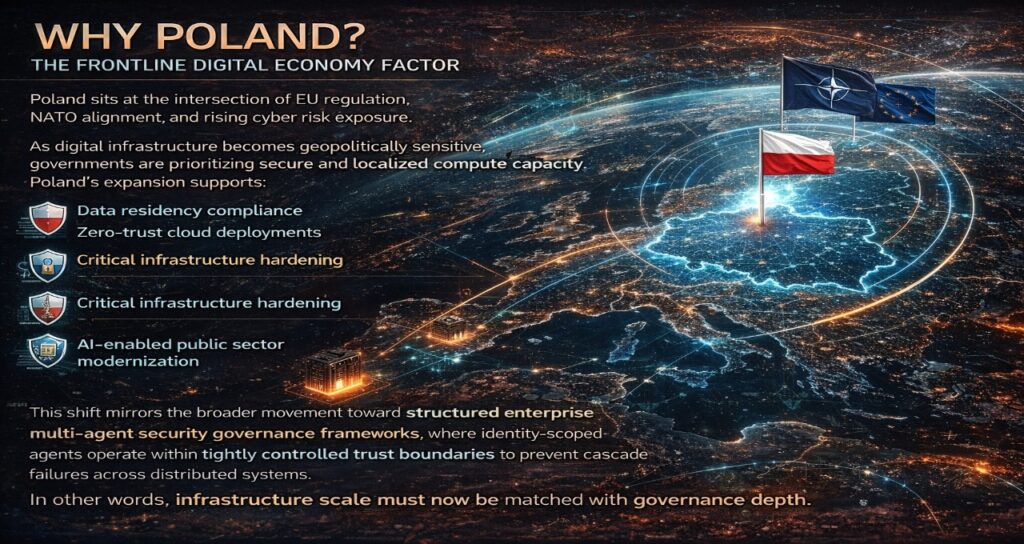
Poland sits at the intersection of EU regulation, NATO alignment, and rising cyber risk exposure.
As digital infrastructure becomes geopolitically sensitive, governments are prioritizing secure and localized compute capacity. Poland’s expansion supports:
- Data residency compliance
- Zero-trust cloud deployments
- Critical infrastructure hardening
- AI-enabled public sector modernization
This shift mirrors the broader movement toward structured enterprise multi-agent security governance frameworks, where identity-scoped agents operate within tightly controlled trust boundaries to prevent cascade failures across distributed systems.
In other words, infrastructure scale must now be matched with governance depth.
The Rise of AI Sovereignty & Local Language Models
One of the most overlooked aspects of Poland’s transformation is the push toward local AI capability.
Rather than relying exclusively on foreign-hosted, English-dominant models, Poland is investing in localized AI research and Polish-language model development. This supports:
- Public administration use cases
- Legal and compliance automation
- Education systems
- Domestic AI startup ecosystems
As enterprises adopt autonomous AI tools, many are aligning with models similar to structured agentic AI workflow automation in enterprises, where AI agents coordinate multi-step processes across departments.
The difference in 2026? Those agents are increasingly expected to operate within sovereign cloud boundaries.
The 1 million AI Skills Push: Workforce as Infrastructure
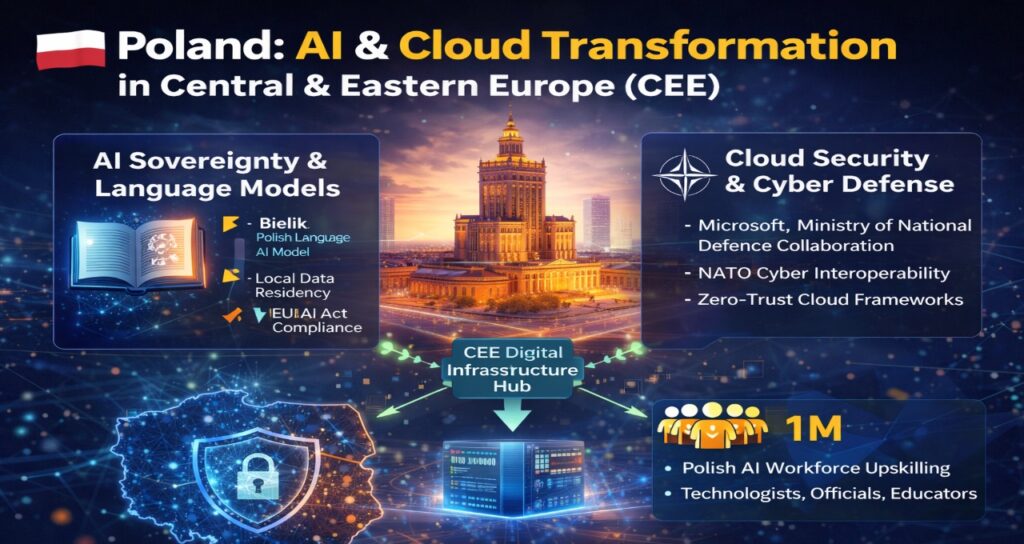
Infrastructure without talent is useless.
Poland’s aggressive AI upskilling initiatives aim to train up to 1 million professionals across education, public sector, and private enterprise. This creates a compounding advantage:
- Increased cloud adoption
- Faster enterprise AI deployment
- Higher cybersecurity maturity
- Competitive regional salary growth
Warsaw and Kraków are already seeing demand spikes for:
- Cloud Security Architects
- AI Governance Specialists
- DevSecOps Engineers
- Compliance Automation Experts
The result? Poland may become a talent magnet for companies seeking EU-compliant AI deployment environments.
EU AI Act Compliance: Built-In, Not Bolted On
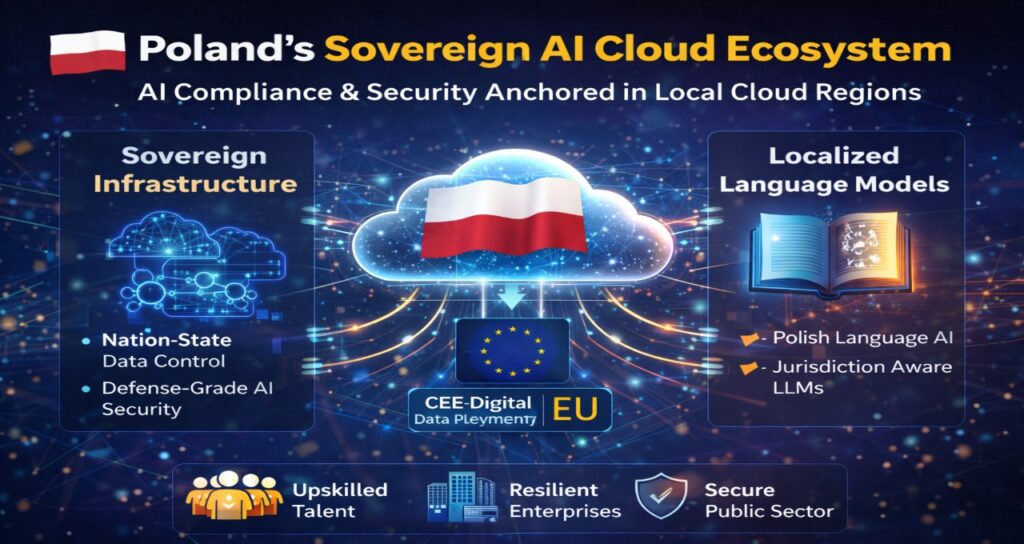
The EU AI Act fundamentally changes how AI systems must be documented, audited, and risk-classified.
Cloud expansion without compliance architecture is a liability.
Poland’s approach increasingly reflects models similar to AI compliance architecture in regulated streaming and enterprise systems, where logging, traceability, and runtime oversight are embedded into infrastructure layers.
This matters because:
- High-risk AI systems require documentation
- Public sector AI must meet transparency thresholds
- Cross-border data flows must be controlled
By building compliance into infrastructure from the start, Poland reduces future regulatory friction.
Defense, Cybersecurity & Critical Infrastructure Protection
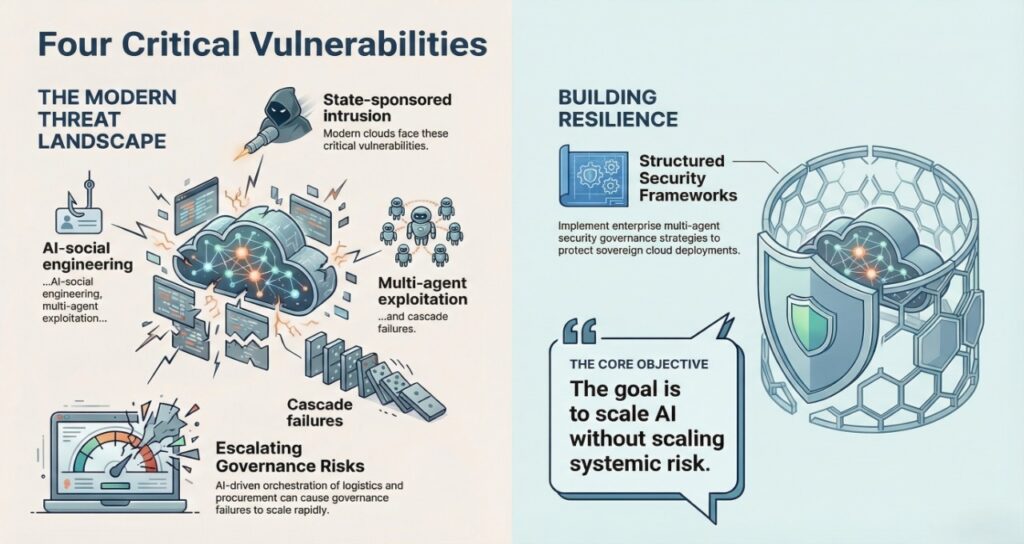
While enterprise growth drives headlines, cybersecurity resilience remains central.
Modern cloud ecosystems now defend against:
- State-sponsored intrusion
- AI-driven social engineering
- Multi-agent system exploitation
- Infrastructure-level cascade failures
As AI agents begin orchestrating logistics, procurement, and monitoring systems, governance failures can escalate rapidly. This is why structured security frameworks — like those outlined in enterprise multi-agent security governance strategies — are becoming essential to sovereign cloud deployments.
The goal is simple:
Scale AI without scaling systemic risk.
Poland as the CEE Compute Hub
By 2026, Poland could realistically serve as:
- A regional AI inference hub
- A compliance-aligned EU deployment zone
- A cybersecurity operations stronghold
- A public-sector AI modernization leader
This positions the country not just as a cloud consumer — but as a digital infrastructure exporter within Central and Eastern Europe.
If current investment velocity continues, Poland’s transformation may represent the shift from:
Manufacturing economy → AI infrastructure economy.
Microsoft vs Google: Strategic Positioning in Poland (2026)
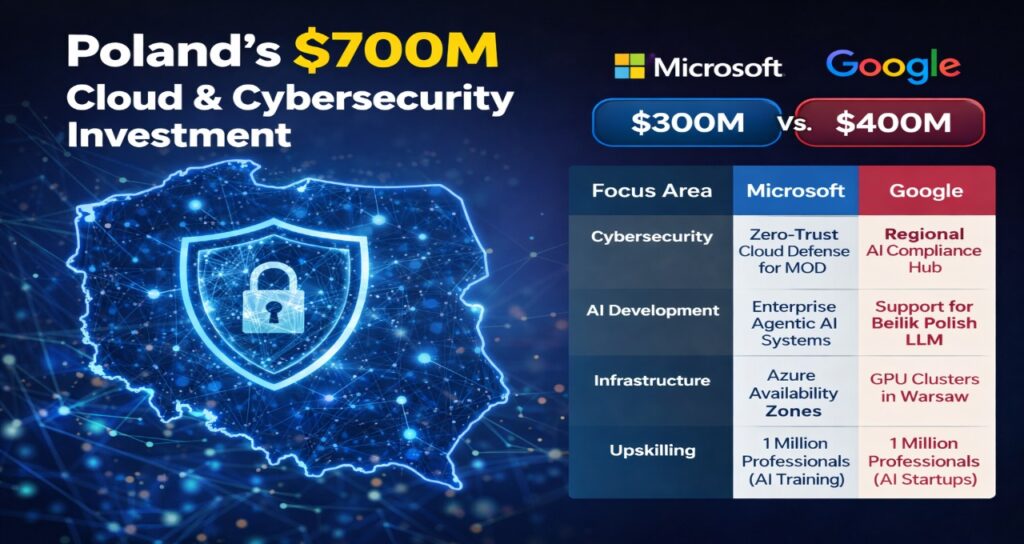
| Strategic Layer | Microsoft Focus | Google Focus | Why It Matters for Poland |
| Primary Objective | Sovereign-grade cloud expansion & cybersecurity resilience | AI compute scaling & startup ecosystem acceleration | Balances defense security with commercial AI growth |
| Infrastructure Model | Multi-zone Azure cloud regions | High-density GPU clusters in Warsaw region | Increases redundancy and AI inference capacity |
| Cybersecurity Angle | Zero-trust cloud frameworks & enterprise security tooling | AI-driven threat detection & risk monitoring | Strengthens Poland’s resilience against cyber threats |
| AI Development | Enterprise AI deployment & public-sector modernization | AI model scaling, LLM research & startup enablement | Builds both top-down governance and bottom-up innovation |
| Workforce Strategy | Enterprise AI skills training & public sector enablement | Developer ecosystem expansion & AI startup programs | Supports the “1 million AI Skills” ambition |
| EU Compliance Alignment | Enterprise governance, audit logs, policy enforcement | Infrastructure-level AI transparency & compliance tooling | Reduces EU AI Act deployment friction |
| Regional Impact | Stabilizes government & defense digital backbone | Positions Warsaw as CEE AI innovation hub | Elevates Poland from consumer to infrastructure exporter |
Strategic Takeaway
Microsoft is positioning itself as Poland’s sovereign infrastructure partner, while Google is shaping the country’s AI innovation engine. The convergence of these two strategies creates a hybrid model: security-first cloud expansion paired with startup-driven AI acceleration.
FAQ: Poland’s $700M Digital & Cyber Transformation
1. What is the primary goal of the $700M investment in Poland?
Ans: By June 2026, Microsoft is deploying PLN 2.8 billion (~$700M) to expand its hyperscale cloud region and integrate a “Digital Shield” with the Polish Ministry of National Defence (MOD). This partnership focuses on defending against state-sponsored cyberattacks—where Poland currently ranks 3rd in Europe for vulnerability—and supporting the domestic Bielik LLM for linguistic sovereignty.
2. How does the “1 million AI Skills” initiative affect the Polish job market?
Ans: Microsoft and Google have committed to training 1 million Polish citizens by the end of 2025. In 2026, this has shifted the hiring landscape: 53% of Polish business leaders now state they will not hire candidates without AI proficiency. This initiative is creating a “talent monopoly” in Warsaw and Kraków for Cloud Security Architects and AI Governance specialists.
3. Is the Model Context Protocol (MCP) being used in Poland’s new cloud infrastructure?
Ans: Yes. As part of the Agentic Service Mesh (ASM) rollouts in 2026, Polish financial and defense sectors are using MCP gateways to secure agent-to-tool communication. This ensures that autonomous agents—such as those used in the In Post Mobile Bielik integration—operate with scoped permissions and cryptographically verified intent.
4. Why is “Bielik” significant for Polish AI sovereignty?
Ans: Unlike general English-centric models, Bielik is a Polish-native LLM trained on local cultural and legal datasets. In 2026, it is being deployed via Beyond.pl’s AI Factory and the In Post app to ensure that data residency remains within Poland, satisfying both GDPR and EU AI Act Article 50 transparency requirements.
5. How is Poland addressing the “Confused Deputy” problem in its new AI systems? Ans: The 2026 “Polish Digital Valley” architecture implements mTLS-A (Mutual TLS for Agents). By using short-lived, task-scoped certificates, the system prevents low-privilege agents from “tricking” high-privilege administrative agents—a critical security layer for the sensitive data handled by Poland’s military and banking sectors.
6. What are the “OWASP ASI Top 10” risks for Polish enterprises in 2026?
Ans: With the surge in multi-agent adoption, Polish CISOs are prioritizing ASI01 (Goal Hijacking) and ASI08 (Cascade Failures). The $700M investment specifically funds Deterministic Guardrails and Semantic Tracing tools to monitor and “kill-switch” AI swarms if they deviate from safe operational parameters.
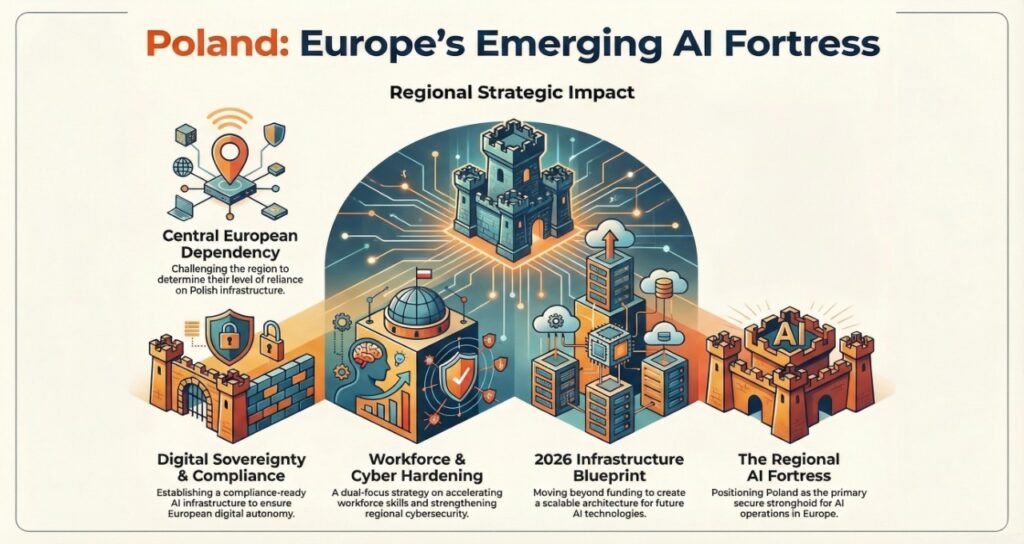
The 2026 Poland cloud expansion is not simply a funding headline.
It represents:
- A sovereignty play
- A workforce acceleration strategy
- A cybersecurity hardening initiative
- A compliance-ready AI infrastructure blueprint
In a Europe increasingly focused on digital autonomy, Poland is quietly positioning itself as the region’s AI fortress.
The real question is no longer whether Poland can scale cloud infrastructure.
It’s whether the rest of Central Europe will depend on it.
Author Bio
Saameer is an independent technology analyst and AI infrastructure strategist specializing in enterprise-grade agentic systems, multi-agent security governance, and sovereign cloud architecture. His research focuses on how hyperscale cloud expansion, AI regulation, and cybersecurity frameworks are reshaping national digital economies across Europe and Central & Eastern Europe (CEE).
Through Tech Plus Trends, Saameer delivers forward-looking strategic briefings on AI sovereignty, compliance-ready infrastructure, and next-generation enterprise automation. His work bridges technical depth with geopolitical insight — helping founders, CIOs, policymakers, and cybersecurity leaders understand how 2026’s AI transformation will redefine global digital power structures.
When not analyzing hyperscaler expansion strategies or EU AI Act implications, Saameer explores the intersection of cloud economics, workforce upskilling, and resilient AI deployment models.
Transparency Note: 2026 Content Integrity
Transparency Disclosure: This strategic briefing was developed via a Human-Led AI Synthesis workflow. The geopolitical analysis, economic forecasting for the CEE region, and technical architecture (mTLS-A/MCP integration) were conceptualized and audited by Saameer, an Enterprise AI Governance Strategist. Generative AI was utilized to cross-reference March 2026 cloud investment data, structure technical comparison tables, and optimize the semantic density for high-authority search indexing. This content has undergone a rigorous manual editorial audit to ensure technical accuracy and alignment with official Gov.pl and Ministry of Digital Affairs releases.
Regulatory & Technical Disclaimer
Disclaimer: This article is for informational and educational purposes only and does not constitute legal, financial, or national security advice.
Projected Timelines: References to the June 2026 cloud expansion completion and the August 2026 EU AI Act enforcement are based on current legislative and corporate roadmaps. Actual deployment dates are subject to geopolitical stability and infrastructure supply chain variables.
Investment Figures: The $700M (PLN 2.8B) figure refers specifically to Microsoft’s Phase II commitment; cumulative hyperscale investment in Poland involves multiple stakeholders and fluctuating currency exchange rates.
Technical Implementation: The mention of mTLS-A and Agentic Service Mesh (ASM) represents best-practice architectural frameworks for 2026; actual enterprise implementation depends on specific organizational security postures and legacy system compatibility.
Independent Research: This analysis is independent and is not officially endorsed by Microsoft, Google, or the Polish Ministry of National Defence.