
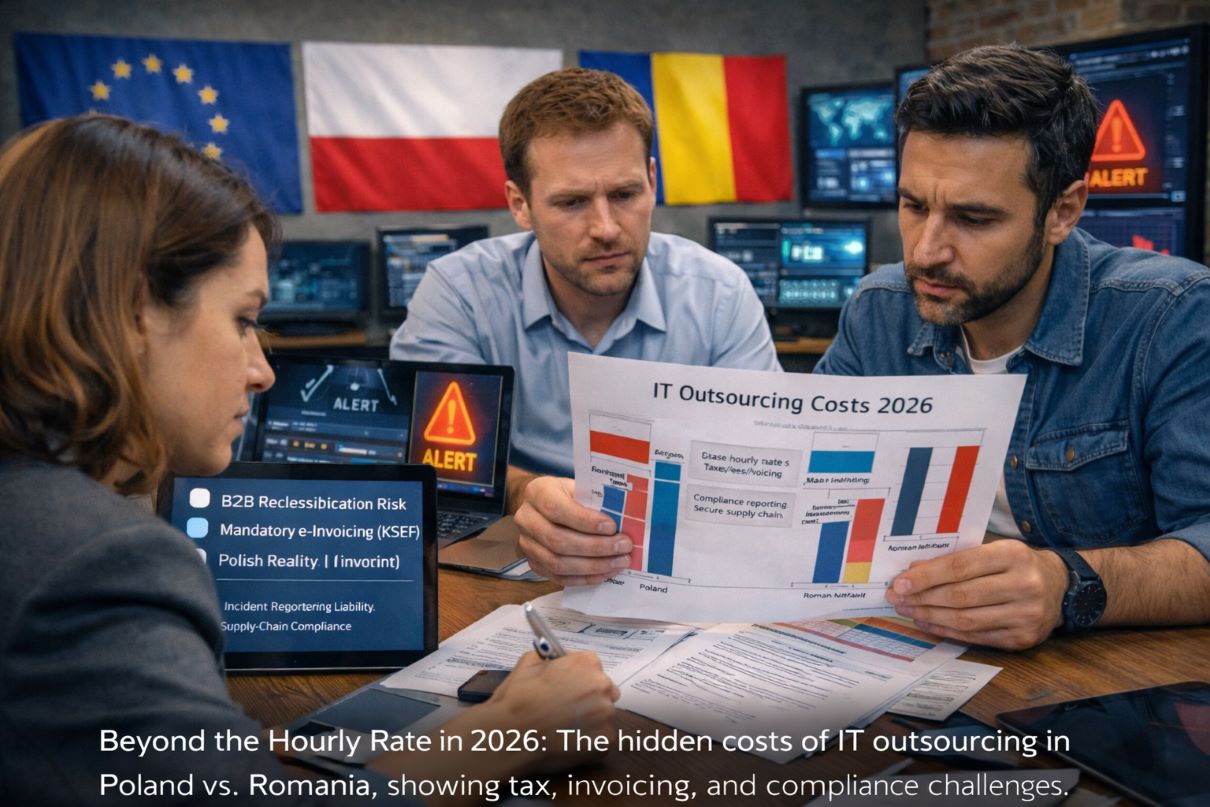
Why This Comparison Matters Now
In 2026, outsourcing decisions are no longer driven by salary arbitrage alone. For UK and US technology leaders, the question is not where developers are cheaper—but where regulatory friction, compliance exposure, and operational drag will quietly surface months after a contract is signed.
Poland and Romania remain two of Europe’s most frequently shortlisted IT outsourcing destinations. Both offer strong engineering talent, EU-aligned legal systems, and mature nearshore ecosystems. Yet beneath similar hourly rate tables lies a widening divergence in true delivery cost, driven by labor enforcement reform, cybersecurity liability expansion, and fiscal digitalization mandates that did not meaningfully exist even in 2024.
The risk in 2026 is not choosing the wrong country. It is choosing based on outdated assumptions.
Information Gain: The “True Cost” Shift Most Comparisons Miss
Most outsourcing guides still frame cost as a function of hourly rates. That framing is now structurally obsolete.
In 2026, regulatory gravity—not wages—determines outsourcing efficiency. Costs increasingly emerge from:
- Immediate labor-law enforceability
- Mandatory fiscal infrastructure (e-invoicing, audit APIs)
- Supply-chain cybersecurity liability
These costs do not appear on invoices. They appear in execution drag, contract renegotiation, and management overhead.
Deep Analysis: Where the Hidden Costs Actually Appear in 2026
1. Poland’s Labor Reform Is Now Enforceable Law (The PIP Shift)
Until recently, Poland’s B2B contractor scrutiny was framed as a future risk. In 2026, it is a present legal reality.
As of January 1, 2026, Poland’s National Labour Inspectorate (PIP) gained the authority to administratively reclassify B2B contracts into employment status without a court ruling. This is a fundamental shift.
Why this matters operationally:
- Reclassification is immediately enforceable
- ZUS (social security) contributions must be paid at once, even if the company appeals
- Foreign clients often inherit the financial and contractual impact indirectly through revised invoices or forced employment restructuring
This transforms Poland’s cost profile. What once appeared as a stable B2B ecosystem now carries embedded legal volatility, particularly for long-running engagements and team scaling.
This is the single largest hidden cost increase for Poland in 2026.
2. The KSeF Mandate: Poland’s Fiscal Digitalization Cost
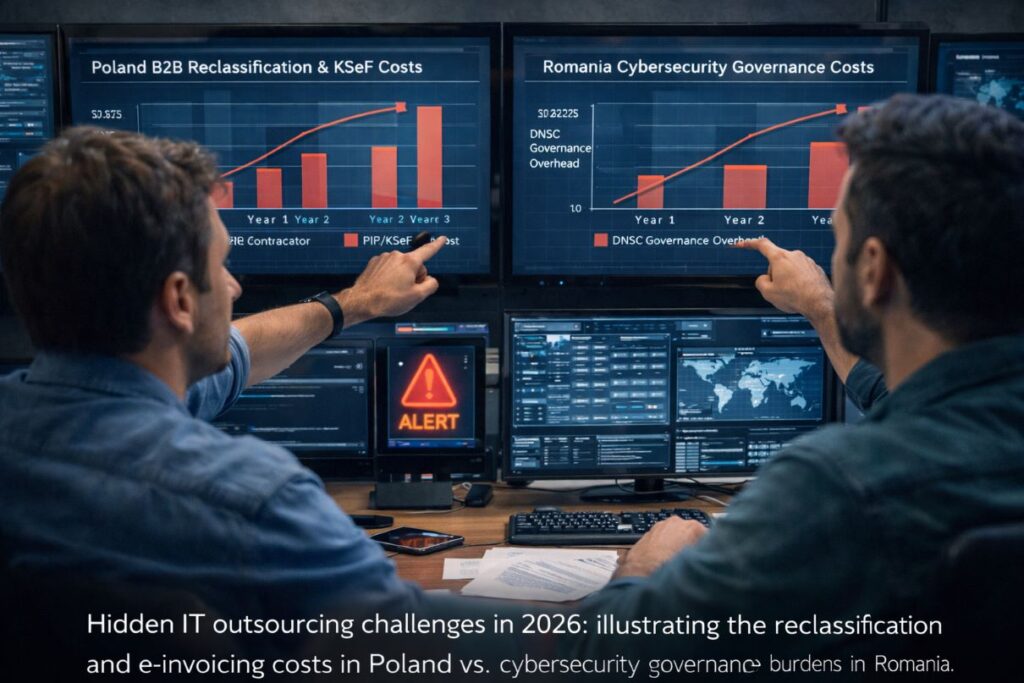
Another 2026-specific shift rarely mentioned in outsourcing comparisons is Poland’s mandatory National e-Invoicing System (KSeF).
From February/April 2026 onward, all invoices must be issued through KSeF using structured XML formats. This is not an accounting footnote—it is infrastructure.
Hidden cost impact:
- Vendors have invested heavily in KSeF API integrations
- Invoice processing workflows have become technically complex
- Many Polish service providers have introduced a 3–5% administrative surcharge to offset compliance and maintenance costs
For UK and US clients, this adds friction at the billing and procurement layer—especially when integrating with non-EU finance systems.
3. Romania’s NIS2 “Domino Effect”: Supply-Chain Liability
Romania’s cost advantage remains real—but it now comes with a deeper governance implication.
Under NIS2 implementation, Romania’s DNSC has expanded enforcement to include supply-chain accountability. Regulated entities are increasingly fined for failures originating from vendors and software suppliers.
The hidden consequence:
If a UK startup provides software to a Romanian bank or energy provider, that client will now often impose:
- 24/7 audit-readiness requirements
- Mandatory incident response coordination
- Continuous security reporting obligations
This creates a secondary compliance burden that does not raise hourly rates—but significantly raises management overhead.
Romania’s cost efficiency increasingly rewards teams that are operationally disciplined, not merely price-sensitive.
The 2026 Cost Reality: What the Numbers Actually Mean
Average Hourly B2B Rates (USD, 2026)
| Role | Poland (Warsaw / Kraków) | Romania (Bucharest / Cluj) |
| Senior Full-Stack (AI-ready) | $65–95 | $55–80 |
| DevOps / Cloud Architect | $75–110 | $60–90 |
| QA Automation Engineer | $45–65 | $35–55 |
Real Cost Multipliers (Often Ignored)
- Poland: +15–20% effective cost from immediate PIP enforcement, ZUS exposure, and KSeF compliance
- Romania: +10% operational overhead from NIS2 reporting, audit readiness, and supply-chain liability
Winners vs. Losers
Winners
| Profile | Why |
| Enterprise SaaS & Fintech Firms | Poland’s institutional maturity offsets higher cost |
| Compliance-Heavy Organizations | Stronger legal predictability at scale |
| Large, Long-Term Programs | Poland absorbs governance complexity better |
Losers
| Profile | Why |
| Cost-First Buyers | Hidden compliance costs surface post-contract |
| Firms Ignoring PIP Reform | Immediate reclassification creates budget shocks |
| Security-Unprepared Teams | Romania’s DNSC enforcement amplifies oversight load |
Why This Matters Beyond Cost
The 2026 divergence is structural, not cyclical.
Poland’s cost increase is driven by fiscal digitalization (KSeF) and labor protection (PIP reform). Romania’s overhead is driven by operational governance (NIS2/DNSC compliance).
For a UK or US firm:
- Poland is becoming an “auto-pilot” hub—more expensive, but procedurally stable
- Romania remains a “high-performance” hub—cost-efficient, but requiring active management
Neither is wrong. Each demands a different leadership posture.

What To Do Now
- Model Enforcement, Not Just Rates
Include immediate reclassification and audit-trigger scenarios in your cost planning. - Ask Vendors About KSeF Readiness
Billing friction is now a delivery risk in Poland. - Clarify Supply-Chain Security Ownership
Especially in Romania, define who owns DNSC reporting and audit coordination. - Practice Management by Exception
Let teams execute—but retain human oversight for regulatory and ethical judgment.
Final Takeaway
Outsourcing in 2026 is no longer about finding the cheapest engineers. It is about choosing where regulatory weight will land—and whether your organization is built to absorb it.
Hourly rates start the conversation. Governance determines how it ends.
Sources and context-
- Polish National Labour Inspectorate (PIP) Reform Briefings
- Poland National e-Invoicing System (KSeF) Implementation Guidelines
- Romanian DNSC NIS2 Enforcement Notices
- EU NIS2 Directive
- Gartner Nearshore & Workforce Risk Forecasts (2026)
Related Tech Plus Trends analysis on AI infrastructure, agentic systems, and platform governance:
- https://techplustrends.com/gpt-5-2-codex-self-healing-software-2026/
- https://techplustrends.com/chatgpt-atlas-vs-google-chrome-ai-browser/
- https://techplustrends.com/inside-the-1-billion-disney-openai-sora-deal-how-sora-will-stream-on-disney-in-2026/
- https://techplustrends.com/openai-2026-pivot-chatgpt-ads-gumdrop-ai-pen/
- https://techplustrends.com/openai-foxconn-vietnam-us-supply-chain/
- https://techplustrends.com/agentic-commerce-auto-shopper-era/
- https://techplustrends.com/silicon-based-workforce-ai-coworkers/
- https://techplustrends.com/techplustrends-com-nis2-compliance-poland-romania-2026/
Author Bio
Written by Saameer Go, a senior European technology analyst covering AI infrastructure, cybersecurity regulation, and digital labor markets. The author focuses on how legal and platform shifts translate into operational risk for US and EU technology leaders.