
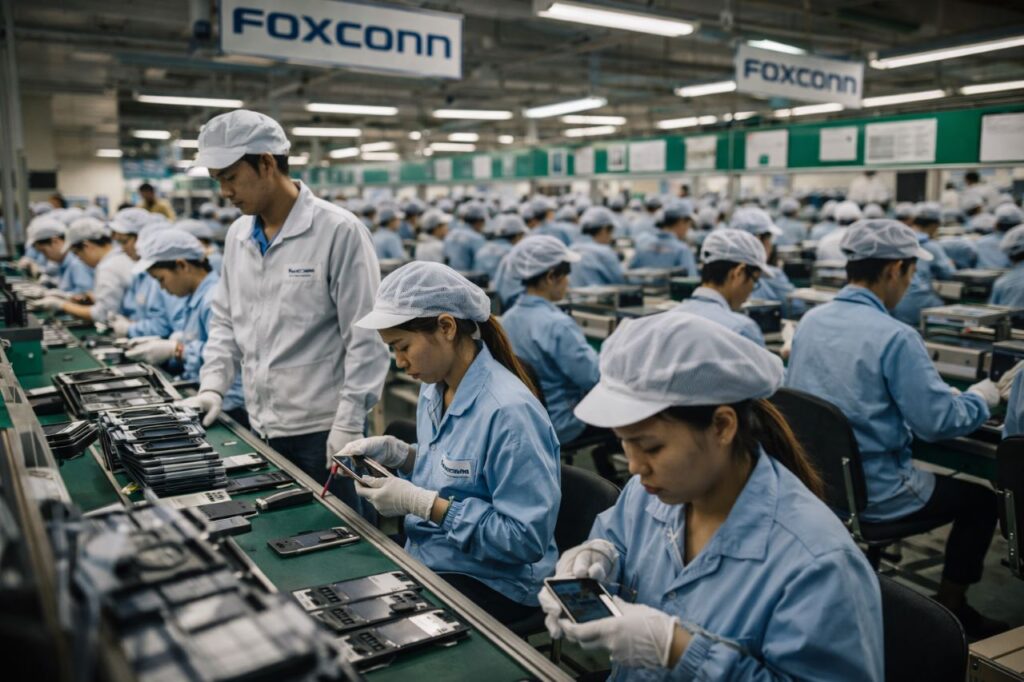
Behind OpenAI’s first hardware product is a deeper shift toward AI sovereignty, federal security compliance, and a re-engineered global supply chain.
Why This Story Exists Now
By early 2026, artificial intelligence has reached a point where software breakthroughs alone no longer determine leadership. Physical control—over chips, factories, and jurisdictions—now plays an equally decisive role.
That reality explains why OpenAI’s first consumer hardware product, internally known as Project Gumdrop, is no longer being assembled in China. Instead, OpenAI has pivoted toward Foxconn-led production in Vietnam, alongside a growing US manufacturing footprint.
On the surface, this looks like another chapter in US–China tech decoupling. But that framing misses the deeper forces at work. This shift was not driven by tariffs or cost optimization. It was driven by federal security requirements tied to OpenAI’s expanding role inside the US government’s AI infrastructure.
Information Gain
What readers learn here—and will not find clearly laid out elsewhere—is why OpenAI’s hardware roadmap became inseparable from US national security standards, and how that forced a supply-chain reset.
Three under-reported details matter most:
1. Gumdrop Is a Multi-Billion-Dollar Bet, Not a Side Project
In May 2025, OpenAI acquired io, the hardware startup founded by Jony Ive, in an all-stock deal valued at approximately $6.5 billion. That acquisition signaled that OpenAI was not experimenting with devices—it was committing to a long-term hardware platform.
Project Gumdrop is the first public expression of that strategy.
2. The “Third-Core” Device Concept
In 2026 interviews, Sam Altman has described Gumdrop as a “third-core” device—designed to live alongside a MacBook and an iPhone, not replace them. It is intended to be:
- Always nearby
- Ambiently aware
- Integrated continuously with AI systems
This positioning explains why Gumdrop’s trust and security profile matters far more than that of conventional consumer electronics.
3. Hardware Provenance Became a Gatekeeper
As OpenAI entered deeper partnerships with the US government—most notably through the Department of Energy’s Genesis Mission—hardware provenance became a non-negotiable requirement. Access to federal supercomputing and sensitive datasets is conditioned on demonstrably China-free supply chains.
This is the core reason OpenAI’s manufacturing plans changed.
The Content Gap
Most mainstream reporting treats OpenAI’s manufacturing pivot as a geopolitical or trade issue. That narrative is incomplete.
| Common Coverage | What’s Actually Driving the Shift |
| Tariffs and trade tension | Federal security compliance |
| Foxconn as a vendor | Foxconn as a geopolitical shield |
| Vietnam for cost efficiency | Vietnam as a trusted defense node |
The real story is not where Gumdrop is cheapest to build—but where it is legally and strategically safe to build.
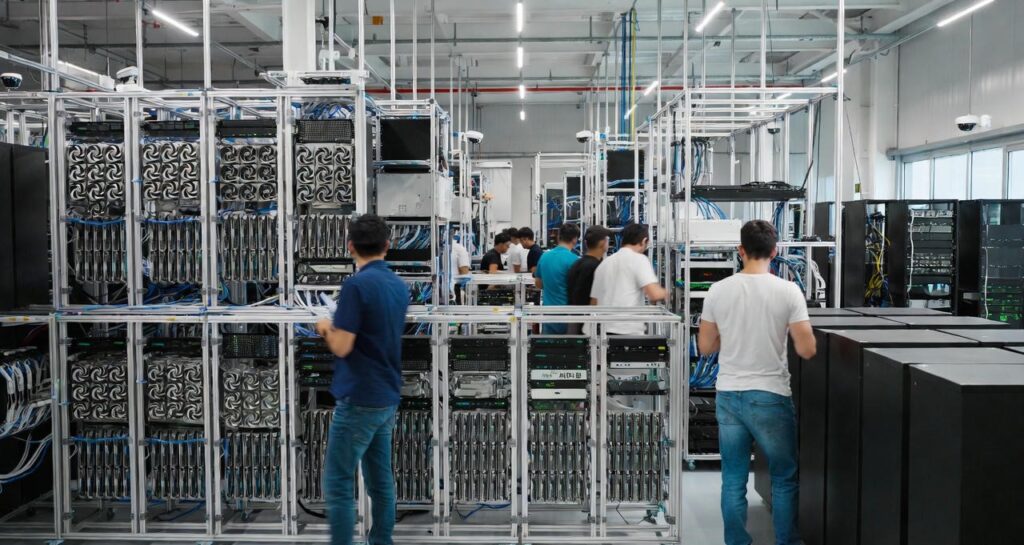
Deep Analysis
The Luxshare Breakup: A Site Dispute, Not a Quality Failure
Early in Gumdrop’s development, OpenAI explored working with Luxshare, one of China’s largest electronics manufacturers. That partnership ultimately collapsed.
According to industry reporting and supply-chain sources, the failure was not about manufacturing capability. It was about site geography.
Luxshare was unable to offer a production path for Gumdrop’s high-security audio capture hardware that fully avoided China-linked facilities. As OpenAI’s federal exposure increased, that limitation became a dealbreaker.
This was not ideological decoupling—it was compliance-driven separation.
The Genesis Mission: From Partnership to Legal Constraint
The Genesis Mission, launched via executive action in late 2025, formalized OpenAI’s relationship with the US Department of Energy. The program grants access to:
- DOE’s Stellar-AI supercomputing infrastructure
- Data from 17 National Laboratories
- Sensitive scientific and energy-related datasets
The condition is explicit: participating systems must meet strict hardware provenance standards. Any China-linked manufacturing introduces unacceptable risk.
Without a compliant supply chain, OpenAI would lose access to the compute resources underpinning its most advanced models.
Why Foxconn—and Why Vietnam
Foxconn offered OpenAI something Luxshare could not: credible geographic optionality.
As of early 2026:
- Vietnam is positioned as the primary site for high-volume consumer assembly, including Gumdrop.
- The United States remains under active evaluation, with Foxconn vetting facilities in Wisconsin, Ohio, and Texas for partial production.
This dual-node strategy allows OpenAI to separate:
- Consumer AI hardware
- National-security-adjacent AI infrastructure
Vietnam is not a cost play. It is a risk-buffered jurisdiction aligned with US security expectations.
What Is Project Gumdrop?
Based on reporting, disclosures, and executive commentary, Gumdrop is not a phone or headset. It is an ambient input device, often described as:
- Simple
- Playful
- Tactile
- Small enough to fit in a pocket—or be “biteable,” as Altman has remarked, referencing its approachable physical design
Functionally, Gumdrop captures handwriting and audio continuously, feeding real-time context into AI systems. That constant data flow elevates its security classification well beyond ordinary consumer gadgets.
Winner vs Loser Breakdown
| Stakeholder | Outcome |
| Foxconn | Becomes a strategic AI infrastructure partner |
| Vietnam | Emerges as a trusted AI hardware node |
| US Federal Agencies | Gain enforceable hardware sovereignty |
| China-Based OEMs | Excluded from frontier AI hardware |
Strategic Impact
Business Model Implications
Hardware margins matter less than regulatory access. Companies that can certify clean supply chains gain entry to federal compute ecosystems others cannot.
Platform Shift
This move aligns with OpenAI’s broader evolution—from application provider to platform steward—already visible in its browser, monetization, and infrastructure strategy.

Why This Matters (Second-Order Effects)
Jobs:
Manufacturing geography shapes where high-value AI jobs concentrate.
Creators:
Developers will increasingly build for hardware platforms defined by trust guarantees.
Users:
Consumer AI trust will hinge on invisible supply-chain decisions.
Industry Power Shifts:
AI leadership now requires control over factories as much as algorithms.
Regulatory / Antitrust / Policy Angle
As AI hardware becomes intertwined with national infrastructure, governments are likely to codify supply-chain requirements. What is informal today will become enforceable regulation.
What Happens Next
Short-Term (2026):
- More AI firms restructure hardware supply chains
- Vietnam and US manufacturing gain priority status
- China-linked assembly loses access to sensitive projects
Long-Term:
- AI hardware splits into civilian and security tiers
- Tech sovereignty becomes a board-level mandate
- Efficiency gives way to resilience
FAQ
1.Why did OpenAI move manufacturing away from China?
Ans-To meet federal hardware provenance requirements tied to government partnerships.
2.Is this mainly about tariffs?
Ans-No. Tariffs are secondary to security compliance.
3.Why Vietnam specifically?
Ans-Vietnam offers scale without China-linked jurisdictional risk.
4.What makes Gumdrop sensitive hardware?
Ans-Its continuous audio and handwriting capture.
5.Will other AI companies follow this path?
Ans-Yes—especially those seeking federal or defense-adjacent access.
Final Takeaway
OpenAI’s supply-chain pivot marks a turning point. In 2026, AI leadership is no longer determined solely by model performance. It is defined by who controls the physical systems behind intelligence itself.
The era of neutral hardware is over.
Sources & Context Links
- Reporting on OpenAI’s acquisition of io
- US Department of Energy Genesis Mission disclosures
- Coverage of Foxconn’s Vietnam and US manufacturing expansion
- Tech Plus Trends: OpenAI’s Platform Shift in 2026
- Tech Plus Trends: ChatGPT Atlas vs Chrome
- Related article: –
- GPT-5.2 Codex & Self-Healing Software- tpt.li/gpt5-codex
- ChatGPT Atlas vs. Google Chrome- tpt.li/atlas-vs-chrome
- $1B Disney x OpenAI Sora Deal- tpt.li/disney-sora
- OpenAI 2026 Pivot & Gumdrop Pen- tpt.li/gumdrop-pivot
Author Bio
Saameer Go is the founder and editor of Tech Plus Trends. He covers artificial intelligence platforms, global tech infrastructure, and the geopolitics of emerging technology, focusing on how power shifts shape product decisions.