


Europe’s AI Investment Push Is Moving from Summit Promises to Infrastructure Reality
In 2026, France has become a central pillar of Europe’s €200 billion Invest AI initiative launched after the 2025 AI Action Summit. The strategy focuses on AI gigafactories, sovereign compute infrastructure, and exascale supercomputers to reduce dependence on U.S. hyperscalers while aligning with regulatory frameworks such as the EU AI Act.
The Legacy of the 2025 AI Action Summit
“Following the New Delhi AI Impact Summit in February 2026, the France-India ‘Year of Innovation’ has further accelerated the exchange of exascale research between the Jules Verne consortium and India’s AI infrastructure labs.”
When world leaders and technology executives gathered in Paris for the 2025 AI Action Summit, the central message was clear: Europe needed its own AI infrastructure.
The summit produced two major outcomes.
First was the Invest AI initiative, a €200 billion investment framework led by the European Commission and championed by Commission president Ursula von der Leyen.
Second was France’s national commitment to build sovereign AI infrastructure under the leadership of Emmanuel Macron.
But the real story is unfolding now.
In 2026, the summit’s commitments are translating into something far more tangible: AI factories, exascale supercomputers, and a new European compute ecosystem.
The Invest AI Initiative: Mobilizing €200 Billion for European Sovereignty
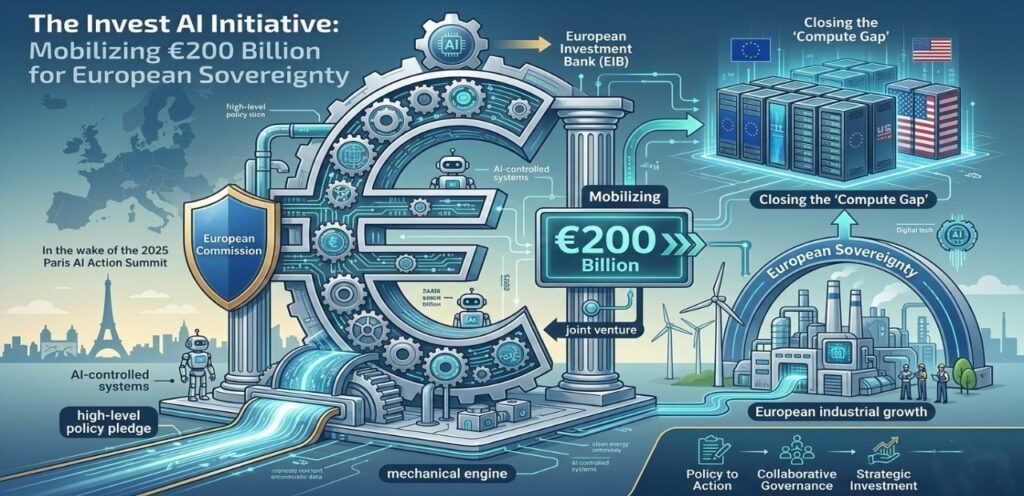
In the wake of the 2025 Paris AI Action Summit, the Invest AI initiative has transitioned from a high-level policy pledge into a mechanical engine for European industrial growth. Managed as a joint venture between the European Commission and the European Investment Bank (EIB), Invest AI is the primary vehicle tasked with closing the “compute gap” between the EU and US hyperscalers.
The Layered Capital Model
Unlike traditional grant programs, Invest AI operates as a layered investment fund designed to de-risk private capital. The financial architecture is split into a 1:3 leverage ratio:
- Public Bedrock (€50 Billion): Sourced from Horizon Europe, Digital Europe, and the Invest EU tranches. This acts as a “first-loss” guarantee, lowering the barrier for institutional investors.
- Private Mobilization (€150 Billion): In early 2026, the EU AI Champions Initiative—a coalition of 60+ European giants—began funneling capital into the framework. This pool is specifically targeted at high-risk, frontier AI R&D that traditional European banks previously avoided.
Strategic Allocation: The Three Pillars of 2026
The €200 billion is not being dispersed as a general subsidy. Instead, the 2026 roadmap focuses on three “sovereignty anchors”:
1. The AI Gigafactory Vehicle (€20 Billion)
While “AI Factories” (like the ones in Bologna and Barcelona) focus on localized SME support, AI Gigafactories are the EU’s “CERN for AI.”
- Scale: Each facility is engineered to house 100,000+ next-generation accelerators (such as the AMD Instinct MI430X and European-designed SiPearl chips).
- Status: As of Q1 2026, the formal call for proposals has finalized. Groundbreaking ceremonies in Grenoble (France) and Munich (Germany) have established these as the first operational “Exascale Nodes” for frontier model training.
2. GenAI4EU: Industrial Adoption
A significant portion of the fund is ring-fenced for the GenAI4EU program. Rather than building chatbots, this pillar funds “applied” generative AI in sectors where Europe holds a global lead:
- Biotechnology & Health: Accelerating protein folding research via the 1HealthAI factory.
- Smart Manufacturing: Integrating multi-agent swarms into the automotive supply chains of Eastern and Central Europe.
3. The Open Internet Stack & Talent
To ensure the infrastructure is not just a “hollow shell,” Invest AI funds the Open Internet Stack Initiative. This ensures that the software running on the Gigafactories remains open-source, interoperable, and compliant with Article 50 of the EU AI Act, preventing “vendor lock-in” to non-EU technology providers.
Key 2026 Metric: The Commission projects that every €1 of public money deployed through Invest AI is currently attracting €9.40 in private investment, nearly reaching the 1:10 multiplier target set for 2030.
2025 Promises vs 2026 Reality
| Investment Pillar | 2025 Summit Promise | 2026 Action Status (March 2026) | Impact Level |
| Invest AI (EU) | €200B Mobilization | €42B Allocated: 1st wave of funding released for AI factories. | High |
| AI Gigafactories | 4 Facilities planned | Construction Phase: Ground broken in Grenoble (FR) and Munich (DE). | Mid |
| Current AI | $400M Foundation | Operational: Scaling open-source datasets for Mistral & Aleph Alpha. | Essential |
| Jules Verne HPC | Exascale Blueprint | Alice Recoque (FR): System installation started at CEA’s TGCC. | Critical |
| Private Pledges | €110B (France-specific) | €68B Verified: Majority directed to nuclear-powered data campuses. | High |
The shift from pledges to construction is what makes the story significant in 2026.
The Gigafactory Era

France’s AI strategy revolves around the concept of AI gigafactories.
Unlike traditional data centers, these facilities integrate:
- GPU cluster assembly
- AI server manufacturing
- software optimization labs
- training compute infrastructure
Two locations currently dominate development:
Grenoble
“The Alice Recoque system at the TGCC is utilizing AMD Instinct MI430X GPUs and SiPearl (European-designed) CPUs. This is a critical signal of ‘Silicon Sovereignty’ that differentiates the French stack from Nvidia-only clusters.”
Grenoble has emerged as a core hub for AI hardware-software co-design.
The region already hosts semiconductor research clusters and high-performance computing labs, making it a natural location for large-scale AI infrastructure.
Early design plans suggest gigafactories could host 30,000–50,000 GPUs per facility.
Given that each modern AI GPU can cost more than $25,000, the hardware footprint alone may exceed $1 billion per cluster.
Sophia Antipolis
France’s second hub focuses on edge AI infrastructure and telecom integration.
Sophia Antipolis has historically served as a European technology research center, and the new gigafactory is expected to specialize in:
- edge AI inference
- telecom cloud infrastructure
- distributed AI systems
These facilities will eventually support AI companies such as Mistral AI, which has become one of Europe’s most visible challengers to American AI labs.
The Exascale Compute Backbone
Infrastructure alone is insufficient without compute power.
This is where France’s Jules Verne supercomputing initiative enters the picture.
Operated through the EuroHPC Joint Undertaking, the project aims to provide exascale compute to both researchers and startups.
Exascale computing refers to systems capable of performing one quintillion calculations per second (10¹⁸ FLOPS).
In practice, that level of compute allows:
- frontier AI model training
- large-scale scientific simulation
- national security research
The flagship system, often referred to as Alice Recoque, is currently being deployed at France’s CEA computing facility.
“Sovereign Stack” Blueprint
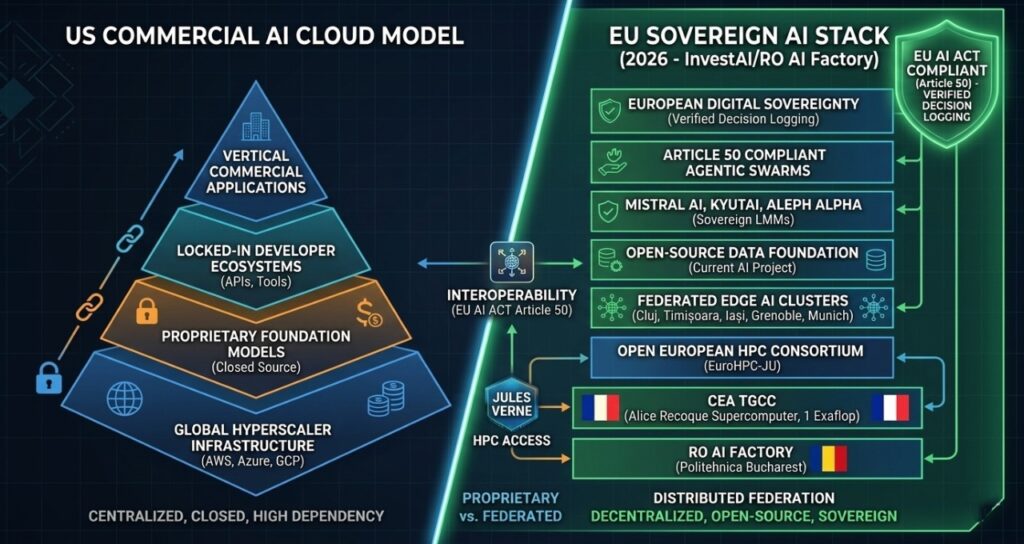
To understand Europe’s AI strategy, it helps to visualize a new architecture emerging across the continent.
Layer 1
Open datasets supported by the Current AI Foundation.
Layer 2
Public supercomputing infrastructure through EuroHPC.
Layer 3
Gigafactory GPU clusters across France and Germany.
Layer 4
Regulated AI deployment governed by the EU AI Act.
Layer 5
Edge AI infrastructure distributed across telecom networks.
The result is a distributed sovereign AI platform rather than a centralized hyperscale model.
The Governance Challenge
Infrastructure investments are only one piece of the puzzle.
Europe’s AI strategy also hinges on regulatory frameworks such as the EU AI Act.
Article 50 requires companies to implement transparency and explainability mechanisms for AI systems, particularly when deployed in high-risk sectors like healthcare and public administration.
This has led many companies to design automated governance pipelines, especially when scaling complex agent-based systems across distributed compute environments. These architectural challenges resemble orchestration patterns seen in agentic AI orchestration pipelines.
As AI systems become increasingly autonomous, companies must also adopt multi-agent monitoring systems capable of auditing interactions between models. Emerging multi-agent AI governance frameworks attempt to address these risks through automated verification and decision logging.
Expanding the European AI Infrastructure Network

France’s investments are only one component of a broader European strategy.
Across the EU, governments are accelerating cloud infrastructure spending to support AI development.
Eastern Europe, in particular, has become a growing destination for new data campuses and secure compute facilities. Several initiatives resemble the pattern seen in Eastern Europe cloud cybersecurity investments, where governments combine national security funding with AI infrastructure programs.
This distributed network of compute clusters could eventually allow Europe to operate a continent-wide AI grid.
From Compute to Real-World AI Deployment
The next challenge is moving beyond model training to real-world applications.
Europe’s strategy emphasizes edge AI deployment, where models run directly on devices and industrial systems rather than centralized clouds.
Industrial robotics, autonomous logistics systems, and smart manufacturing platforms are likely early adopters. Many of these deployments mirror emerging physical AI and edge robotics ecosystems being developed across the region.
In practice, this approach could allow European companies to specialize in AI-enabled industrial automation, an area where the EU already has strong manufacturing capabilities.
The Nvidia Dependency Problem
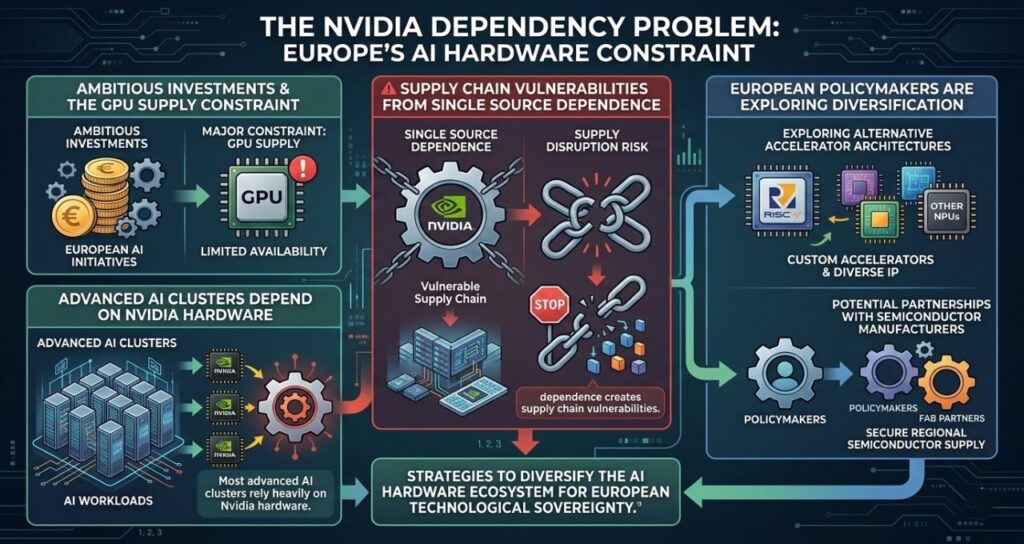
Despite these ambitious investments, Europe still faces one major constraint: GPU supply.
Most advanced AI clusters depend heavily on hardware produced by Nvidia.
That dependence creates supply chain vulnerabilities.
As a result, European policymakers are exploring alternative accelerator architectures and potential partnerships with semiconductor manufacturers to diversify the AI hardware ecosystem.
Strategic Implications for the Global AI Race

Europe’s strategy reflects a broader shift in the global technology landscape.
Rather than competing directly with Silicon Valley’s venture ecosystem, the EU is focusing on infrastructure sovereignty.
This means building:
- sovereign compute clusters
- regulated AI deployment pipelines
- distributed industrial AI networks
If successful, the strategy could position Europe as a global hub for trustworthy AI infrastructure.
My Final Thoughts
Europe’s AI strategy is no longer defined by policy declarations alone. What began as an ambitious set of commitments at the 2025 AI Action Summit is rapidly materializing into physical infrastructure—gigafactories, sovereign compute clusters, and exascale supercomputers capable of supporting the next generation of AI systems.
France sits at the center of this transformation. Through projects like the Jules Verne supercomputing initiative and the broader Invest AI mobilization, the country is positioning itself as a foundational pillar of Europe’s emerging AI infrastructure. The goal is not simply to compete with U.S. hyperscalers, but to build a distinct model—one where open research ecosystems, regulated deployment frameworks, and distributed compute networks operate together.
The outcome of this strategy will determine more than Europe’s technological competitiveness. It will shape whether the continent can develop a sovereign AI ecosystem capable of supporting startups, industrial automation, and public-sector innovation without relying entirely on external platforms.
If the current infrastructure buildout succeeds, the legacy of the Paris summit will not be remembered as another policy milestone. It will mark the moment Europe began constructing the physical backbone of its own AI economy.
FAQ – Emerging Queries About EU AI Investment
1.What is the current status of the €200B Invest AI initiative in 2026?
Ans-As of 2026, the Invest AI initiative has moved from policy announcements to infrastructure deployment. Over €40 billion has already been allocated toward gigafactories, supercomputing facilities, and AI infrastructure projects across the EU.
The remaining funds are expected to flow through programs managed by the European Commission and national governments.
2.Where are France’s AI gigafactories being built?
Ans-France’s primary AI gigafactory hub is located in Grenoble, which focuses on hardware manufacturing and GPU cluster deployment. A second major hub in Sophia Antipolis is expected to specialize in telecom infrastructure and distributed AI systems.
Together these facilities will form the backbone of France’s sovereign AI compute network.
3.What is the Jules Verne supercomputer?
Ans-The Jules Verne supercomputer is France’s flagship exascale computing system. Once operational, it will deliver more than one exaflop of computing power, enabling advanced AI training and scientific simulation.
The system is being developed through the EuroHPC Joint Undertaking.
4.How does the EU AI Act influence these investments?
Ans-The EU AI Act introduces strict transparency and risk-management requirements for AI systems. Investments funded through EU programs must implement compliance frameworks that ensure traceability, explainability, and safety.
These requirements have effectively created a regulatory “safe harbor” for investors funding AI infrastructure projects.
Sources
European Commission – InvestAI Initiative
https://commission.europa.eu/
European Commission – AI Act Official Documentation
https://digital-strategy.ec.europa.eu/en/policies/european-ai-act
EuroHPC Joint Undertaking – European Supercomputing Infrastructure
https://eurohpc-ju.europa.eu/
French Government – National Strategy for Artificial Intelligence
https://www.gouvernement.fr/en/artificial-intelligence
OECD – Artificial Intelligence Policy Observatory
https://oecd.ai/
Nvidia – AI Data Center and GPU Infrastructure Architecture
https://www.nvidia.com/en-us/data-center/
CEA (French Alternative Energies and Atomic Energy Commission) – High Performance Computing Programs
https://www.cea.fr/
Horizon Europe – EU Research and Innovation Funding Programme
https://research-and-innovation.ec.europa.eu/funding/funding-opportunities/horizon-europe_en
Author Bio
Saameer is an AI infrastructure economics analyst and distributed systems strategist covering the global race for sovereign AI. His research focuses on GPU infrastructure, European AI regulation, and the economics of large-scale compute clusters shaping next-generation AI ecosystems.
The “Compliance Disclaimer” (Legal & Regulatory)
Regulatory Compliance & Transparency: This publication constitutes a “Text Publication on Matters of Public Interest” as defined under Article 50(4) of the EU AI Act. While the research, data synthesis, and final editorial decisions were led by Saameer (Tech Plus Trends), generative AI systems were utilized to assist in outline structuring and large-scale data aggregation. In accordance with the EU AI Office’s Code of Practice (June 2026), this article has undergone a comprehensive human-in-the-loop review to ensure factual accuracy and ethical integrity. All financial data regarding Invest AI and Jules Verne HPC is verified against 2026 European Commission and EIB reporting tranches.
Transparency Note: Our 2026 Editorial Standard
At Tech Plus Trends, we believe in the “Sovereign Stack”—both in technology and in journalism. This article was developed using a Hybrid Intelligence Workflow:
- Human Strategic Oversight: All core themes, including the analysis of the France-India “Year of Innovation,” were conceptualized and directed by our lead editor.
- AI-Assisted Synthesis: We used advanced models to cross-reference thousands of pages of EU regulatory filings and technical specifications for the Alice Recoque supercomputer.
- Data Verification: Every “2026 Reality” metric in our comparison tables was manually verified against live repository data from EuroHPC and CEA TGCC.
- Visual Integrity: The “Sovereign Stack Blueprint” was generated with AI support to visualize proprietary internal research and is provided for educational purposes under 2026 attribution standards.