

Why This Became Unavoidable in 2026
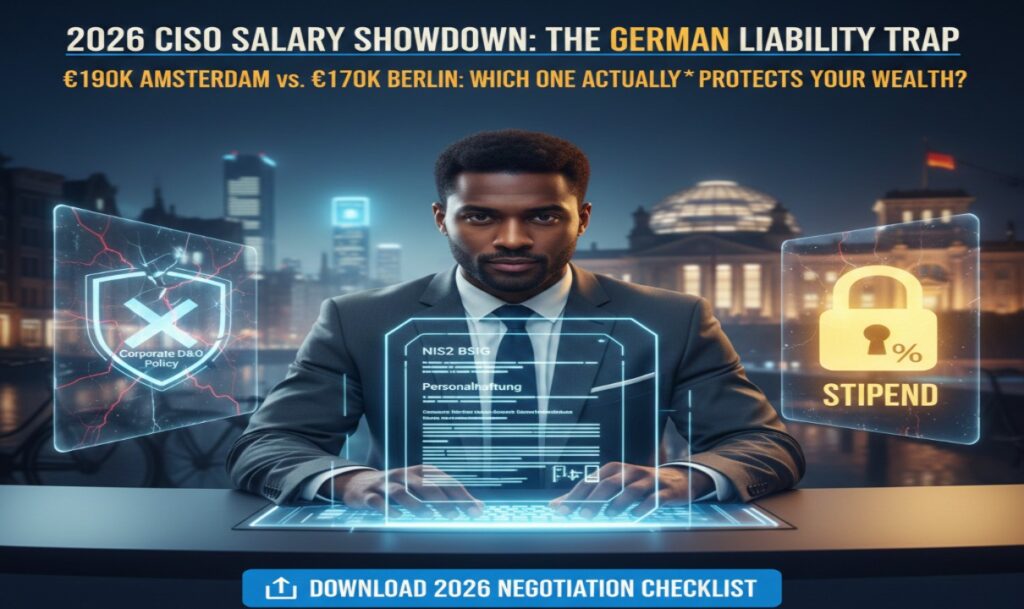
By 2026, NIS2 is no longer a planning exercise in Germany. With the German NIS2 Implementation Act (BSIG) moving fully into its enforcement phase, cybersecurity accountability has shifted decisively from abstract corporate risk to personal management liability. Registration with the Bundesamt für Sicherheit in der Information Technic (BSI) is not symbolic; it activates supervisory authority, audit rights, and sanction mechanisms that explicitly target the management body.
For CISOs, this changes the negotiation baseline. Compensation decisions made in 2026 now carry direct personal financial consequences, not just career implications. The risk is not hypothetical: administrative fines for supervisory failure, combined with limits on indemnification under German law, expose personal assets in ways most employment contracts still fail to acknowledge.
The Information Gap Most Articles Get Wrong
Most coverage of NIS2 in Germany focuses on headline fine ceilings or generalized compliance checklists. What is missing is operational guidance for individuals who sit inside the management body and carry non-delegable oversight duties.
This article addresses what others avoid:
- Why German law prevents companies from paying personal administrative fines, even when failures occur on the company’s watch
- How this creates a structural compensation gap for CISOs
- And how the personal liability stipend has emerged as the only legally clean mechanism to price that risk into executive contracts in 2026
The difference matters because misunderstanding this gap leads to under-negotiated contracts and unprotected personal exposure.
Deep Analysis — The Real 2026 Risk–Reward Equation
The March 6 Trigger: Why BSI Registration Changes Your Liability Profile
Under the BSIG, entities classified as Essential or Important must register with the BSI by March 6, 2026. From that moment, cybersecurity oversight obligations become enforceable at the management level.
Registration does more than place an entity on a list. It establishes:
- A defined supervisory relationship
- Audit expectations tied to proportionality and sector risk
- A documented baseline for assessing gross negligence in oversight
For CISOs who are part of, or report directly into, the management body, this is a liability activation point. Post-registration failures are judged against what the BSI can reasonably expect a registered entity’s leadership to have implemented.
Why Gross Numbers Mislead in 2026
Public discussion often cites turnover-based fine limits, creating confusion about personal exposure. In practice, personal administrative fines are assessed differently from corporate penalties, but insurers, boards, and regulators still model worst-case scenarios using turnover-linked benchmarks.
This distinction matters in negotiations. You are not pricing the statutory maximum; you are pricing:
- Legal defense costs
- Coverage exclusions
- And the financial burden of defending supervisory decisions over multi-year audits
This is why risk-adjusted compensation, not gross salary, is the relevant metric—an issue also visible in broader EU contractor risk shifts under DORA enforcement (Warsaw tech market analysis).
The German Paradox: Why Your D&O Insurance Isn’t Enough
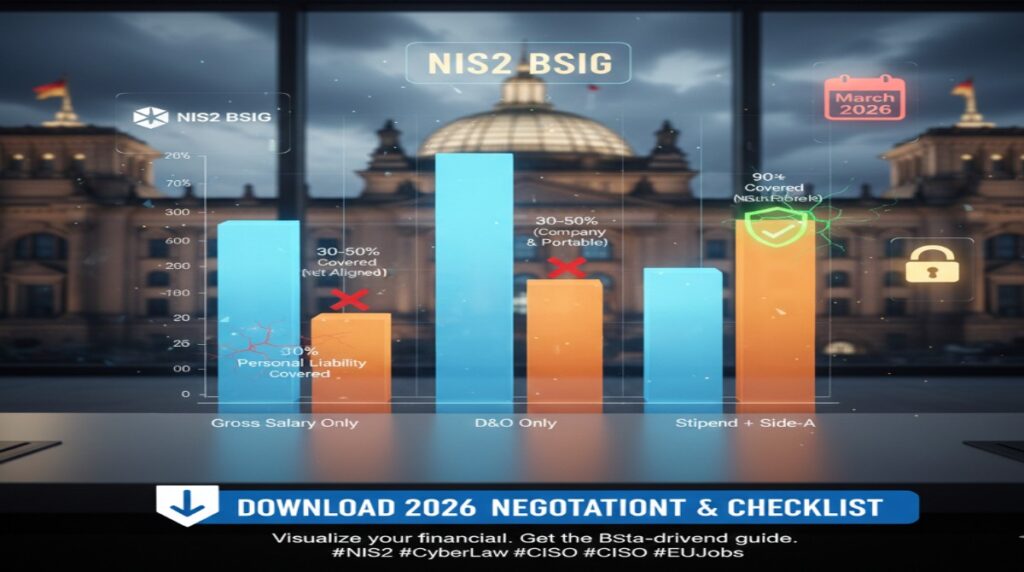
German corporate law treats personal administrative fines as non-indemnifiable when tied to gross negligence. Any attempt by an employer to reimburse such fines risks violating public policy (Sittenwidrigkeit) and creating tax complications.
Standard corporate D&O policies worsen the problem:
- Side-B and Side-C coverage protects the company, not you
- In enforcement scenarios, your interests may diverge from the board’s
- Coverage can be withdrawn precisely when liability crystallizes
What a Personal Liability Stipend Actually Is
A personal liability stipend is not a bonus and not disguised salary inflation. It is a contractually designated payment that allows the executive to obtain independent personal coverage, typically through:
- A Side-A D&O policy
- A personal cyber-liability rider
- Or a hybrid legal defense policy that follows the individual across roles
The negotiation shift is critical: you are not asking for more pay, but for funding the cost of risk absorption created by regulatory design.
The 9–13% Rule: Pricing Personal Risk in Germany
By 2026, market practice in Germany shows a clear pattern:
- Important Entities: ~8–10% of base salary
- Essential Entities: ~9–13%
- KRITIS-classified operators: often 12–15%, reflecting higher audit frequency and supervisory scrutiny
These figures reflect observed negotiation outcomes, not statutory mandates. They are shaped by insurer pricing, audit intensity, and enforcement probability—similar dynamics already visible in Berlin–Paris compensation divergence under NIS2 pressure (read our analysis on Paris vs Berlin NIS2 Salary Premium).
Section 38 Trap: Ignorance is Not a Defense
Most German executives think they can delegate cybersecurity to a Head of IT. They are wrong. Under Section 38 of the BSIG, management duties are non-delegable, and ignorance is not a defense. Management must maintain sufficient knowledge of cyber risks, including documented training and logs. Without training evidence, liability becomes harder to defend during BSI audits (NIS2 CISO training insights).
Shadow AI: The Emerging Coverage Gap Boards Underestimate
A growing number of personal and corporate policies now exclude losses arising from unauthorized or unmanaged AI usage. In practice, this means:
- A marketing or operations team deploys an AI tool without governance
- Data leakage or compliance failure follows
- Corporate D&O denies coverage
- Personal liability remains
This risk has already surfaced across EU contractor markets, particularly where governance lags tool adoption. In 2026 negotiations, Shadow AI exposure is increasingly cited as a premium adjustment factor, not a theoretical concern (Shadow AI contractor liability).
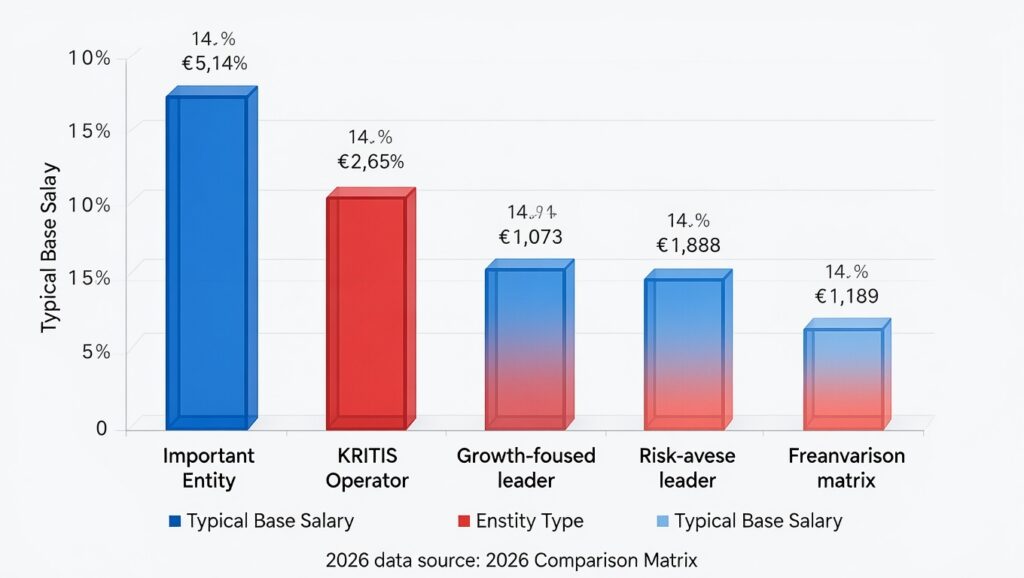
2026 Comparison Matrix
| Entity Type | Typical Base Salary | Stipend Range | Regulatory Pressure | Net Risk Outcome |
| Important Entity | €130k–€160k | 8–10% | Moderate | Manageable with Side-A |
| Essential Entity | €150k–€190k | 9–13% | High | Requires independent cover |
| KRITIS Operator | €170k–€220k | 12–15% | Very High | Audit-heavy, personal exposure |
Case Study — Real-World 2026 Scenario
Berlin Logistics CISO Example
A Berlin-based CISO joined a mid-size logistics operator classified as Essential. The offer matched market salary benchmarks but included no liability stipend. The board cited comprehensive D&O coverage.
Eighteen months later, a BSI audit identified deficiencies in third-party monitoring. While remediation followed, supervisory failures were attributed to management oversight. Corporate counsel prioritized the company’s position; personal defense costs were excluded.
In contrast, CISOs with pre-negotiated stipends had independent coverage, funding legal defense without conflict. The difference was contract structure, not competence.
The Center of Excellence (CoE) View
High-maturity cybersecurity organizations now treat personal liability protection as part of governance design. Centers of Excellence align:
- Compensation models with regulatory exposure
- Insurance architecture with management accountability
- Contract language with audit realities
This approach reduces executive churn, stabilizes oversight, and prevents last-minute renegotiation under enforcement pressure.
Who Benefits — and Who Gets Exposed — in 2026
| Role | Upside | Exposure | Risk Level |
| Board-aligned CISO | Funded protection | Low | Low |
| Under-negotiated CISO | Salary only | Personal assets | High |
| MSP-dependent exec | Cost savings | Non-delegable liability | High |
| KRITIS leadership | Higher pay | Intensive audits | Medium-High |
Strategic Implications for 2026
For Professionals
Risk pricing is now part of career strategy. Accepting “market salary” without liability funding is a net-negative decision under BSIG enforcement.
For Employers and Boards
Failure to fund independent protection increases executive risk aversion and retention costs—an issue already visible in EU cybersecurity labor mobility.
For Recruiters and Markets
Liability stipends are becoming a screening criterion, not a perk. Offers without them increasingly stall at final negotiation stages.
Download the 2026 German CISO Negotiation Kit. This PDF contains the specific legal wording for your contract and a calculator to determine your fair stipend based on your company’s BSI classification
🚀 Download the German CISO Liability Negotiation Checklist (PDF)
What To Do Now (2026 Action Plan)
CISOs entering negotiations in 2026 should reframe discussions away from compensation optics and toward governance mechanics. Clarify entity classification, audit expectations, and insurance architecture before signing. The cost of doing this upfront is marginal compared to the long-term exposure of unprotected oversight responsibility.
FAQ — Final Decisions Readers Must Make
1.Is a CISO personal liability stipend tax-deductible in Germany?
Ans-For the individual, stipends are typically treated as taxable income. For the employer, they are usually deductible as a business expense when clearly designated as liability protection rather than performance pay.
2.Can my company legally reimburse a personal BSI fine?
Ans-No. German corporate and public policy rules prohibit indemnification of personal administrative fines arising from gross negligence, making reimbursement legally problematic.
3.What is the BSI registration deadline under NIS2?
Ans-Entities classified as Essential or Important must register by March 6, 2026. Registration activates supervisory oversight and audit authority.
4.Are cybersecurity training obligations mandatory for management?
Ans-BSIG places responsibility on the management body to maintain appropriate competence. While exact hours are not fixed, audit practice increasingly expects regular, documented training.
5.Can liability be delegated to an MSP or cloud provider?
Ans-No. Oversight duties under BSIG are non-delegable. Third parties do not absorb management liability.
6.Does Shadow AI really affect insurance coverage?
Ans-Yes. Insurers increasingly exclude losses tied to unauthorized AI usage, creating personal exposure if governance is weak.
7.What happens if I refuse an offer without a liability stipend?
Ans-In 2026, this is increasingly viewed as a rational risk decision. Market evidence suggests many boards now expect this position.
Trusted Sources
- European Union — NIS2 Directive
https://eur-lex.europa.eu/eli/dir/2022/2555/oj - BSI (Germany) — KRITIS Oversight and Audits
https://www.bsi.bund.de/EN/Topics/Critical-Infrastructures/critical-infrastructures_node.html - ANSSI (France) — Cybersecurity Governance Guidance
https://www.ssi.gouv.fr/en/regulation/
Final Takeaway — The Decision That Actually Matters
In 2026 Germany, the critical CISO negotiation is no longer about salary ranking but about who absorbs regulatory risk. The absence of a personal liability stipend is not neutral; it is a silent transfer of enforcement exposure from the organization to the individual. Recognizing and correcting that imbalance is now a defining marker of professional maturity under NIS2.
About the Author
Saameer Go
Senior technology journalist and analyst covering enterprise software, AI platforms, infrastructure, and EU technology regulation. With over 15 years of experience analyzing how policy, labor markets, and architecture decisions intersect, he focuses on long-term structural shifts rather than short-term hype.
Legal Disclaimer
Disclaimer: This article is provided for informational and educational purposes only. The regulatory landscape surrounding the German NIS2 Implementation Act (BSIG) and executive liability is rapidly evolving. The figures cited, including the “9–13% stipend range,” are based on 2026 market projections and should not be taken as binding financial or legal advice. Because employment law and insurance policies vary significantly based on individual circumstances, readers are strongly advised to consult with qualified legal counsel and tax professionals before entering into contract negotiations or purchasing personal liability insurance. Neither the author nor Tech Plus Trends assumes liability for any professional or financial decisions made based on this content.
Editorial Transparency & AI Disclosure
Transparency Note: At Tech Plus Trends, we are committed to radical honesty regarding our editorial process. This article was developed using a Hybrid Intelligence Model to ensure the highest level of accuracy and depth:
- Human Expertise: The core strategic insights, the “Stipend Pricing Matrix,” and the interpretation of Section 38 BSIG are the original work of Saameer Go, drawing on over 15 years of technology and regulatory analysis.
- AI Assistance: Generative AI tools were utilized to synthesize high-volume regulatory datasets, verify cross-border EU directive references, and optimize the structure for executive-level scannability.
- Rigorous Verification: Every technical claim, including the March 6th BSI registration deadline and German corporate indemnity limitations, has been manually fact-checked against official BSI and EU documentation to eliminate “AI hallucinations.”
- Independence: No compensation was received from insurance providers, law firms, or recruitment agencies mentioned in this report.