
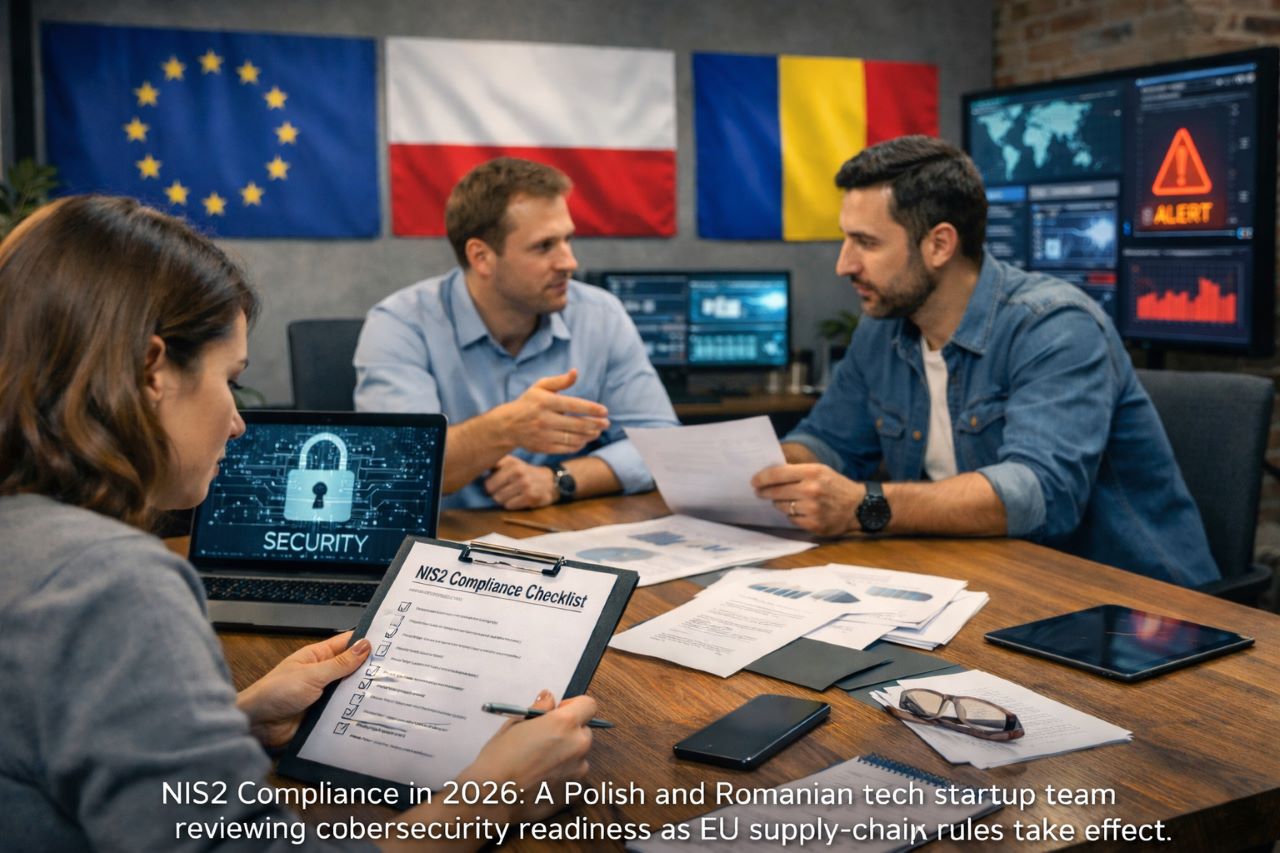
Opening Context: Why This Story Exists Now
By 2026, cybersecurity regulation in Europe has crossed a quiet but consequential line. What once lived in policy briefings and legal memos now shows up in vendor contracts, procurement questionnaires, and client audits.
The EU’s NIS2 Directive is no longer an abstract framework. It is an operational requirement—one that increasingly reaches small and mid-sized tech startups in Poland and Romania, even when founders believe they fall outside its scope.
This moment mirrors a broader pattern playing out across the tech industry. As AI platforms mature and infrastructure becomes more centralized—whether through self-healing software systems, agent-driven workplaces, or sovereign hardware supply chains—governments are asserting tighter control over the digital systems they depend on. We’ve seen this shift in OpenAI’s move toward secure, geopolitically aligned hardware manufacturing, and the same logic now applies to cybersecurity governance across Europe.
The risk for startups in 2026 is not that NIS2 exists. It’s assuming it doesn’t apply—until a client, regulator, or incident proves otherwise.
Information Gain: The Supply-Chain Pull-In Most Coverage Misses
Most English-language NIS2 articles focus on technical controls: risk assessments, incident response plans, and encryption standards. What they consistently under-explain is how startups are being pulled into compliance indirectly, regardless of size.
This happens through what compliance teams now call the supply-chain pull-in effect.
Under NIS2, traditional SME exemptions break down when a company:
- Provides software or IT services to a regulated entity (banking, energy, telecom, healthcare)
- Processes operational or sensitive data on behalf of that entity
- Is contractually embedded into a critical digital service
In practical terms, a 12-person SaaS firm in Kraków or Cluj can be required to meet NIS2 standards because one enterprise customer is subject to them.
This mirrors dynamics already visible in other parts of the tech stack. Just as AI browser platforms like ChatGPT Atlas are reshaping how information is accessed, and agentic commerce systems are changing how purchasing decisions are automated, regulation is increasingly flowing downstream, not stopping at the largest players.
That downstream pressure is the real compliance story of 2026.
Deep Analysis: How NIS2 Is Actually Enforced in Poland and Romania
Although NIS2 is an EU directive, enforcement is national—and the differences matter.
Poland: Vendor Risk Comes First
- Authorities: CSIRT NASK / CSIRT GOV
- Legal basis: Amendments to the National Cybersecurity System Act
Polish regulators place heavy emphasis on supply-chain security. Startups working with public institutions or regulated enterprises are increasingly assessed not only on their own controls, but on how well they document risk ownership, escalation paths, and incident classification.
For software houses and B2B SaaS companies, NIS2 compliance often surfaces first during client security audits, not regulator inspections.
Romania: Speed and Transparency Over Completeness
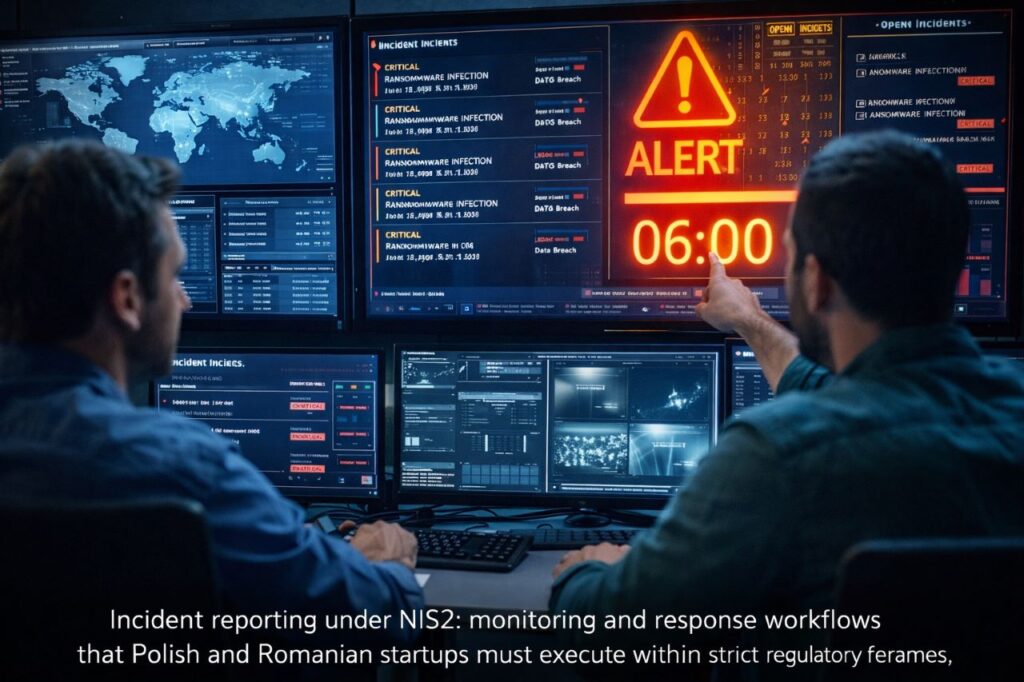
- Authority: DNSC (Directorate for National Cyber Security)
- Legal basis: GEO No. 155/2024
Romania’s implementation stands out for its compressed incident reporting window. Significant incidents may need to be reported to DNSC within six hours, far tighter than the directive’s general 24-hour guidance.
The expectation is not perfect information—but early notification, followed by updates. This aligns with Romania’s broader push toward faster national cyber situational awareness.
Case Study: When the SME Exemption Disappears
Consider a mid-sized software startup in Bucharest providing workflow tools to a regional energy operator.
The company assumed NIS2 did not apply due to headcount. In late 2025, the client updated its vendor contracts, requiring:
- Proof of incident response readiness
- Named cybersecurity responsibility
- Guaranteed reporting timelines aligned with DNSC rules
Failure to comply meant losing the contract.
The startup had 90 days to operationalize compliance—not because a regulator knocked, but because NIS2 obligations flowed through the supply chain.
This pattern is becoming standard across Europe, just as multi-agent AI systems are becoming standard in modern workplaces, shifting responsibility from execution to oversight.
Winners’ vs Losers in the NIS2 Transition
| Category | Winners | Losers |
| Startup Type | B2B vendors aligned with regulated clients | “Too small to care” SaaS teams |
| Leadership Mindset | Founders who map downstream risk early | Teams relying on EU-level summaries |
| Operations | Companies with clear incident ownership | Ad-hoc, undocumented security practices |
| Market Position | Trusted suppliers in audits | Vendors quietly excluded from procurement |
| Geography Awareness | Teams tracking local enforcement | Firms assuming uniform EU timelines |
NIS2 does not reward size. It rewards preparedness, clarity, and speed.
Why This Matters: Compliance as Market Access
The most underestimated impact of NIS2 is not fines—it’s commercial exclusion.
By 2026:
- Large EU enterprises are de-risking their supplier base
- Cyber maturity is becoming a procurement filter
- Startups without documented governance are screened out early
This reflects a broader shift we’ve seen across tech in recent years—from OpenAI’s restructuring around secure infrastructure partnerships to the rise of agent-managed workflows where accountability matters more than raw output.
Cybersecurity, like AI governance, is now part of how trust is priced into the market.
What To Do Now: Practical Steps for Founders
- Map Your Supply-Chain Exposure
Identify which clients are regulated entities and how their obligations extend to you. - Register with the Right Authority
- Poland: CSIRT NASK / GOV
- Romania: DNSC reporting frameworks
- Set a Single Internal Reporting Standard
Treat Romania’s six-hour window as your baseline across operations. - Document Responsibility Clearly
Regulators care more about ownership than perfection. - Practice “Management by Exception”
Focus human attention on what automated systems might miss—judgment, context, and long-term impact.

Optional Resource for Founders
For teams that want to sanity-check their current posture, we’ve compiled a one-page NIS2 Startup Readiness Scorecard designed specifically for Polish and Romanian tech companies.
It covers:
- Supply-chain pull-in risk
- Incident classification thresholds
- A prefilled six-hour incident reporting template aligned with DNSC guidance
This is not legal advice, but a practical self-assessment tool many teams use before vendor or client audits.
Free Resource: Download the NIS2 Startup Readiness Scorecard (PDF)
FAQs: What Founders Are Asking in 2026
1.Does NIS2 apply to startups under 50 employees?
Ans-Yes, if you are part of a regulated supply chain.
2.Is Romania stricter than the EU directive?
Ans-Yes, particularly on incident reporting timelines.
3.Do we need a full-time CISO?
Ans-No—but responsibility must be clearly assigned.
4.Are fines the biggest risk?
Ans-Often not. Contract loss is more immediate.
5.Does compliance require certification?
Ans-No formal certificate, but documentation is essential.
6.Can we wait until enforcement ramps up?
Ans-By 2026, enforcement is already active.
Final Takeaway
NIS2 marks the end of cybersecurity as a voluntary maturity signal and the beginning of cybersecurity as a participation requirement.
For tech startups in Poland and Romania, the real risk is not over-regulation—it is discovering too late that compliance was assumed. In a market increasingly shaped by secure AI platforms, autonomous systems, and regulated infrastructure, trust is now operational.
The startups that treat NIS2 as infrastructure—not paperwork—will be the ones still signing contracts in 2027.
Sources & Context
- European Union Agency for Cybersecurity (ENISA)
- Romanian DNSC (Directorate for National Cyber Security)
- Polish CSIRT NASK
- EU NIS2 Directive documentation
- Related Tech Plus Trends analysis on AI infrastructure, agentic systems, and platform governance:
- https://techplustrends.com/gpt-5-2-codex-self-healing-software-2026/
- https://techplustrends.com/chatgpt-atlas-vs-google-chrome-ai-browser/
- https://techplustrends.com/inside-the-1-billion-disney-openai-sora-deal-how-sora-will-stream-on-disney-in-2026/
- https://techplustrends.com/openai-2026-pivot-chatgpt-ads-gumdrop-ai-pen/
- https://techplustrends.com/openai-foxconn-vietnam-us-supply-chain/
- https://techplustrends.com/agentic-commerce-auto-shopper-era/
- https://techplustrends.com/silicon-based-workforce-ai-coworkers/
Author Bio
Saameer Go is a technology journalist and editorial strategist covering AI platforms, cyber-security regulation, and digital infrastructure in Europe and the US. His work focuses on how policy decisions translate into real operational consequences for startups and technology teams.