
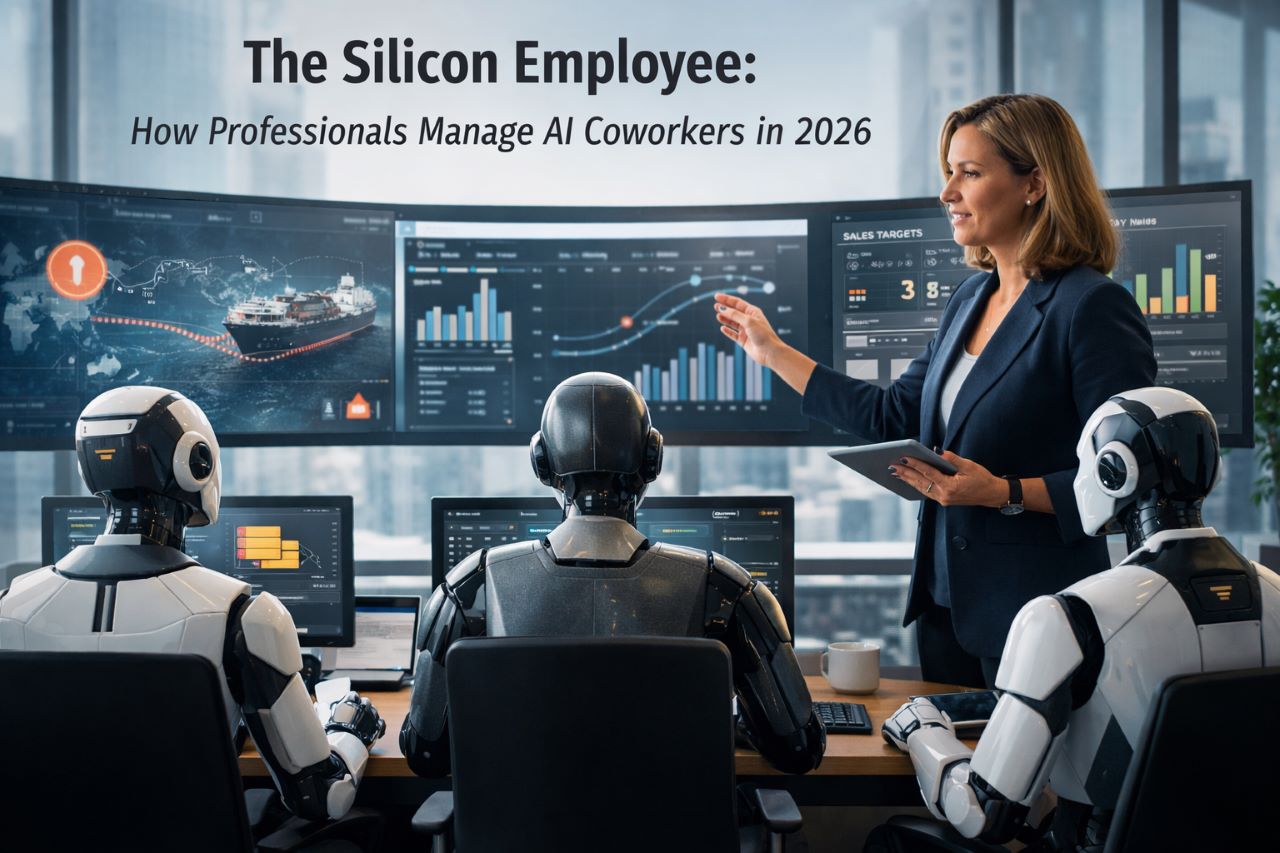
By 2026, the most consequential change in the workplace is no longer about automation replacing jobs. It is about decision-making authority quietly shifting away from humans and into software systems.
Across US and European enterprises, AI agents already schedule work, prioritize tasks, adjust budgets, negotiate with vendors, and evaluate outcomes with limited human input. Gartner’s projection that roughly 15% of work decisions will be autonomous by 2026 has moved from an abstract forecast to an early operational reality.
The real transformation is not the disappearance of work, but the recomposition of responsibility. A new workforce layer is emerging: silicon-based employees—specialized AI agents that execute continuously, coordinate with one another, and escalate only high-stakes exceptions to their human counterparts.
The professional challenge is no longer competing with AI. It is learning how to manage it without losing authority.
Information Gain: AI as a Team, Not a Tool
Most coverage still frames workplace AI as tools that help individuals work faster: copilots, assistants, and chat interfaces. That framing misses the structural shift now underway.
AI is no longer being deployed as a helper. It is being deployed as a team.
Organizations are assembling multi-agent architectures—collections of narrow, specialized agents that collaborate, validate one another’s outputs, and operate within defined authority limits. This changes what “work” actually means.
Execution is becoming machine-native. Judgment, accountability, and boundary-setting remain human.
The critical skill gap in 2026 is not prompt-writing or AI literacy. It is orchestration: knowing how to define objectives, set constraints, and retain responsibility when execution itself is automated.
Deep Analysis: The Silicon Team in Action
To handle real enterprise complexity, companies are shifting toward role-based agent systems, often structured around clearly defined responsibilities:
- Production Agent: Generates drafts or operational plans. In technical sectors, this has evolved into Self-Healing Software (tpt.li/codex-2026).
- Performance Agent: Evaluates outputs against KPIs, budgets, and historical data
- Commercial Agent: Adjusts pricing, procurement, or resource allocation
- Coordinator Agent: Acts as the project manager, resolving conflicts and escalating anomalies
- Content Agent: Handles high-fidelity creative output, such as the systems used in the Disney x OpenAI Sora Deal.
No single agent “understands the business.” Stability comes from separation of duties and constant cross-checking, not from centralized intelligence.
This design mirrors distributed systems engineering more than traditional management theory. It introduces friction deliberately—surfacing issues early rather than optimizing blindly.
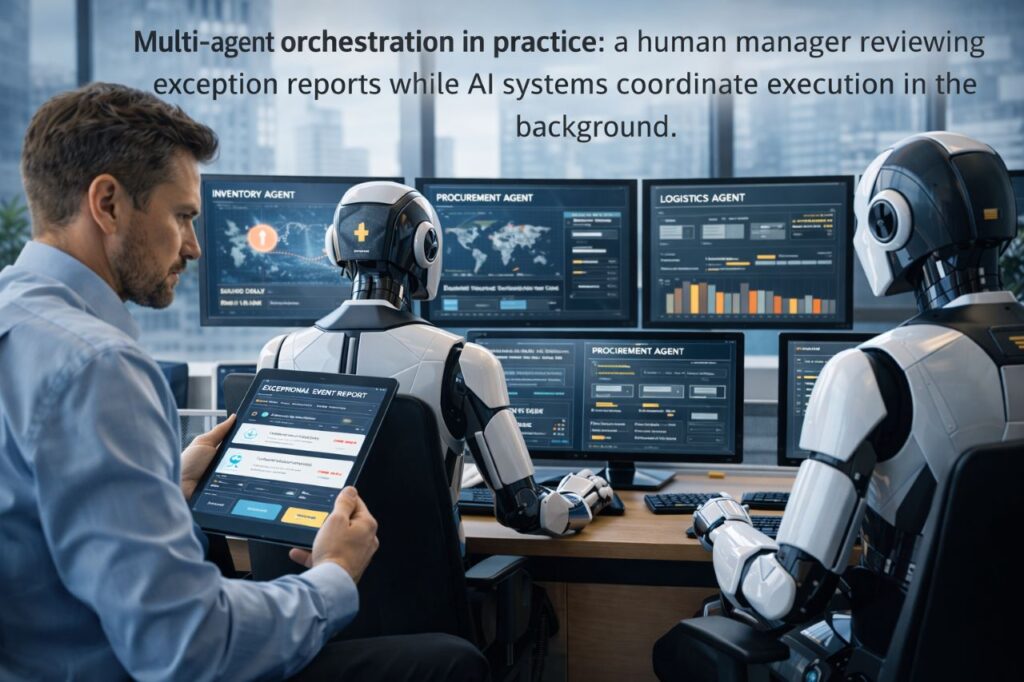
Scenario: The 2026 Supply Chain Manager
In 2022, a supply chain manager at a mid-sized retail company spent roughly 60% of their day inside spreadsheets. In 2026, they oversee a Silicon Pod.
- The Inventory Agent detects a shipping delay and calculates stock-out risk across regions.
- The Procurement Agent identifies alternative suppliers and drafts revised contracts with adjusted pricing.
- The Logistics Agent reroutes shipments to prioritize high-margin stores.
- The Coordinator Agent compiles these actions into a single Exceptional Event Report and sends it to the human manager.
The human role changes completely.
The manager does not do the math or the rerouting. They review the report, assess long-term supplier relationships and reputational impact—factors the AI cannot weigh—and approve or modify the plan.
Execution takes seconds. Judgment remains human.
This is what the silicon workforce looks like in practice: not autonomous chaos, but structured delegation with clear escalation paths.
Winners and Losers
Winners
System Managers
Professionals who define objectives, escalation rules, and constraints gain leverage, even if they execute less work themselves.
Lean Teams
Small, high-skill organizations can scale output without linear headcount growth.
Governance Platforms
Tools that monitor, audit, and constrain agent behavior become more valuable than agents themselves.
Losers
Pure Execution Roles
Jobs defined primarily by repetitive, high-volume output with limited decision authority face steady compression.
The Unaccountable
Organizations that deploy autonomy without clear human ownership accumulate silent risk.
Speed-Over-Resilience Firms
Companies relying on single-agent systems without checks and balances trade short-term efficiency for long-term instability.
Why This Matters
The rise of the silicon-based workforce reshapes how power, responsibility, and value are distributed at work.
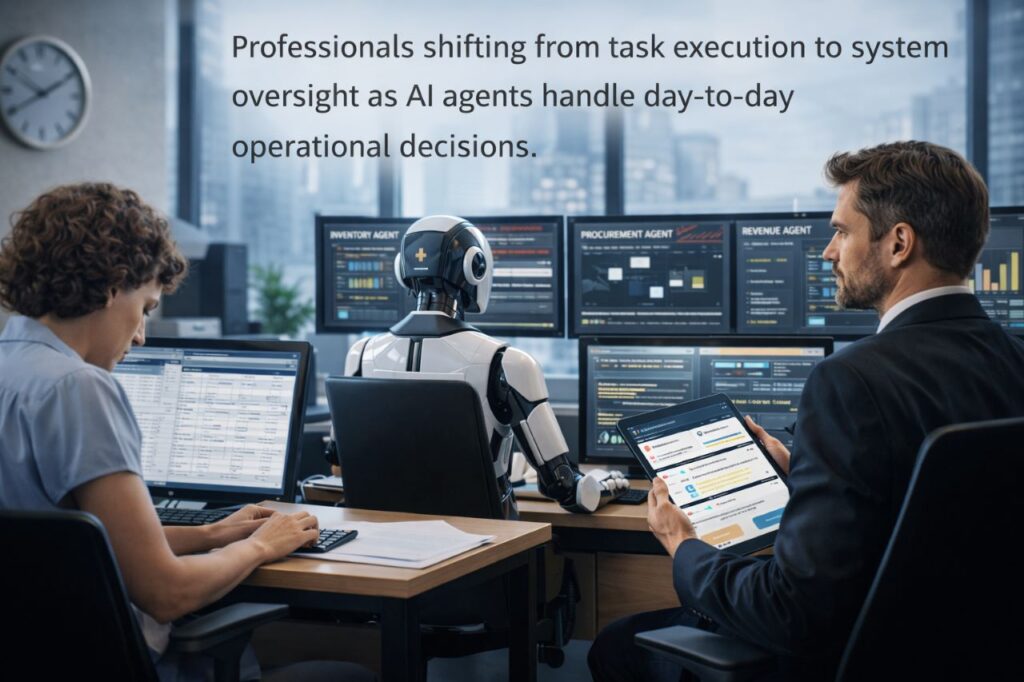
For individuals, career resilience increasingly depends on moving from execution to oversight.
For organizations, competitive advantage shifts from raw efficiency to coordination quality.
For society, decision authority migrates into systems unless humans deliberately retain control.
This shift is not inevitable. It is architectural.
What To Do Now
Start by reframing your own role:
- Deconstruct your workflow: Break work into creation, review, decision, and optimization.
- Identify delegation points: Which stages could be handled by a specialized agent pod?
- Define your human-only zone: Where must judgment remain non-negotiable for ethical or strategic reasons?
- Practice management by exception: Instead of doing the work, learn to audit the one thing the system might have missed.
The earlier this shift happens, the more authority you retain.
Tech Plus Trends Knowledge Hub
- Agentic Commerce: How Auto-Shoppers are Redefining Retail
- Next-Gen Browsing: ChatGPT Atlas vs. Google Chrome
- Supply Chain: OpenAI’s Impact on Global Logistics
FAQs
1.What is a silicon-based workforce?
Ans-A coordinated group of AI agents performing specialized roles under human supervision.
2.Are AI agents replacing managers?
Ans-No. They increase the importance of oversight, judgment, and accountability.
3.Do I need to code to manage AI agents?
Ans-Technical literacy helps, but systems thinking matters more.
4.Are multi-agent systems reliable today?
Ans-Within defined constraints, yes—but governance remains essential.
5.Which roles are affected first?
Ans-Execution-heavy roles with limited decision authority.
6.Is this only relevant to large enterprises?
Ans-No. Smaller teams often adopt orchestration faster due to simpler workflows.
Final Takeaway
The future of work is not humans versus machines. It is humans deciding what machines are allowed to decide.
As execution shifts to silicon, professional value rises with judgment, oversight, and responsibility. Those who learn to manage AI coworkers early will not be replaced—they will quietly become indispensable.
Sources
- Gartner workplace automation outlook (2025–2026)
- Enterprise reporting on multi-agent AI deployments
- Research on distributed systems and orchestration models
- Industry analysis on AI governance and decision automation
Author Bio
Saameer Go is the founder and editor of Tech Plus Trends. He covers AI platforms, workplace automation, and the structural shifts reshaping how technology redistributes decision-making and power.