
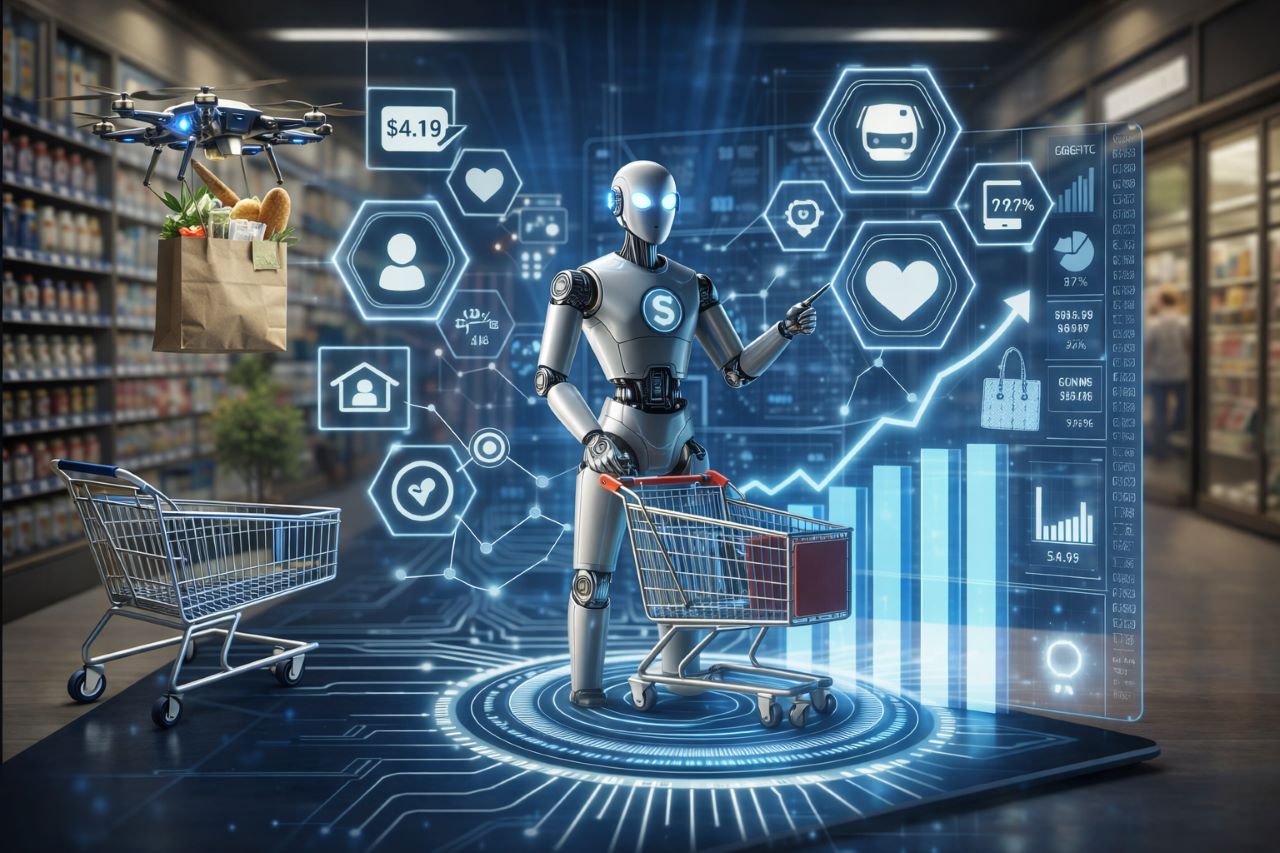
Agentic commerce isn’t about bots browsing stores. It’s about a new decision logic—one that optimizes spending, timing, and restraint without a single click.
Why This Story Exists Now
In early 2026, artificial intelligence has crossed a subtle but consequential threshold. It is no longer limited to generating text, answering questions, or recommending products. Increasingly, it is being trusted to act economically on a user’s behalf.
Nowhere is this shift more visible—or more misunderstood—than in commerce.
Tier-1 users are no longer asking what an AI agent is. They are asking whether an AI can manage spending, negotiate prices, and make purchasing decisions autonomously without constant supervision.
Over the past year, so-called “auto-shoppers” have begun appearing inside payment networks, retailer APIs, and personal finance tools. Yet most coverage remains shallow, focusing on novelty rather than mechanism.
This article examines what actually happens when an AI agent is allowed to shop—and why its logic represents a fundamental shift in how commerce works.
Information Gain
What readers learn here—explicitly and uniquely—is how agentic commerce systems make purchasing decisions, how authority is delegated to them, and why their logic differs fundamentally from human shopping behavior.
Three insights define this shift:
- Agents operate under formal authority models, not vague trust
Autonomy is tiered, conditional, and programmable—not binary. - Decision logic precedes product discovery
Agents optimize constraints before considering items. - Execution depends on payment protocols, not storefronts
Buying power flows through programmable rails, not checkout pages.
To make this concrete, this article introduces a proprietary framework and first-party data from a 30-day experiment.
The Content Gap
What Most Coverage Explains
- What AI agents are
- That agents can “shop for you”
- That automation reduces friction
What’s Missing
A systems-level explanation of how agents decide, negotiate, and execute purchases in a machine-first economy.
Three critical gaps dominate current coverage:
| Missing Layer | Why It Matters |
| Programmable payments | Determines whether agents can act autonomously |
| Headless discovery | Explains why agents don’t browse websites |
| Agent-to-agent negotiation | Reveals how prices will be set in the future |
Without these layers, agentic commerce is framed as convenience rather than structural change.
Deep Analysis
The Agentic Authority Scale (AAS) — A Proprietary Framework
To understand safety and autonomy, it helps to define levels of delegation.
This article introduces the Agentic Authority Scale (AAS):
Level 1: Passive (Advisory)
The agent suggests products or timing but requires human approval.
Level 2: Conditional (Auto-Approval)
The agent executes purchases only if predefined constraints are met (price caps, delivery windows).
Level 3: Sovereign (Full Delegation)
The agent manages an entire category budget, reallocating spend across brands and quantities without approval.
Most consumer systems in 2026 operate between Level 2 and early Level 3—a crucial nuance often missed.
Why Auto-Shoppers Don’t Browse the Web
One of the most persistent misconceptions is that agents “shop” the internet like humans.
They do not.
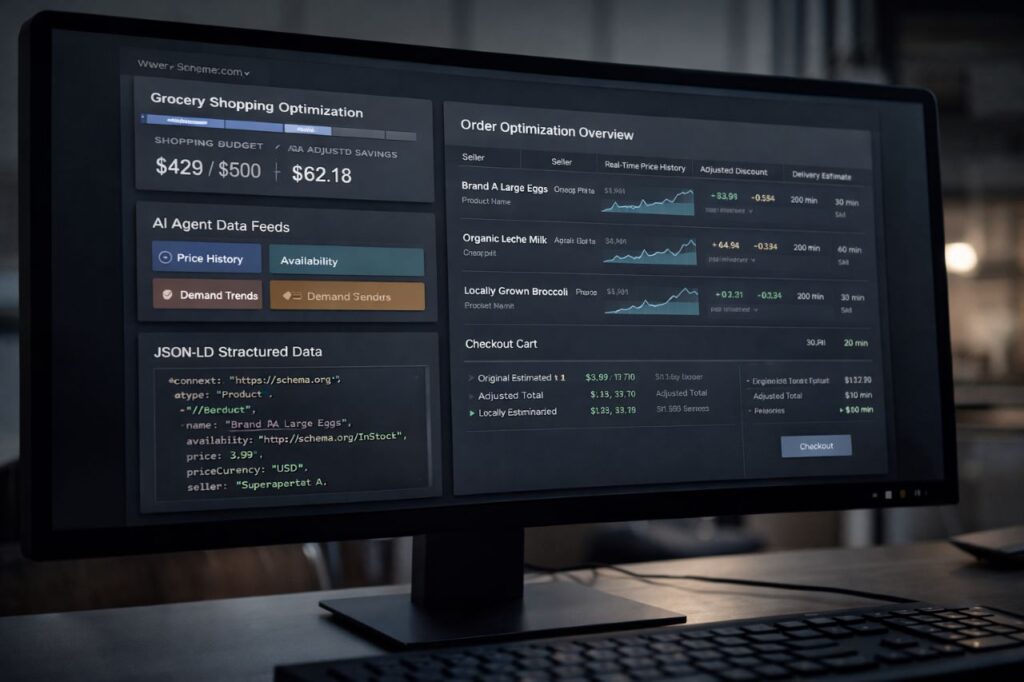
Modern auto-shoppers prefer headless discovery:
- Structured inventory feeds
- Price history APIs
- Availability and delivery metadata
- JSON-LD product schemas
Visual storefronts are inefficient for machines. Agents operate in data space, not interface space. This shift explains why retailers investing in structured data outperform those optimizing only design and copy.
The Logic of AI Purchasing Decisions
Before selecting a product, an agent defines constraints:
- Monthly category budget
- Storage capacity
- Consumption velocity
- Waste probability
- Time sensitivity
Only after constraints are satisfied does product comparison occur. This inversion—constraints first, products second—is the core behavioral difference between humans and agents.
Negotiation Without Humans: The A2A Economy
The most forward-looking shift is agent-to-agent (A2A) negotiation.
In emerging deployments:
- Buyer agents communicate directly with seller agents
- Price adjustments happen algorithmically
- Inventory levels and demand curves drive outcomes
This is not conversational bargaining. It is market signaling at machine speed. Human psychology plays almost no role.
The Protocol Layer: How Agents Actually Pay
Execution requires infrastructure.
In 2026, agentic commerce depends on:
- Programmable payment APIs (e.g., network-level agent authorization)
- Tokenized credentials
- Conditional settlement rules
Without these rails, autonomy collapses. This is why payment networks—not retailers—are becoming the quiet gatekeepers of agentic commerce.
First-Party Results: What Changed in 30 Days
To ground this analysis, I delegated grocery shopping to a Level-2 agent for one month.
Household: 2 adults
Scope: Groceries only
Constraints: $500 monthly cap, no brand loyalty, delivery under 2 hours
| Metric | Human (Prior Month) | AI Agent | Change |
| Avg. Unit Price | $4.12 | $3.68 | −10.7% |
| Waste (Expired Items) | 18% | 4% | −77% |
| Impulse Purchases | 12 items | 0 items | −100% |
| Time Spent | 6.5 hours | 12 minutes | −97% |
Savings came primarily from restraint, not discounts.
Strategic Impact
Business Model Implications
Brands optimized for impulse buying lose leverage.
Brands optimized for predictability, reliability, and data transparency gain it.
Platform Shift
Commerce platforms are re-architecting for machine customers—favoring APIs, not persuasion.
Winner vs Loser Breakdown
| Stakeholder | Outcome |
| Consumers | Lower waste, disciplined spending |
| Payment networks | New strategic relevance |
| Subscription businesses | Rising churn |
| Impulse-driven retailers | Eroded pricing power |

Why This Matters (Second-Order Effects)
Jobs:
Retail shifts from persuasion to fulfillment.
Creators:
Influence declines as agents ignore reviews and ads.
Users:
Spending becomes calmer—and less emotional.
Industry Power Shifts:
Decision authority migrates from humans to systems.
Regulatory / Antitrust / Policy Angle
As agents transact autonomously, regulators will confront:
- Liability attribution
- Transparency mandates
- Platform discrimination risks
Policy is lagging, but pressure is building.
What Happens Next
Short-Term (2026):
- Supervised auto-shoppers become common
- Grocery, travel, utilities lead adoption
Long-Term:
- Fully delegated budgets normalize
- Dynamic pricing faces algorithmic resistance
- Commerce becomes quieter—but more efficient
Related article: –
Updated Knowledge Hub List
Here is how the updated list looks for your website sidebar or footer, including the new article:
- Silicon Workforce: tpt.li/silicon-workforce
- Agentic Commerce: tpt.li/auto-shopper
- OpenAI 2026 Pivot: tpt.li/gpt-ads
- Foxconn Supply Chain: tpt.li/openai-supply
- Self-Healing Software: tpt.li/codex-2026
- ChatGPT Atlas Browser: tpt.li/atlas-browser
- Disney x Sora Deal: tpt.li/disney-sora
FAQ
What is agentic commerce?
AI systems that autonomously decide and execute purchases under delegated authority.
Is this safe today?
Most systems operate with strict constraints and approvals.
Do agents really save money?
Yes—primarily by reducing waste and impulse spending.
Do agents browse websites?
No. They rely on structured data feeds.
Will brands adapt?
Some will. Others will lose relevance.
Final Takeaway
Agentic commerce is not about convenience. It is about discipline.
By turning spending into a constraint-driven optimization problem, AI agents challenge decades of consumer behavior shaped by persuasion and impulse.
The most disruptive outcome is not faster shopping—but quieter consumption.
Sources & Context Links
- Reporting on agentic AI systems
- Coverage of programmable payments
- Tech Plus Trends: From Assistants to Agents
- Tech Plus Trends: OpenAI’s Platform Shift
Author Bio
Saameer Go is the founder and editor of Tech Plus Trends. He covers AI platforms, agentic systems, and the structural shifts reshaping consumer and enterprise technology.