
Why this matters now
In 2026, Warsaw’s tech labor market is no longer governed by generic “developer demand” narratives. It is governed by institutional gravity.
On one side sits a deeply entrenched banking, insurance, and shared services ecosystem—under pressure from KSeF 2.0, NIS2, and post-pandemic modernization mandates. On the other sits a fast-growing network of global R&D hubs and AI-first companies experimenting with agentic systems, automation, and product velocity.
The choice between Java and Python in Warsaw is no longer about syntax, performance, or learning curves. It is a decision about which economic engine you are plugging your career into—and what level of regulatory, financial, and technological risk you are willing to absorb over the next decade.
Information Gain — What most articles completely miss
Most “Java vs. Python” comparisons fail because they assume a single labor market.
Warsaw has at least two.
Java and Python are not competing for the same jobs in 2026. They are embedded in different institutional systems with different incentives:
- Java powers Warsaw’s role as a Central and Eastern European backbone for banking, fintech, and regulated enterprise services.
- Python fuels AI experimentation, internal tooling, and agentic workflows inside global R&D centers and scaleups.
Understanding this distinction transforms the debate from “Which language should I learn?” into “Which risk model do I want my career to follow?”
That is the information gap most global tech blogs never close.
Deep Research — Warsaw’s real labor mechanics in 2026
The legacy modernization wave (why Java demand looks paradoxical)
Warsaw’s banking and SSC sector is not standing still. It is in the middle of a once-in-a-generation modernization cycle:
- Java 8/11 monoliths are being migrated to Java 21 and Java 25 (LTS)
- Reactive stacks are being simplified using Virtual Threads (Project Loom)
- Spring Boot is paired with Kubernetes to meet auditability and throughput requirements driven by KSeF 2.0
This explains the so-called “Senior Java crisis.” Demand is concentrated at the architect and senior engineer level, not among juniors. Banks are hiring Java developers not to maintain legacy systems, but to make them cheaper, simpler, and more compliant under NIS2-style scrutiny—a regulatory context also explored in depth in this Poland-focused NIS2 compliance analysis: https://techplustrends.com/techplustrends-com-nis2-compliance-poland-romania-2026/
Python’s agentic demand (not data science, not hype)
Python’s growth in Warsaw is often attributed to “AI” in vague terms. In reality, demand is driven by agentic workflows—systems that can reason, delegate, and orchestrate tasks across tools.
Warsaw-based R&D centers are increasingly experimenting with frameworks such as LangGraph and CrewAI, particularly in environments like Google Cloud’s local engineering hub. This mirrors broader shifts toward self-healing and autonomous software architectures, similar to those described in the context of next-generation coding systems here: https://techplustrends.com/gpt-5-2-codex-self-healing-software-2026/
These roles reward systems thinking and architectural judgment, not generic Python literacy.
Salary divergence: floor versus ceiling
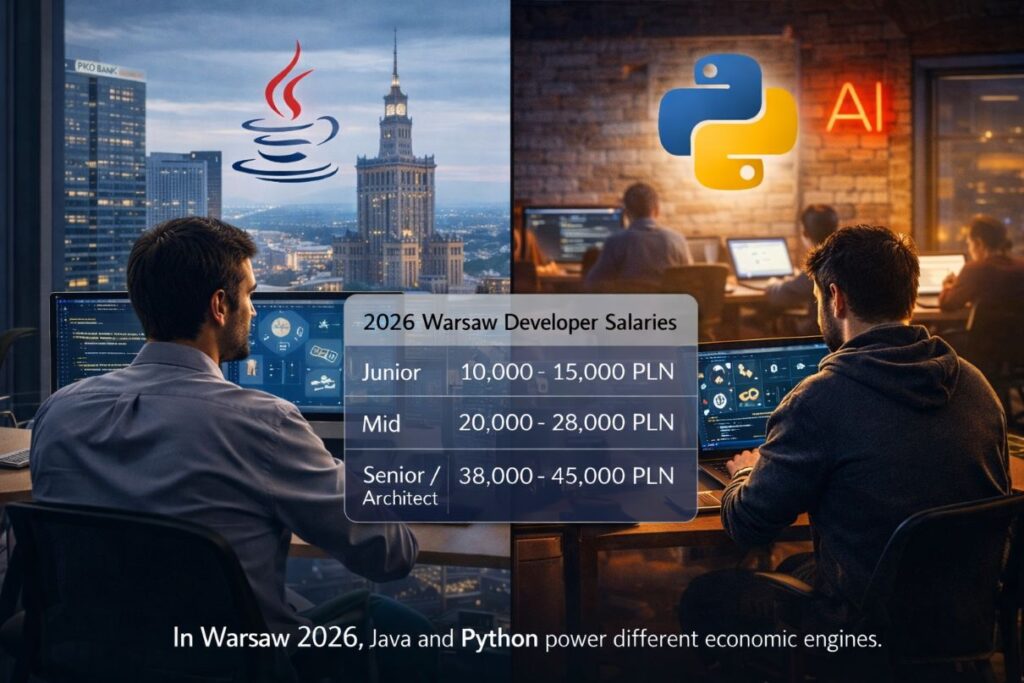
Warsaw’s 2026 B2B market shows a clear split:
- Java offers a higher salary floor, especially for mid-level developers embedded in regulated environments.
- Python offers a higher ceiling, but only for specialists operating close to revenue-generating AI systems.
This reflects institutional risk tolerance, not language superiority.
Case Study — Two developers, one city
In 2022, two developers graduate from Warsaw University of Technology (PW).
Developer A joins a banking SSC near Rondo Daszyńskiego, working on Java-based transaction systems. By 2026, they are deeply involved in Java 25 migrations, earning a stable, high mid-to-senior B2B rate with long-term contract security.
Developer B joins a Praga-based product team building AI-driven internal tools in Python. Their early years are volatile, but by 2026 they are embedded in a global R&D group designing agentic systems tied directly to business outcomes.
Both careers are successful. They are simply anchored in different economic realities.
Winners vs. Losers — Mandatory analysis
| Category | Winners in Warsaw 2026 | Losers in Warsaw 2026 |
| Roles | Java architects, AI-focused Python engineers | Script-only juniors, generic analysts |
| Company Types | Banks, SSCs, global R&D hubs | Low-margin outsourcing shops |
| Behaviors | Deep stack + domain specialization | Tool hopping without institutional context |
| Risk Exposure | Auditable, governed systems | Opaque automation and short-lived projects |
Comparison Matrix — Java vs. Python (Warsaw, 2026)
| Dimension | Java (LTS 21/25 + Spring) | Python (Agentic / FastAPI) |
| Warsaw HQ Location | Wola / Rondo Daszyńskiego | Praga / Mokotów / Remote |
| Primary Industry | BFSI, fintech, insurance | Global R&D, AI labs, e-commerce |
| 2026 B2B Floor (Mid) | 20,000–28,000 PLN | 18,000–26,000 PLN |
| 2026 B2B Ceiling | ~38,000 PLN (Architect) | 45,000+ PLN (AI specialization) |
| Regulatory Driver | KSeF 2.0, financial audit | NIS2, GDPR-aligned AI |
| Hiring Cycle | Long-term, stable | Faster, milestone-based |
CoE Framing — Language choice as governance strategy
In Warsaw, technology decisions increasingly flow through Centers of Excellence (CoEs).
Java-heavy organizations use CoEs to enforce standardization, auditability, and compliance—particularly important as automation and RPA mature, as discussed in this SSC-focused analysis: https://techplustrends.com/best-rpa-tools-poland-ssc-2026/
Python-heavy organizations use CoEs differently: to govern experimentation, prevent uncontrolled AI deployment, and define acceptable autonomy boundaries—an issue closely related to the rise of agentic commerce and autonomous systems: https://techplustrends.com/agentic-commerce-auto-shopper-era/
Language choice, in practice, reflects how much uncertainty an organisation can tolerate.
Why This Matters — Second-order effects
- Human impact: Careers bifurcate into stable, regulated paths versus volatile, high-upside roles
- Economic impact: Warsaw’s competitiveness depends on balancing banking gravity with AI velocity
- Organizational impact: Hybrid, polyglot seniors—Java for transactional cores, Python for AI orchestration—are becoming the highest-paid profiles
This mirrors broader shifts toward AI coworkers and silicon-based workforces reshaping how teams are structured: https://techplustrends.com/silicon-based-workforce-ai-coworkers/
What To Do Now — Practical actions
- Assess your risk tolerance, not just your interest in a language
- Evaluate employers by institutional maturity, not stack slogans
- Java developers should invest in cloud-native design and Kotlin literacy
- Python developers should move toward agentic orchestration, not generic analytics
For contractors and SSC leaders, this also intersects with regional cost and outsourcing dynamics explored here: https://techplustrends.com/outsourcing-poland-vs-romania-2026-costs/
FAQs — Real questions Warsaw professionals ask
1.Is Java still worth learning in Warsaw in 2026?
Ans-Yes—especially for long-term enterprise and banking careers.
2.Is Python oversaturated?
Ans-At the junior level, yes. At the AI-specialist level, no.
3.Which stack is safer for B2B contractors?
Ans-Java offers more predictable contracts.
4.Can I switch from Java to Python later?
Ans-Yes, but domain knowledge transfers more easily than syntax.
5.How does KSeF affect Java demand?
Ans-KSeF requires high-throughput, auditable backend systems. In Warsaw, banks prefer the JVM because it integrates cleanly with existing financial reconciliation engines.
6.Is Kotlin replacing Java in Warsaw?
Ans-No. It is modernizing it.
Sources
- Polish banking and SSC labor market reports (2025–2026)
- Warsaw B2B salary benchmarks
- EU regulatory frameworks (KSeF, NIS2, GDPR AI)
- Enterprise modernization and agentic AI research
- TechPlusTrends editorial analyses (linked contextually above)
Final Takeaway
In Warsaw, Java and Python are not rivals. They are infrastructure choices tied to institutional risk models.
The right decision is not about what is trendy—but about how you want your career to behave under pressure.
Understanding that distinction is what separates informed strategy from reactive choice.
Author Bio
Saameer Go is a senior technology journalist and editorial strategist covering enterprise software, AI governance, and European technology labor markets. With over 15 years of experience analyzing how regulatory, economic, and institutional forces shape technical careers, his work prioritizes long-term clarity over short-term trends.