
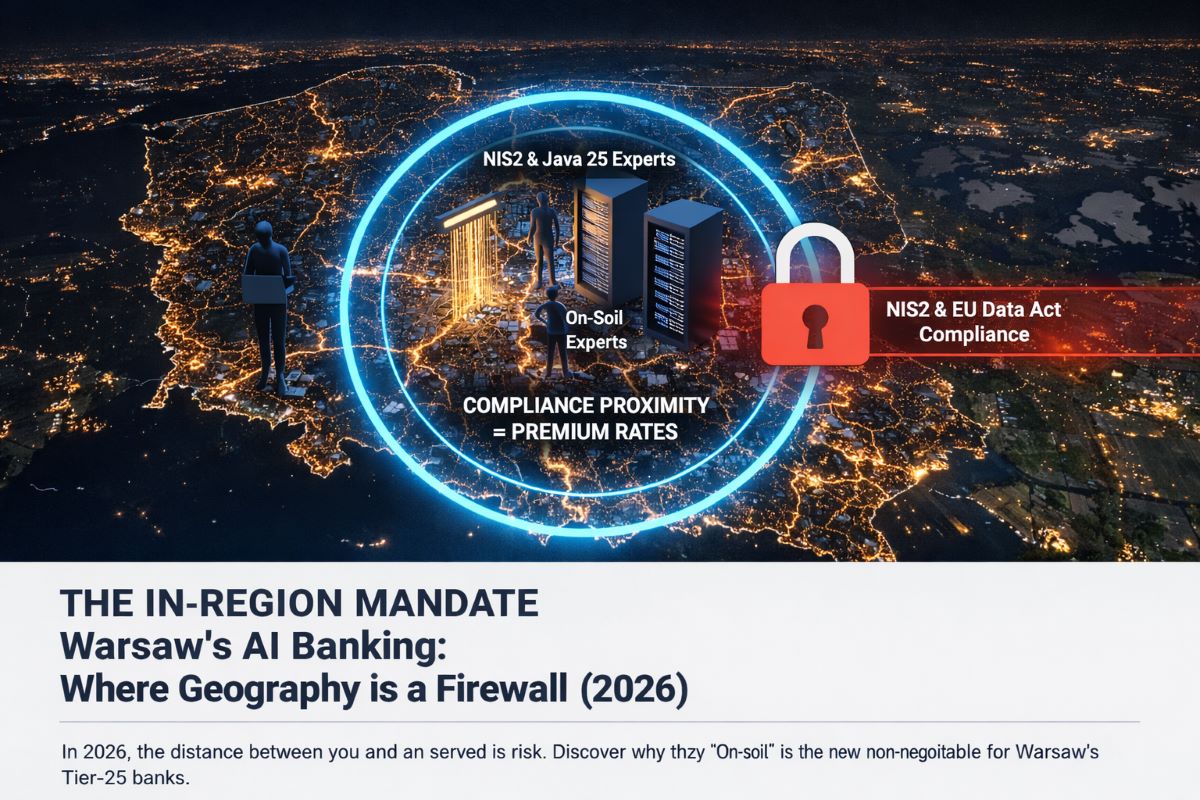
Update (2026): This analysis reflects the latest regulatory, labor, and platform changes currently in force across the EU banking sector.
Warsaw has already established itself as Central Europe’s most advanced AI-ready banking hub. Sovereign cloud regions, GPU-dense infrastructure, and low-latency execution environments are now operational realities rather than roadmap promises. Yet in 2026, Tier-1 banks operating from Poland are confronting a constraint that sits outside traditional technology discussions.
Under NIS2 and the EU Data Act, who operates critical systems — and from where — has become a measurable operational risk. This is no longer a debate about office culture or remote productivity. It is about regulatory exposure, incident response timing, and audit defensibility. Many organizations are discovering this only after their infrastructure strategy is already in place.
Key Takeaways
- Developer location is now a regulatory risk variable in EU banking.
- NIS2 elevates supply-chain geography into board-level oversight.
- Java 25 and Project Loom solve concurrency — not jurisdictional exposure.
- Warsaw banks increasingly require on-soil B2B contractors for critical systems.
- This compliance premium explains why Polish rates outpace neighbouring markets.
My Information Gain
Most commentary frames the decline of remote work as a cultural or managerial shift. That interpretation misses the deeper force at play. In regulated financial systems, distance is becoming auditable.
This article introduces a decision primitive that is largely absent from public discourse:
Compliance Proximity.
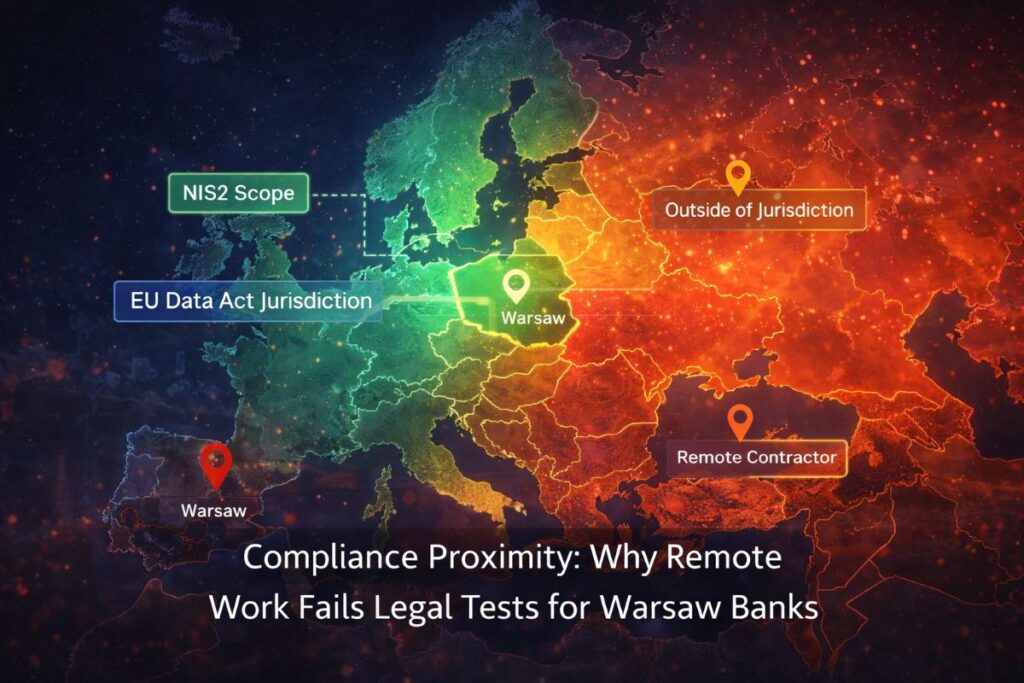
In 2026, the physical and legal distance between a contractor and the infrastructure they operate directly affects incident containment, forensic access, insurance coverage, and post-incident liability. For Tier-1 banks, proximity is no longer convenience — it is risk management.
Why “Compliance Proximity” Is Quietly Replacing Border-less Remote Work
Modern JVM advances such as Java 25 and Project Loom allow banks to run agentic AI systems with unprecedented concurrency. Execution bottlenecks that once dominated architecture discussions have largely been resolved.
What remains unsolved is physics and jurisdiction.
Even with optimized execution layers, a developer operating from outside the region introduces:
- Higher latency during live production intervention
- Reduced system observability under stress
- Legal ambiguity during evidence collection
For AI-driven banking systems operating within sub-5ms latency budgets, these factors are no longer theoretical. They surface directly during audits and incident simulations — especially when infrastructure is tightly coupled to local GPU clusters and sovereign cloud zones, as seen in Warsaw’s advantage over Bucharest (https://techplustrends.com/warsaw-ai-infrastructure-vs-bucharest-2026/).
Case Study / Real-World Scenario: Incident Response Under NIS2
Consider a Tier-1 bank running AI-assisted transaction monitoring from its Warsaw hub. During a live anomaly event, regulators require immediate containment, system introspection, and traceable operator access.
When critical B2B engineers are located outside the jurisdiction:
- Access paths cross legal boundaries
- Evidence handling becomes fragmented
- Incident timelines expand
Post-incident reviews increasingly focus not only on technical root causes, but on who had operational authority and from where. This is where otherwise competent remote arrangements begin to fail regulatory scrutiny.
Who Benefits — and Who Gets Exposed — in 2026
| Group | Exposure Profile |
| On-Soil Java 25 Contractors (Poland) | Compliance-aligned, audit-resilient |
| Remote Contractors Outside Jurisdiction | Elevated NIS2 and insurance scrutiny |
| Banks with Regional Execution Teams | Lower incident and audit friction |
| Borderless Delivery Models | Increasing regulatory exposure |
This dynamic explains why senior Java architects operating within Poland’s B2B framework are commanding structurally higher rates than peers elsewhere, even when headline technical skills appear similar (https://techplustrends.com/romania-vs-poland-senior-java-architect-tax-2026/).
Comparison Matrix: Borderless Talent vs. Sovereign Talent
| Dimension | Borderless Remote Model | In-Region Mandate Model |
| Incident Response | Jurisdictionally complex | Locally executable |
| Audit Defensibility | Harder to evidence | Clear accountability |
| Latency & Observability | Variable | Predictable |
| Regulatory Risk | Elevated | Reduced |
Cost comparisons across Central Europe show that apparent labor savings often dissolve once compliance, audit, and insurance factors are priced in (https://techplustrends.com/outsourcing-poland-vs-romania-2026-costs/).
CoE Framing: When Developers Become “Critical Suppliers”
From a Center of Excellence perspective, banks are reclassifying certain engineering roles. Developers who touch AI-driven execution layers, JVM runtimes, or real-time decision systems are increasingly treated as critical suppliers.
This classification triggers stricter oversight under NIS2 supply-chain rules and aligns with Poland’s broader tightening of B2B tax and compliance expectations for contractors operating in sensitive sectors (https://techplustrends.com/central-europe-it-contractor-tax-audit-2026/).
Strategic Implications for 2026
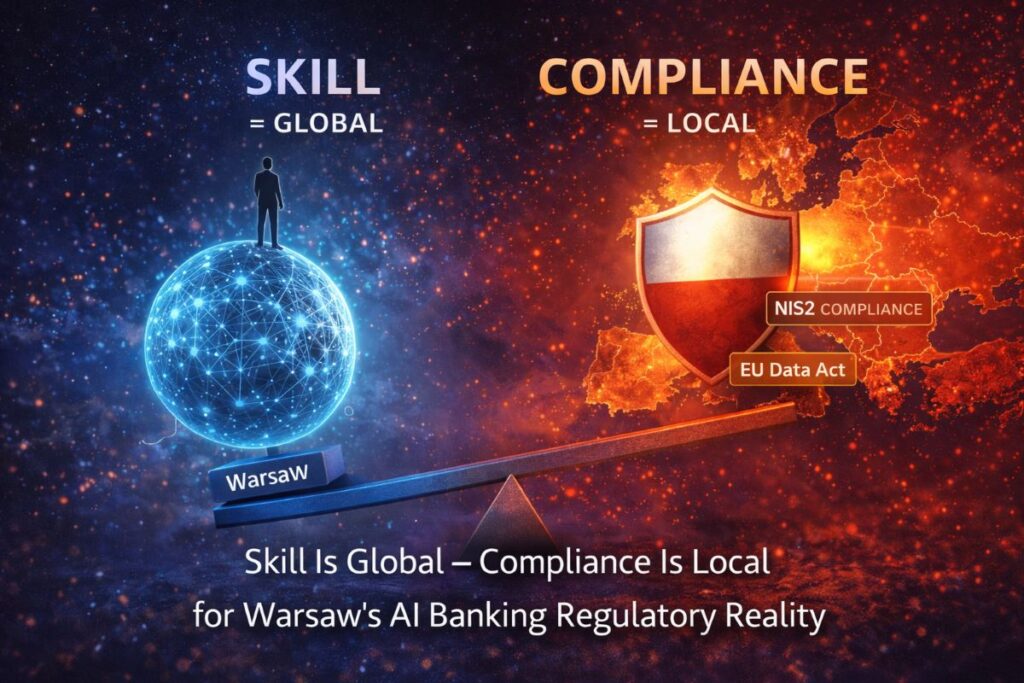
- Workforce geography becomes part of the security model.
- Java 25 expertise alone is insufficient without regional alignment.
- Warsaw’s advantage compounds because infrastructure, regulation, and labor are converging.
This is not a temporary correction. It is a structural realignment.
Why This Matters
As compliance proximity hardens, high-trust technical work concentrates geographically. Contractors willing to relocate gain durable advantage. Those who cannot may find themselves excluded from Tier-1 systems despite strong credentials.
At the system level, this reinforces Warsaw’s role not just as an infrastructure hub, but as a sovereign execution center — a theme already visible in the market response to Java 25 migration projects within Polish banking (https://techplustrends.com/java-25-migration-warsaw-banking-b2b-gold-mine/).
What To Do Now
- Banks: Audit operator location alongside system architecture.
- Contractors: Treat geography as a professional risk factor.
- CTOs & CISOs: Align workforce models with regulatory reality before incidents force change.
FAQs
1.Is remote work banned under NIS2?
Ans-No. But it increases exposure for critical systems.
2.Does the EU Data Act mandate local developers?
Ans-It raises pressure for local control of execution layers.
3.Can secure VPNs solve this?
Ans-They mitigate access risk, not jurisdictional liability.
4.Is this unique to Poland?
Ans-No, but Poland’s maturity makes it visible first.
5.Will this affect contractor rates?
Ans-Yes — compliance alignment commands a premium.
6.Is this trend reversible?
Ans-Unlikely. Regulatory pressure is structural.
Final Takeaway
In 2026, the most valuable Java 25 expert is not just technically capable, but geographically aligned. As AI banking systems collide with regulatory gravity, Compliance Proximity becomes the final constraint. Warsaw’s advantage now rests not only on what runs in its data centers — but on who is allowed to operate it, and from where.
Sources
- EU NIS2 Directive
- EU Data Act (2026 enforcement framework)
- European Banking Authority resilience guidance
- OpenJDK Project Loom documentation
Author Bio
Saameer Go is a senior technology journalist and analyst covering enterprise software, AI platforms, infrastructure, and EU technology regulation. With over 15 years of experience analyzing how policy, labor markets, and architecture decisions intersect, he focuses on long-term structural shifts rather than short-term hype.
Disclaimer & Transparency Note
Not Professional Advice: This analysis is for informational and strategic purposes only. It does not constitute legal, financial, or technical advice. While Java 25 and Project Loom represent significant shifts in execution architecture, individual bank infrastructure and specific regulatory requirements under NIS2 or the EU Data Act 2026 may vary. Readers should consult with specialized architects or legal counsel before initiating large-scale migrations.
AI Usage Disclosure: In accordance with the EU AI Act 2026, we disclose that portions of the technical formatting and data synthesis in this article were supported by Generative AI. All technical specifications regarding Java 25, ZGC performance, and Warsaw infrastructure roadmaps have been fact-checked by our human editorial team to ensure accuracy.
Forward-Looking Statements: Market rates, B2B contract premiums, and infrastructure timelines are based on 2026 projections and internal Tech Plus Trends audits. These are subject to change based on macroeconomic shifts, legislative amendments, or hyperscaler hardware availability.