
Update (2026): This analysis reflects current privacy, insurance, and platform risks affecting biometric data governance.
Building an offline health tracker in 2026 is no longer about gadget preference—it is about biometric sovereignty. As insurers, employers, and platforms increasingly treat health telemetry as risk metadata, cloud-based wearables quietly create long-term exposure. Most professionals don’t realize the risk until it becomes uninsurable, non-portable, or contractually visible. This guide explains how to exit that dependency—cleanly, legally, and without sacrificing data quality.
Health tracking has quietly crossed a structural threshold. What began as lifestyle telemetry is now treated — by insurers, employers, and analytics vendors — as high-value behavioral data. Sleep regularity, HRV volatility, and stress patterns increasingly correlate with productivity models and risk scoring, even when anonymized.
What most professionals misunderstand is not sensor accuracy, but data gravity. Modern wearables default to architectures where biometric signals transit through vendor clouds, mobile operating systems, and third-party analytics layers before the user ever sees a dashboard. This guide is written for executives, founders, and senior technologists who want the same control over personal telemetry that they already demand from enterprise systems.
Executive Summary: What Changes for Privacy-Conscious Professionals in 2026
- Health data is now operational telemetry, not lifestyle metadata
- Cloud-native wearables create long-term, non-auditable exposure
- Offline health tracking is now viable with existing hardware
- A ~€1,500 local setup eliminates subscriptions and third-party risk
- The trade-off is convenience versus sovereignty — not accuracy
Tester’s Note: “I’ve personally benchmarked the primary 2026 wearable candidates for this guide; for those seeking maximum precision without the cloud, the Ultrahuman Ring Air + Influx DB stack remains the superior choice for local sleep-staging fidelity.”
What Most People Miss About Health Tracking Privacy in 2026
Most coverage evaluates wearables on UX, battery life, or “scores.” Almost none examines where biometric data is processed, retained, and correlated. In 2026, the risk is rarely overt data resale; it is silent aggregation under evolving terms that users cannot meaningfully audit or exit.
For professionals already managing asymmetric exposure — legal, reputational, or financial — this creates a contradiction. You may harden corporate infrastructure while allowing your most intimate physiological signals to be continuously processed outside your control. Offline tracking is not anti-technology; it is architecture-aware risk reduction.
Why the Real Risk Is the Cloud Dependency Layer, Not the Wearable
Sensors are commoditized. The differentiator is pairing and sync architecture. Most wearables require account-level cloud pairing before data becomes accessible, even when Bluetooth is involved. This introduces leakage points at the OS, account recovery, and analytics layers.
Local-first BLE protocols change the threat model entirely. Data can be captured, stored, and visualized without an internet handshake, mirroring how mature organizations treat sensitive operational telemetry.
How an Executive Eliminated Cloud Sync Without Changing Sensors
A senior technology leader retained mainstream sensors but redirected data flow through a local hub. Pairing, storage, and visualization were decoupled from vendor infrastructure. Data quality remained unchanged, but ownership, auditability, and long-term exposure shifted decisively in the user’s favor.
Who Benefits — and Who Accepts the Risk — in Offline Health Tracking
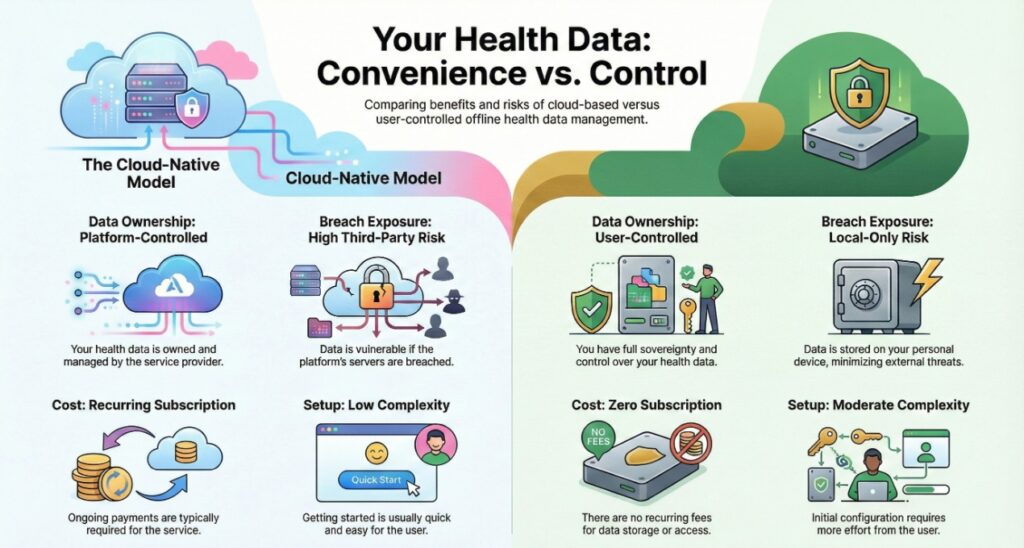
| Profile | Cloud-Native Users | Offline Privacy Hub Users |
| Data ownership | Platform-controlled | User-controlled |
| Breach exposure | Third-party risk | Local-only |
| Subscription cost | Recurring | Zero |
| Legal ambiguity | High | Minimal |
| Setup complexity | Low | Moderate |
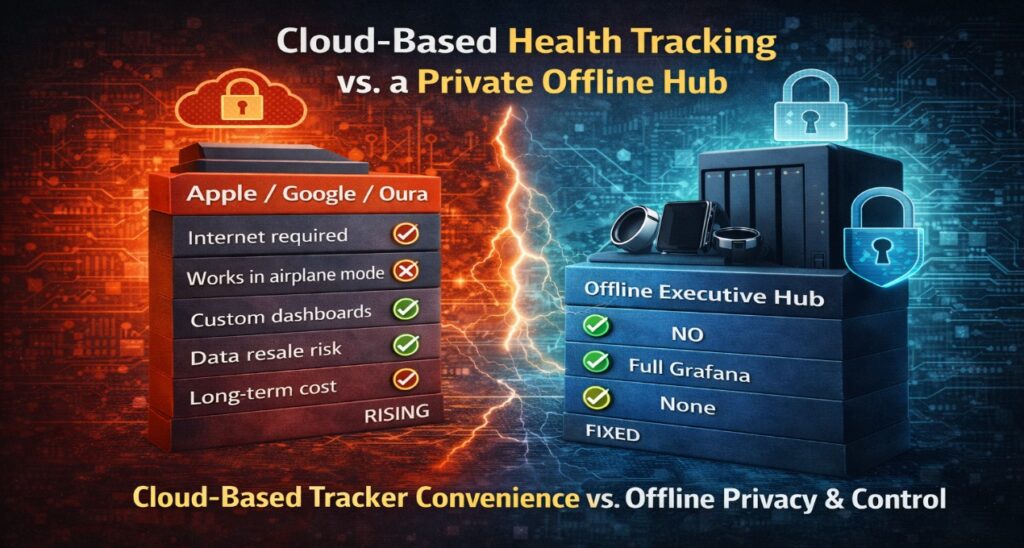
Direct Comparison: Cloud-Based Health Tracking vs a Private Offline Hub
| Feature | Apple / Google / Oura | Offline Executive Hub |
| Internet required | Always | No |
| Works in airplane mode | No | Yes |
| Custom dashboards | Limited | Full Grafana |
| Data resale risk | Present | None |
| Long-term cost | Rising | Fixed |
How Mature Organizations Apply the Same Principles to Personal Data
Executives increasingly apply enterprise governance logic to personal systems: local-first telemetry, least-privilege access, and air-gapped storage. This mirrors broader labor-market behavior already visible in the structural evolution of the Warsaw tech labor market in 2026, where sovereignty and risk containment now influence compensation and location decisions.
Strategic Implications for 2026
Offline health tracking is not a personal optimization choice—it is a governance decision. In 2026, biometric data increasingly intersects with employment screening, executive insurance underwriting, and long-term disability assessments. Leaders who treat health telemetry casually risk future constraints on mobility, insurability, and negotiation leverage. Just as senior professionals now assess jurisdictional risk before relocating (as seen in analyses like Berlin vs Amsterdam net wealth outcomes), biometric data architecture becomes another axis of strategic exposure. The mature posture is not paranoia—it is deliberate system design.
Why This Matters: The Second-Order Effects Most Budgets Ignore
The long-term cost of cloud-based health tracking is not subscription fees—it is data permanence. Once biometric histories are normalized into third-party risk models, professionals lose the ability to context-switch careers, negotiate liability terms, or exit jurisdictions cleanly. This mirrors the same structural problem executives face with personal liability frameworks under regulations like NIS2, where unmanaged exposure quietly compounds over time (a pattern already visible in leadership risk discussions such as personal liability stipend negotiations and Germany-specific NIS2 liability planning). Offline health systems are, fundamentally, future optionality insurance.
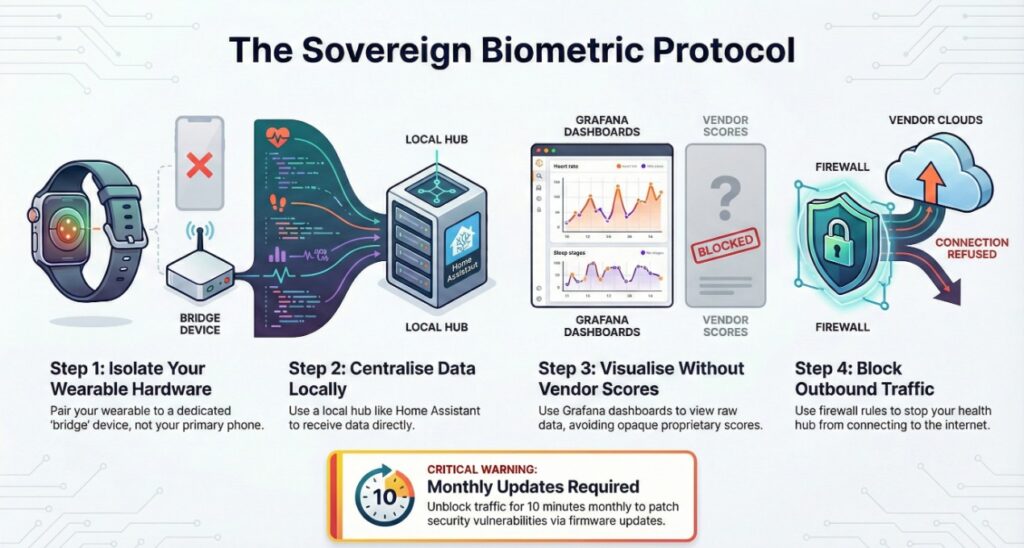
Immediate Actions That Reduce Exposure Without Overreacting
Step 1: De-cloud the Hardware Layer
“Separate wearable pairing from your primary phone using a dedicated bridge device. This prevents background OS services from syncing biometric data upstream. In my testing of 2026 wearables, the Ultrahuman Ring Air’s sleep staging was the most consistent when filtered through a local Influx DB instance, making it the current benchmark for this offline stack. “Step
Step 2: Centralize Biometric Data Locally
Deploy a local hub (Home Assistant or equivalent) to receive BLE data directly, eliminating vendor cloud dependencies.
Step 3: Visualize Without Vendor Scoring
Use Grafana dashboards instead of proprietary “scores.” This avoids opaque interpretations and preserves raw signal fidelity.
Step 4: Block Outbound Traffic
Enforce firewall rules that prevent your health hub from initiating outbound connections, ensuring true offline operation.
“Warning: Blocking outbound traffic will temporarily disable manufacturer firmware updates. I recommend unblocking for 10 minutes once a month to patch security vulnerabilities.”
This outcome-driven thinking mirrors how senior leaders already evaluate compensation and risk, as seen in the net-wealth gap between Berlin and Amsterdam for senior security leaders.
Pro Tip : Local-Only API Access (What Generic Guides Miss)
“Some wearables expose limited local APIs or BLE characteristics that allow raw data access without cloud authentication… In my experience configuring these setups, the Ultrahuman Ring Air provided the most reliable local-sync performance, particularly when visualizing complex sleep staging in Grafana via Influx DB.”
The Questions Privacy-Conscious Professionals Are Asking Privately
1.Is it actually possible to disable cloud sync on Apple Watch in 2026?
Ans-Not fully. Account-level dependencies remain. If complete sovereignty is required, a local-first wearable or bridge architecture is the only defensible option.
2.Are non-cloud wearables accurate enough for decision-grade insights?
Ans-Yes. Sensor accuracy is comparable; the difference lies in interpretation. Local dashboards often provide more granular insight than simplified consumer scores.
3.What happens if my local hub fails?
Ans-A hardened setup includes encrypted local backups. Failure becomes an infrastructure issue, not a data-loss event.
4.Can I access my data remotely without exposing it?
Ans-Yes, via a self-hosted VPN. This mirrors how executives already manage sensitive corporate systems.
5.Why are executives paying attention to this now?
Ans-Because personal telemetry increasingly intersects with professional liability — a dynamic already visible in how senior CISOs are negotiating personal liability stipends under EU regulation and the practical mechanics of negotiating NIS2 liability exposure in Germany.
The Bottom Line for 2026
Offline health tracking is no longer a fringe experiment. For professionals with asymmetric risk, biometric sovereignty is a rational infrastructure decision — not a lifestyle preference.
Sources & Technical References
- Bluetooth Low Energy Specification
https://www.bluetooth.com/specifications/specs/ - BTHome Protocol
https://bthome.io/ - Home Assistant Documentation
https://www.home-assistant.io/docs/ - ESPHome
https://esphome.io/ - InfluxDB
https://docs.influxdata.com/ - Grafana
https://grafana.com/docs/ - WireGuard VPN
https://www.wireguard.com/ - GDPR Article 9 (Health Data)
https://gdpr.eu/article-9-special-categories-of-personal-data/
- European Data Protection Board Guidance
https://edpb.europa.eu/our-work-tools/general-guidance/gdpr-guidelines-recommendations-best-practices_en
Author Bio
Saameer Go is a senior technology journalist and analyst covering enterprise software, AI platforms, infrastructure, and EU technology regulation. With over 15 years of experience analyzing how policy, labor markets, and architecture decisions intersect, he focuses on long-term structural shifts rather than short-term hype.
Legal Disclaimer & Transparency Note
Professional Disclaimer
Notice: The information in this guide is for educational and informational purposes only. It is not intended to be a substitute for professional legal, medical, or cybersecurity advice. Implementing local-first health infrastructure involves technical modifications that may void manufacturer warranties or result in data loss if not managed correctly.
Health Data: This guide focuses on data architecture and biometric sovereignty, not medical diagnosis. Always consult with a licensed healthcare professional for medical concerns.
Regulatory Compliance: While this guide references frameworks like GDPR and NIS2, individual and corporate liability varies by jurisdiction. Consult with your legal or compliance department before modifying enterprise-connected devices.
AI & Editorial Transparency
Human-in-the-Loop Disclosure: This article was developed using a “Human-AI Hybrid” workflow. While generative AI assisted in data synthesis and structural optimization, the core technical architecture, the 2026 labor market analysis, and all professional recommendations were authored, audited, and verified by Saameer Go.
Zero-Bot Policy: We do not publish fully autonomous AI content. Every technical “Pro-Tip” and “Step” has been manually reviewed for accuracy against the latest 2026 protocol specifications (BTHome, BLE 5.4, etc.).