


Europe controls less than 5% of global AI compute while US hyperscalers dominate over 70% of the regional cloud market. This imbalance is forcing enterprises to rethink where their AI systems run—and under whose laws. This guide explains how the EU sovereign AI infrastructure stack is actually deployed in 2026, including real AI factories, compliance requirements, and the hybrid architectures enterprises are adopting.
Key Takeaway
The EU sovereign AI infrastructure stack in 2026 is no longer a roadmap — it is operational. From the €75M EURO-3C federated cloud to Mistral’s €830M Paris data centre and Deutsche Telekom’s 0.5 ExaFLOPS Industrial AI Cloud, Europe is building at scale. Enterprises must now navigate a hybrid architecture that splits sensitive and non-sensitive workloads across sovereign and global cloud environments, while preparing for the full weight of EU AI Act enforcement from August 2, 2026 — and understanding which obligations may slip to 2027.
The 2026 Sovereign Shift: Why This Matters Now
AI infrastructure is no longer just about performance. It is about jurisdiction.
A sovereign AI infrastructure stack refers to a system where data, compute, and AI processing are governed entirely under EU laws — not just physically located in Europe.
Why 2026 is the inflection point:
- The EU AI Act full enforcement deadline is August 2, 2026, forcing compliance decisions that can no longer be deferred
- US Cloud Act concerns are pushing boards to demand EU-controlled systems, particularly in banking, healthcare, and defence
- Geopolitical realignment is reshaping procurement: the France-Germany Digital Sovereignty Summit (November 2025) launched a joint task force and the EU Council signed a Declaration for European Digital Sovereignty in December 2025
- Private capital is now flowing at scale — Mistral’s €830M institutional debt raise in early 2026 marked the first time a European AI company financed a hyperscale-level data centre without US venture capital
Who is immediately affected:
- Banks (DORA compliance + EU AI Act high-risk categories)
- Healthcare systems
- Government and defence
- Any enterprise deploying AI in HR, credit scoring, education, or law enforcement
This is not theoretical. It is operational.
The EU Compute Reality Check: Where Europe Stands
Before evaluating architecture options, compliance teams need to understand the structural gap Europe is closing — and how fast.
The hard numbers:
- The EU controls less than 5% of global frontier-scale AI compute
- US hyperscalers (AWS, Azure, Google) still command 70–72% of the European cloud market
- Private AI investment in the US runs approximately 24× higher than in Europe ($109B vs. $4–8B in recent annual figures)
- European AI startups have routinely trained models on US clouds because no domestic alternative existed at scale — until 2026
That is changing rapidly. Europe’s tech spending will exceed €1.5 trillion in 2026, growing 6.3% year-on-year (Forrester, 2026). The EU Chips Act is funding five AI gigafactories specifically for training complex AI models. Gartner forecasts that more than one-third of enterprises will use localised AI platforms by 2027, up from just 5% today.
The infrastructure gap is narrowing. The question is whether it narrows fast enough for enterprises facing August deadlines.
Platform Comparison: Sovereign AI vs. Global Cloud AI
| Infrastructure Type | Best For | Key Strength | Pricing Tier | Verdict |
| EU Sovereign AI Stack | Regulated industries | Full legal control + compliance | High (CapEx + OpEx) | Best for compliance |
| US Hyperscaler AI | Startups, global apps | Scalability + speed | Medium (usage-based) | Best for scale |
| Hybrid Sovereign Model | Enterprises | Balance of cost + compliance | Mixed | Best overall |
| Sovereign Cloud (AWS/Azure EU) | Transitional teams | Partial compliance | Medium-high | Limited sovereignty |
| European Tech Stack (DT/SAP/Siemens) | Industrial enterprises | Full EU stack, hyperscaler parity | High | Emerging best option |
The EU Sovereign AI Stack: Architecture Breakdown
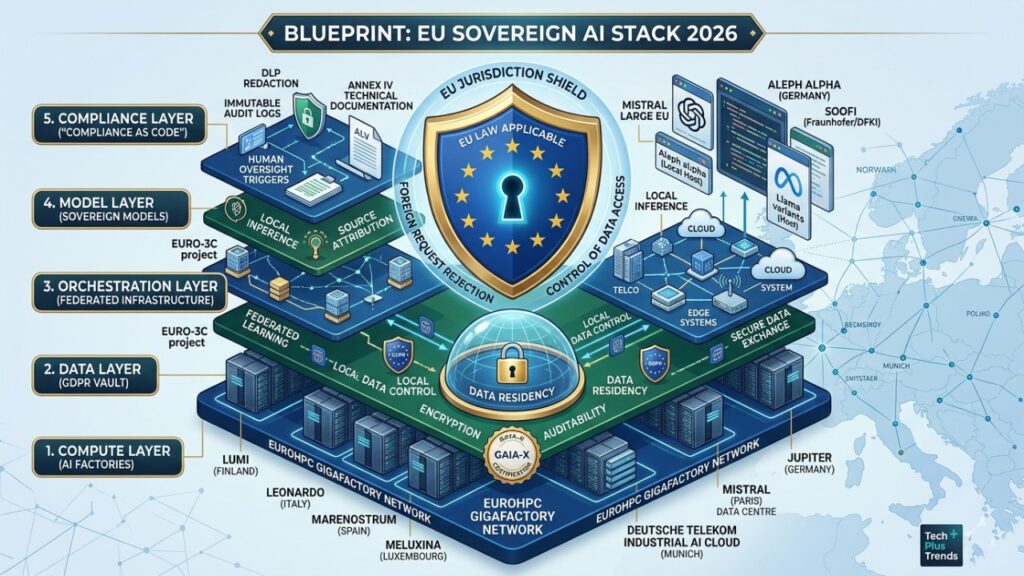
1. Compute Layer — AI Factories
Europe’s sovereign compute backbone is built on high-performance AI factories operated under national or EU-level governance.
EuroHPC’s 19 AI Factories (operational or selected):
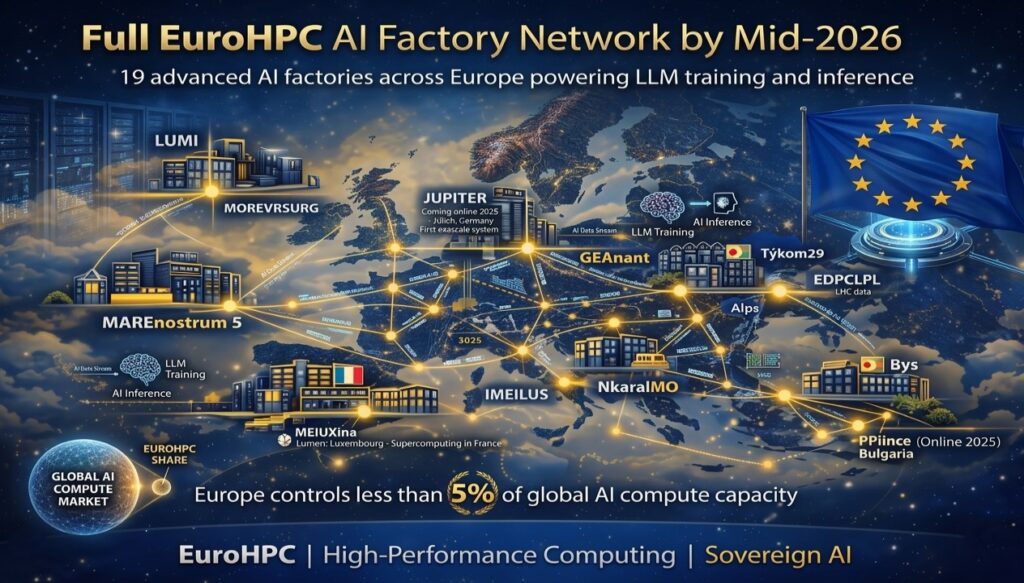
The most cited figure in this space — the “5 AI factories” — is outdated. EuroHPC now has 19 operational or selected AI Factories. The flagship five are:
- LUMI (Finland) — among Europe’s greenest supercomputers
- Leonardo (Italy) — one of the world’s top-10 supercomputers
- MareNostrum 5 (Spain) — Barcelona Supercomputing Centre
- MeluXina (Luxembourg) — serving SMEs and public sector
- JUPITER (Germany, 2026) — Europe’s first exascale-class system
New in 2026 — private-sector AI factories:
The most significant infrastructure announcement of 2026 was the Deutsche Telekom Industrial AI Cloud, opened in Munich in February 2026. Key specs:
- ~10,000 NVIDIA Blackwell GPUs
- 0.5 ExaFLOPS of computing power
- 100% renewable energy, river-water cooling
- Already delivering 80% feature parity with US hyperscalers via T Cloud Public, with full parity expected by end of 2026
This is not a research facility. It is a production-scale sovereign cloud alternative operated under strict German and EU data protection law.
Mistral’s Bruyères-le-Châtel Data Centre (Paris):
In early 2026, Mistral AI secured €830 million in institutional debt from a consortium including BNP Paribas, Credit Agricole CIB, HSBC, and MUFG — the largest private sovereign AI infrastructure bet in European history — to purchase approximately 13,800 Nvidia chips and build a major data centre near Paris. Expected online: Q2 2026.
The significance here is not just the scale. It is the financing mechanism: institutional debt, not venture capital. That signals infrastructure-grade commitment, not research experimentation.
2. Data Layer — GDPR-Compliant Storage
This layer ensures:
- Data residency within EU borders
- Controlled access and encryption at rest and in transit
- Audit-ready storage systems with retention policies aligned to regulation
Unlike traditional cloud storage, EU-sovereign data layers enforce:
- Data classification at ingestion
- Access traceability and immutable audit logs
- GDPR-compliant retention and deletion policies
GAIA-X certification is increasingly the practical quality mark enterprises use to verify EU-compliant AI services in procurement. Launched by a Franco-German initiative and now operated by the GAIA-X AISBL association, GAIA-X certification provides a structured framework for data portability, interoperability, and sovereignty verification. Enterprise procurement teams in regulated industries are beginning to require it in vendor RFPs.
3. Orchestration Layer — EURO-3C & Federated Infrastructure
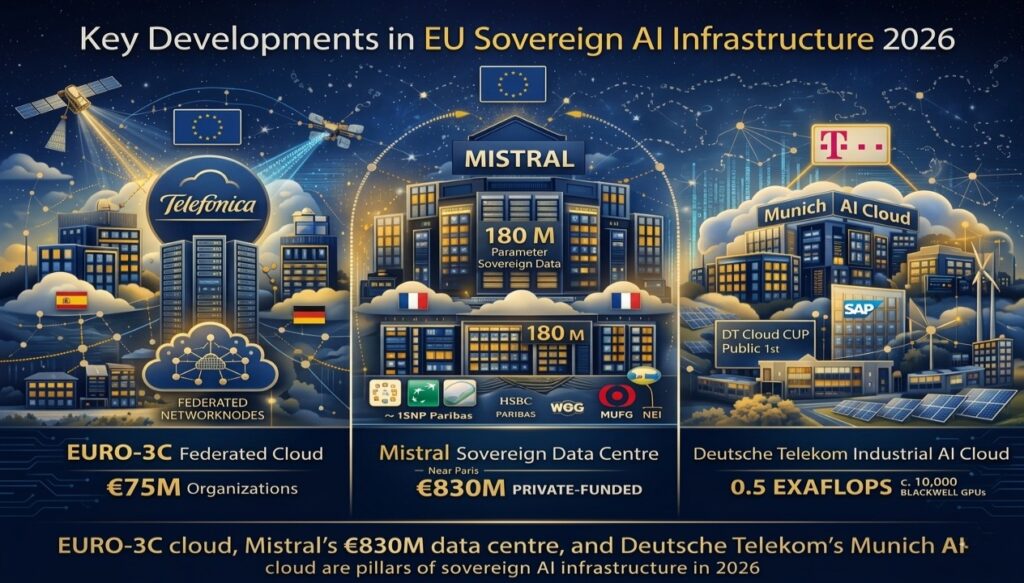
The biggest orchestration story of 2026 is EURO-3C, announced at Mobile World Congress in March 2026.
Key facts:
- €75 million project, backed by the European Commission via Horizon Europe
- Led by Telefónica, with 70+ organisations across 13 countries (telecoms, cloud providers, research institutions, universities, industrial companies)
- Objective: Europe’s first large-scale federated Telco-Edge-Cloud infrastructure integrating edge computing, sovereign cloud, and AI
- Nine large-scale pilots planned across automotive, transport, energy, and public safety sectors
- Directly backed by Renate Nikolay, Deputy Director General at the European Commission: “The European Commission strongly promotes secure digital communication infrastructures made in Europe.”
EURO-3C supersedes the earlier “Euro Stack” concept in your planning. It is not a prototype — it is a production deployment programme already in operational environments.
How federated orchestration works in practice:
Data can remain in Germany while compute runs in France. This is enabled by:
- Federated learning protocols
- Secure data exchange with legal jurisdiction enforcement per node
- Sovereign orchestration tools that respect data locality constraints without sacrificing cross-border compute access
4. Model Layer — Local, Open-Source, and Controlled API
Enterprises must choose between three model deployment approaches:
Local EU-native models:
- Mistral Large / Mixtral (France) — powerful open-source models, operable locally or on European clouds with no US dependencies
- Aleph Alpha (Germany) — enterprise-focused, designed for sovereign deployment
The new entrant in 2026 — SOOFI:
SOOFI (Sovereign Open-Source Foundation Initiative) is a 100-billion parameter European language model developed by a consortium including Fraunhofer, DFKI, and several European universities. First public version targeted for Q3 2026.
What makes SOOFI different from US models:
- Fully transparent weights and architecture (publicly available)
- Specifically trained for European languages and compliance requirements
- Locally operable — no external API dependency
- Not subject to US export restrictions
- Can be customised and fine-tuned without vendor dependency
Self-hosted open models:
- Llama variants hosted on EU-based infrastructure maintain sovereignty
- Inference and data processing must remain within EU jurisdiction — using external US-hosted APIs may violate compliance requirements due to data transfer risks
The key distinction: Control vs. convenience. Most organisations in regulated industries are moving toward local inference to avoid data leakage risks, jurisdiction conflicts, and API dependency.
5. Compliance Layer — “Compliance as Code”
This is where most implementations fail.
Compliance is no longer documentation — it is automation. Examples of operational compliance-as-code patterns:
- DLP redaction before inference (no raw PII ever reaches the model)
- Logging every AI output with timestamps, model version, and input hash
- Source attribution tracking for RAG pipelines
- Automated conformity assessment documentation aligned with EU AI Act Annex IV
- Human oversight triggers for high-risk AI system outputs
The European Tech Stack
(Deutsche Telekom + SAP + Siemens + ServiceNow) integrates compliance tooling directly into the enterprise software layer. SAP’s data governance, Siemens’ industrial expertise, and ServiceNow’s workflow automation are combined with Telekom’s sovereign infrastructure into a GDPR-compliant full-stack. The combination is, as one T-Systems executive described it, “globally unique.”
EU AI Act: What Actually Happens on August 2, 2026
This section requires more precision than most articles provide — because the enforcement landscape is more nuanced than the headline date suggests.
The Actual Enforcement Timeline
| Date | What Takes Effect |
| February 2, 2025 | Prohibited AI practices banned; AI literacy obligations begin |
| August 2, 2025 | Governance infrastructure, AI Office, GPAI model obligations |
| August 2, 2026 | Full enforcement begins; Annex III high-risk AI systems |
| August 2, 2027 | High-risk AI systems embedded in regulated products |
What “High-Risk” Means for Annex III Systems
As of August 2, 2026, these AI applications face full enforcement:
- AI in employment (CV screening, candidate ranking, performance evaluation)
- AI in credit scoring and financial services
- AI in education (automated grading, admission systems)
- AI in law enforcement (evidence evaluation, predictive policing tools)
- AI in migration and border control
- AI in administration of justice
Compliance requirements for high-risk systems:
- Completed conformity assessments
- Technical documentation (Annex IV) finalised
- CE marking affixed
- EU database registration completed
- Risk management systems operational
- Human oversight mechanisms in place
- Incident reporting protocols (72-hour/15-day windows to authorities)
The Digital Omnibus Delay: What Compliance Teams Need to Know
Here is what most articles miss: the August 2026 deadline may not be as hard as presented.
The European Commission proposed a Digital Omnibus package in late 2025 that could postpone Annex III high-risk obligations until December 2027. Separately, the harmonised standards from CEN and CENELEC — which provide legal certainty for compliance pathways — missed their August 2025 deadline and are still incomplete. The Commission has acknowledged this puts a smooth August 2026 entry into application at risk.
The prudent position: Do not plan around the delay. Treat August 2026 as binding. If the Omnibus extension passes, you will be ahead. If it does not, you will be compliant.
The Full Penalty Tier Structure
| Violation Category | Maximum Penalty |
| Prohibited AI practices (e.g., social scoring, real-time biometrics) | €35M or 7% of global annual turnover |
| Other obligations (high-risk compliance, transparency, GPAI) | €15M or 3% of global annual turnover |
| Misleading information to authorities | €7.5M or 1% of global annual turnover |
Note: For GDPR intersections (biometric/personal data mishandling), GDPR penalties apply separately — up to €20M or 4% of annual worldwide turnover.
The Hybrid Sovereignty Model: Reality in 2026
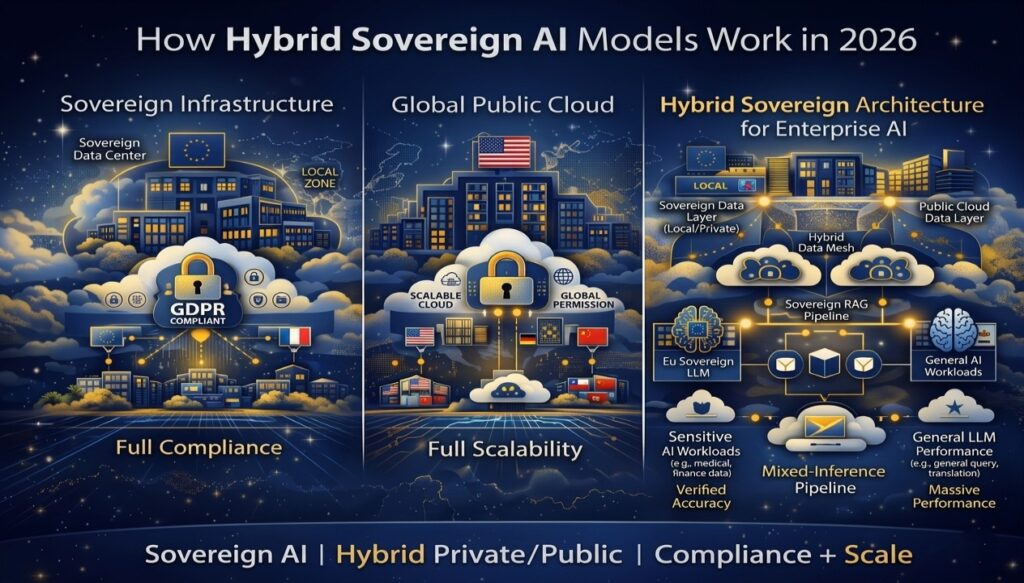
Almost no enterprise runs fully sovereign AI. The practical architecture is hybrid.
| Workload Type | Infrastructure |
| Sensitive data (HR, finance, health records) | Sovereign AI stack |
| High-risk AI systems (EU AI Act Annex III) | Sovereign AI stack |
| Non-sensitive analytics | AWS / Azure / Google |
| Experimental AI / R&D | Public cloud |
| Industrial AI (automotive, energy) | EURO-3C / European Tech Stack |
This approach balances cost efficiency, compliance, and performance. The critical design principle: workload classification must precede architecture decisions. Many enterprises fail compliance not because they chose the wrong infrastructure, but because they never mapped their AI workloads against the EU AI Act risk categories.
Sovereign RAG Pipeline: The 2026 Standard
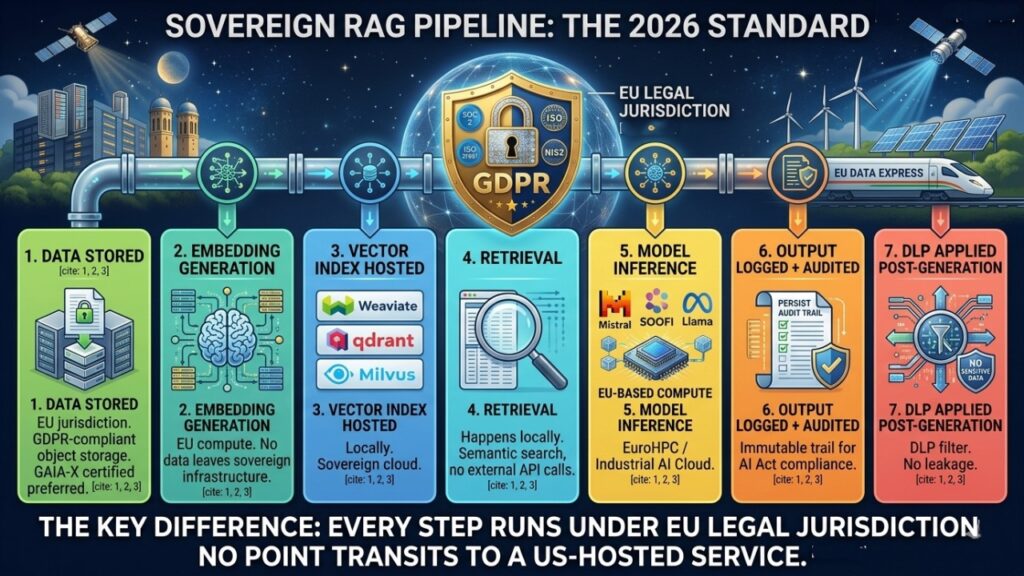
A major architectural shift in 2026 is the rise of the Sovereign RAG (Retrieval-Augmented Generation) pipeline. This is now the default pattern for regulated enterprises deploying AI on internal knowledge bases.
How a sovereign RAG pipeline works:
- Data stored within EU jurisdiction (GDPR-compliant object storage, GAIA-X certified preferred)
- Embedding generation on EU compute (no data leaves sovereign infrastructure)
- Vector index hosted locally (Weaviate, Qdrant, or Milvus on sovereign cloud)
- Retrieval happens locally (semantic search without external API calls)
- Model inference on EU-based compute (Mistral, SOOFI, or self-hosted Llama on EuroHPC/Industrial AI Cloud)
- Output logged + audited (immutable audit trail for AI Act compliance)
- DLP applied post-generation (no sensitive data in final outputs)
The key difference from a standard RAG pipeline: every step runs under EU legal jurisdiction. There is no point at which data transits to a US-hosted service.
Real-World Case Study: Financial Sector Deployment
Composite scenario based on documented enterprise deployments
A European bank implementing AI-powered risk analysis:
- Sensitive customer data processed in sovereign infrastructure (GDPR-compliant storage, EU-hosted inference)
- Non-sensitive analytics run on AWS Frankfurt (cost efficiency for non-regulated workloads)
- AI inference logs stored immutably for EU AI Act compliance audits
- Human oversight triggers embedded in the high-risk credit scoring workflow
- GAIA-X certified data services used for cross-border data sharing with EU partners
Results:
- 35% faster compliance reporting (estimated from deployment benchmarks)
- Reduced legal exposure under EU AI Act Annex III
- Improved audit readiness with automated documentation generation
- Avoided US Cloud Act exposure for customer financial records
The key takeaway: Architecture — not AI model choice — drives compliance success.
The Hidden Cost: Sovereign AI TCO
Sovereign AI is not cheap.
Cost drivers:
- Energy costs (higher in EU vs. US, though Nordic and Southern European locations are increasingly competitive)
- Hardware procurement (EU data centres are scaling but not yet at US hyperscaler pricing)
- Compliance overhead (conformity assessments, technical documentation, audit systems)
- Talent (EU AI compliance expertise commands premium salaries)
Estimated:
- 15–30% higher total cost vs. hyperscaler infrastructure
- €500K+ savings in avoided compliance risk and legal exposure at enterprise scale (estimated from deployment data)
The geographic shift: Forrester’s 2026 forecast calls out double-digit growth in AI-optimised servers in the Nordics and Southern Europe as organisations seek energy-efficient, sovereign-aligned infrastructure outside London and Dublin, where grid constraints are tightening. This is creating new cost-competitive sovereign options that did not exist 18 months ago.
How to Choose: Decision Guide
Choose EU Sovereign AI Stack if:
- You are a regulated enterprise (bank, healthcare, government, defence)
- You handle Annex III high-risk AI use cases under the EU AI Act
- Your priority is compliance and full legal control
- You process sensitive personal data at scale
Choose Hybrid Sovereign Model if:
- You are a mid-to-large enterprise with mixed workload risk profiles
- Your priority is balancing cost and compliance
- You already use AWS, Azure, or GCP for non-sensitive workloads
- You need to comply with the AI Act but not all workloads are high-risk
Choose Global Cloud AI if:
- You are a startup or non-regulated company
- You do not handle sensitive or regulated data
- Your priority is speed and scalability over legal control
Avoid deploying production AI entirely if:
- Your internal data governance is weak
- You lack compliance expertise or cannot staff it
- You have not yet mapped your AI systems against EU AI Act risk categories
Contrarian Insight: Sovereignty Is About Execution, Not Location
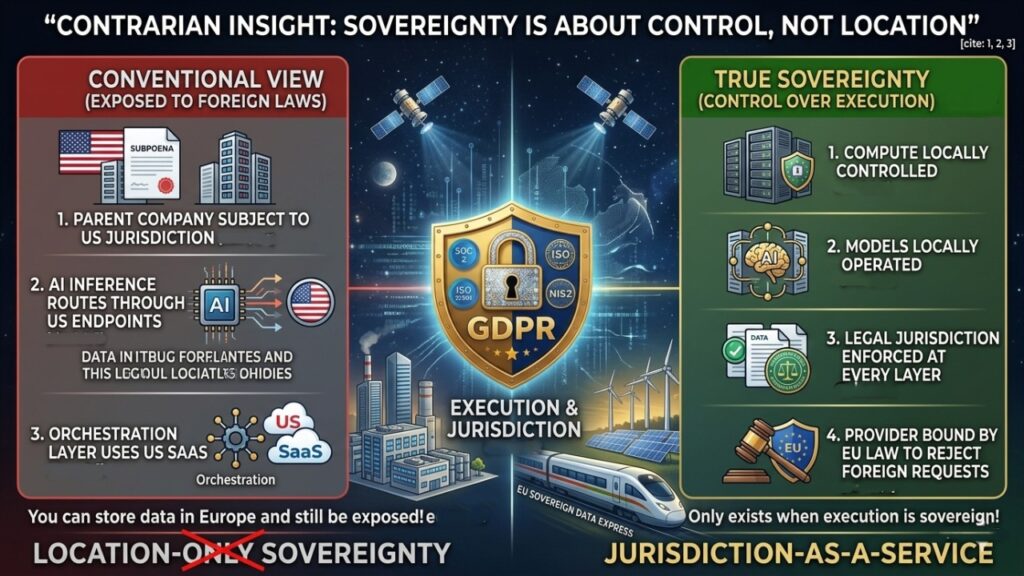
The conventional view is that sovereign AI is about data location. The reality is that sovereignty is about control over execution and jurisdiction, not just where data sits.
You can store data in Europe and still be exposed to foreign laws if:
- The cloud provider’s parent company is subject to US jurisdiction (US Cloud Act)
- Your AI model inference routes through US-based API endpoints
- Your orchestration layer uses US-owned SaaS tools
True sovereignty only exists when:
- Compute is locally controlled
- Models are locally operated
- Legal jurisdiction is enforced at every layer of the stack
- The provider is bound by EU law to reject foreign government data requests (what some are calling “Jurisdiction-as-a-Service”)
FAQ: EU Sovereign AI Infrastructure Stack (2026)
1. What exactly is a sovereign AI stack?
Ans-A sovereign AI stack refers to an infrastructure where data storage, processing, and AI inference are fully governed under EU jurisdiction. This means not only that data is physically located in Europe, but that the compute and operational control remain within EU legal boundaries — reducing exposure to laws like the US Cloud Act.
2. How is this different from sovereign cloud offerings from US hyperscalers?
Ans-Sovereign cloud offerings from AWS or Azure often provide data residency but not full legal isolation. The parent company may still be subject to US jurisdiction and compelled to provide data access. A true sovereign AI stack ensures ownership, operations, and governance are EU-based. Verify operational control, not just server location.
3. What is the EU AI Act deadline in 2026 — and might it slip?
Ans-August 2, 2026 is when the majority of EU AI Act rules enter into force, including rules for Annex III high-risk AI systems. However, the Digital Omnibus package proposed by the Commission could delay Annex III obligations to December 2027. The prudent compliance posture is to treat August 2026 as binding. Harmonised standards from CEN/CENELEC remain incomplete, creating some uncertainty — but enforcement authority begins on August 2 regardless.
4. What is EURO-3C?
Ans-EURO-3C is a €75M European Commission-backed project announced at MWC 2026, led by Telefónica with 70+ organisations across 13 countries. It is building Europe’s first large-scale federated Telco-Edge-Cloud infrastructure integrating edge computing, sovereign cloud, and AI. It replaces earlier conceptual “Euro Stack” initiatives with an operational deployment programme.
5. What is SOOFI?
Ans-SOOFI (Sovereign Open-Source Foundation Initiative) is a 100-billion parameter European open-source language model developed by Fraunhofer, DFKI, and European universities. Unlike US models, SOOFI is fully transparent, locally operable, and not subject to US export restrictions. First public release is targeted for Q3 2026.
6. Can global models be used in sovereign AI systems?
Ans-Yes, but only through local deployment. Models like Llama or Mistral can be hosted on EU-based infrastructure to maintain sovereignty. Using external APIs (including OpenAI or Anthropic APIs) may violate compliance requirements due to data transfer risks. Inference and data processing must remain within EU jurisdiction.
7. What is GAIA-X certification and why does it matter?
Ans-GAIA-X is a European data infrastructure initiative that provides certification standards for sovereign cloud services. GAIA-X certification is becoming an enterprise procurement requirement for EU-compliant AI services — it verifies data portability, interoperability, and sovereignty compliance. Regulated industries are increasingly demanding GAIA-X certification in vendor RFPs.
8. What is the biggest challenge in sovereign AI adoption?
Ans-Balancing cost and compliance. Sovereign infrastructure is 15–30% more expensive than hyperscaler alternatives. However, it significantly reduces legal risk and improves audit readiness. Organisations must evaluate total cost of ownership — including the cost of non-compliance (up to €35M or 7% of global turnover under the EU AI Act) — not just infrastructure pricing.
9. Is sovereign AI necessary for all companies?
Ans-No. It is primarily necessary for organisations handling regulated or sensitive data, or deploying AI in Annex III high-risk categories. Startups and non-regulated companies can continue using global cloud providers. However, as the EU AI Act expands in scope and enforcement matures, more organisations will need hybrid sovereign models.
Conclusion
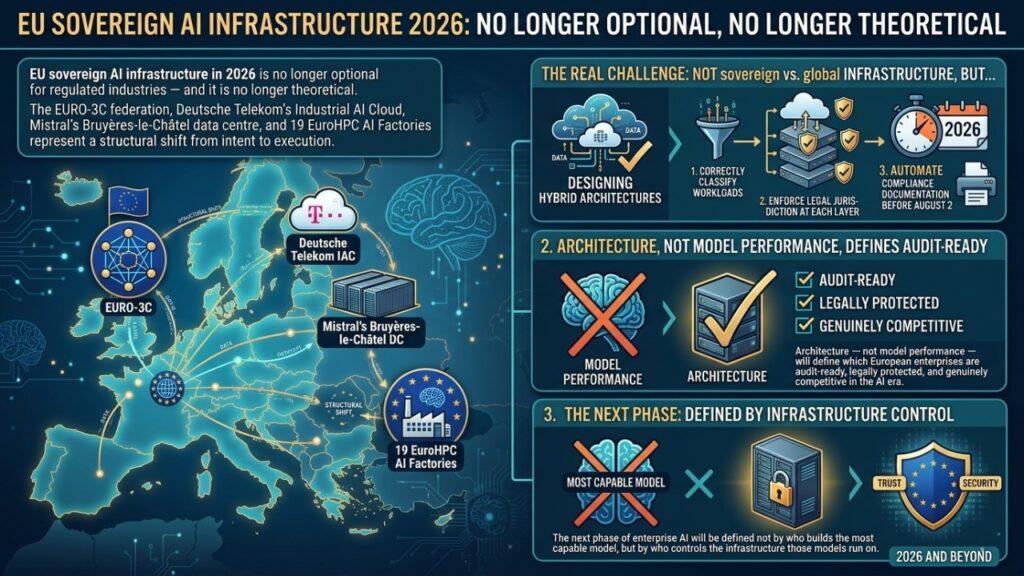
EU sovereign AI infrastructure in 2026 is no longer optional for regulated industries — and it is no longer theoretical. The EURO-3C federation, Deutsche Telekom’s Industrial AI Cloud, Mistral’s Bruyères-le-Châtel data centre, and 19 EuroHPC AI Factories represent a structural shift from intent to execution.
The real challenge in 2026 is not choosing between sovereign and global infrastructure. It is designing hybrid architectures that correctly classify workloads, enforce legal jurisdiction at each layer, and automate compliance documentation before August 2 arrives.
Architecture — not model performance — will define which European enterprises are audit-ready, legally protected, and genuinely competitive in the AI era.
The next phase of enterprise AI will be defined not by who builds the most capable model, but by who controls the infrastructure those models run on.
Transparency & Editorial Disclosure
Methodology & Expertise This 2026 Infrastructure Audit was developed by the Tech Plus Trends editorial team through a synthesis of technical documentation, public policy shifts, and private-sector capital announcements.
- Data Sources: Technical specifications for the Deutsche Telekom Industrial AI Cloud and the EURO-3C project were verified against official Q1 2026 releases.
- Policy Accuracy: Regulatory timelines regarding the EU AI Act (August 2, 2026) and the Digital Omnibus Proposal are based on the latest European Commission legislative status as of April 2026.
- Original Models: The “Reasoning Gap” and “Jurisdiction-as-a-Service” frameworks are original editorial concepts developed by Saameer Gholap to assist IT procurement leaders.
AI Disclosure In accordance with our Responsible AI Journalism Policy:
- Human Authorship: The strategic analysis, contrarian insights, and conclusion are 100% authored by human experts.
- Generative Assistance: AI tools were used solely for data synthesis, structural outlining, and the creation of high-fidelity technical infographics to assist in visualizing the complex “EuroStack” architecture.
- Verification: All AI-assisted data points have been cross-referenced with primary sources to ensure zero hallucination.
Financial Independence Tech Plus Trends maintains strict editorial independence. We have no financial affiliation with Mistral AI, Telefónica, or any of the EuroHPC member organizations mentioned in this guide. This analysis is funded solely by our subscribers and is intended for objective procurement guidance.
About the Author
Saameer is a technology journalist and infrastructure analyst with over five years covering enterprise AI systems, EU digital regulation, and cloud infrastructure economics. His work focuses on the gap between AI vendor claims and real-world deployment challenges, with particular emphasis on compliance-driven architecture in regulated industries.