
Update (2026): This analysis reflects the latest DORA enforcement guidance, EU banking supervisory expectations, and contractor market conditions currently in force.
By 2026, the most important shift in Europe’s financial-sector labor market is no longer about skills, salaries, or tax optimization. It is about liability placement.
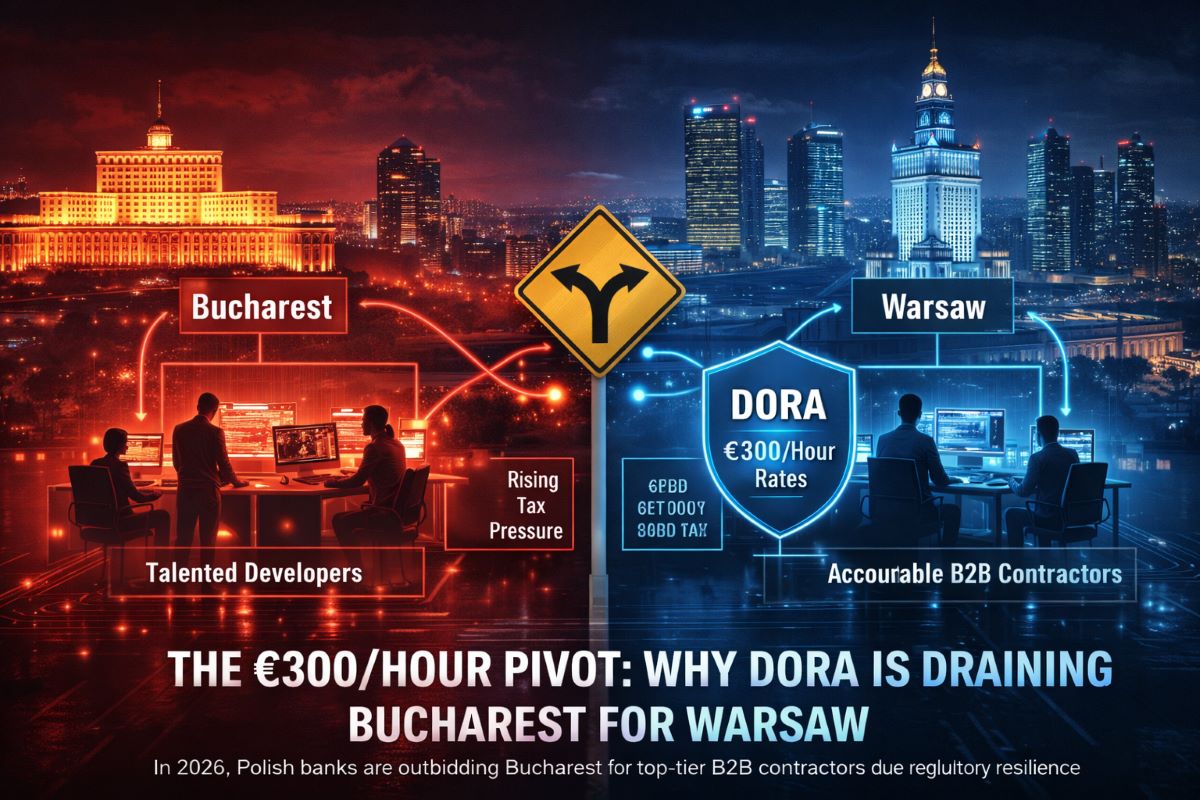
As the Digital Operational Resilience Act (DORA) enters live enforcement, Tier-1 banks operating in Central and Eastern Europe are re-evaluating not just what work gets done, but who is legally exposed when systems fail. This has triggered a quiet but powerful migration of high-end B2B contractors away from traditional talent hubs like Bucharest toward compliance-secure jurisdictions such as Warsaw.
What appears, on the surface, to be a sudden €300/hour rate ceiling in Poland is not a speculative bubble. It is a regulatory repricing of responsibility — and many developers have not yet fully grasped why it is happening.
Key Takeaways
While high rates are driven by liability, the actual enforcement of these standards is governed by our DORA 2026 Audit Framework, and the greatest threat to these rates remains Unmanaged Shadow AI.
- DORA has transformed senior B2B contractors into regulated risk-bearing entities
- Banks now pay a “Resilience Premium” for engineers named in regulatory filings
- Warsaw outperforms Bucharest not on talent, but on compliance gravity
- Java 25 expertise matters — but jurisdictional presence matters more
- €300/hour rates reflect liability absorption, not skill scarcity
My Information Gain: The “Resilience Premium”
Most commentary explains rising B2B rates as a function of AI complexity or developer shortages. That explanation misses the structural driver.
The missing variable is liability.
Under DORA Article 28 (ICT Third-Party Risk), financial institutions are explicitly accountable for the operational resilience of their ICT third-party providers — including individual B2B contractors when they perform critical or important functions. When a contractor becomes integral to system availability, observability, or incident response, the bank must price not only delivery capacity, but audit survivability.
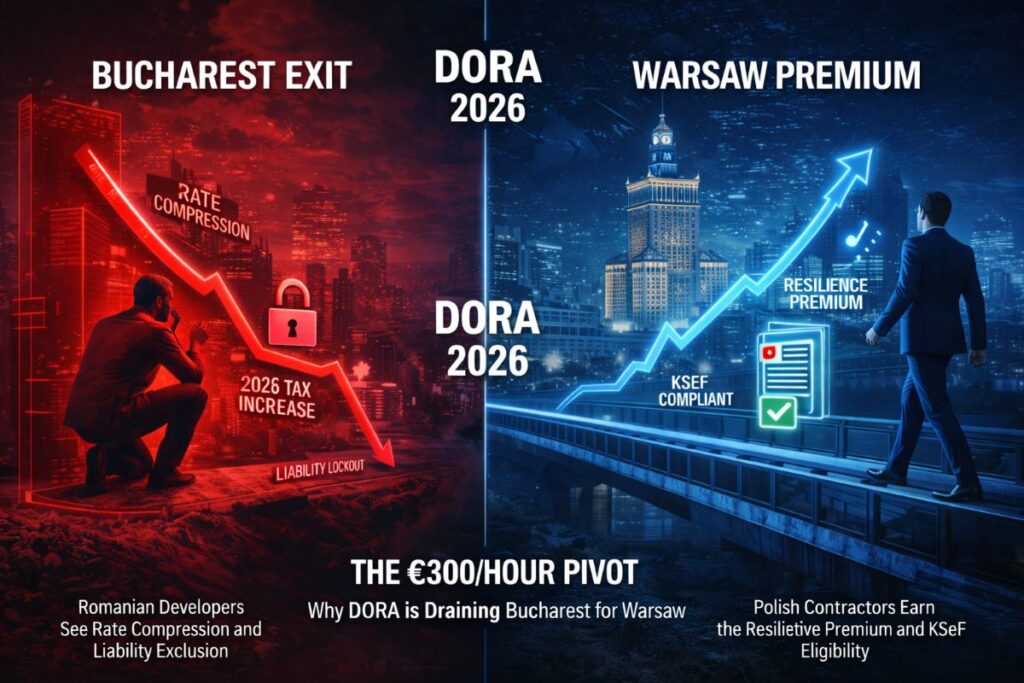
This is the origin of the Resilience Premium. It is a rate uplift paid to contractors who assume verifiable regulatory exposure on behalf of the institution. In Warsaw, this premium is already embedded in senior B2B contracts. In Bucharest, it is largely absent.
Why Infrastructure Gravity Decides Who Gets Paid
The Resilience Premium only emerges where banks can credibly defend their operational perimeter during audits and incidents. This is where infrastructure becomes decisive.
Warsaw has consolidated its position as the dominant CEE hub for regulated AI and banking workloads due to sovereign cloud availability, local hyperscaler regions, enforceable data residency, and low-latency execution environments. These are not abstract advantages; they determine whether a bank can demonstrate control during a DORA inspection.
This infrastructure asymmetry explains why Tier-1 institutions increasingly centralize critical execution layers in Poland rather than relying on relay-based or distributed models, as examined in
https://techplustrends.com/warsaw-ai-infrastructure-vs-bucharest-2026/
Bucharest remains talent-rich. Warsaw has become audit-defensible.
Case Study: Java 25 as a Compliance Accelerator
As banks modernize core platforms to support agentic AI and real-time decisioning, many are discovering that legacy JVM architectures fail regulatory observability tests.
The transition to Java 25 is not simply about throughput. Virtual Threads, structured concurrency, and predictable thread tracing directly support forensic accountability — a prerequisite under DORA’s incident reporting timelines.
This modernization wave has created a concentrated demand spike for specialists capable of upgrading legacy banking stacks without breaking compliance guarantees, as detailed in
https://techplustrends.com/java-25-migration-warsaw-banking-b2b-gold-mine/
Performance enables compliance — but only inside a defensible jurisdiction.
Who Benefits — and Who Gets Exposed — in 2026
| Role Type | Outcome |
| Warsaw-based DORA-ready B2B engineers | Capture the Resilience Premium |
| Java 25 architects with audit literacy | Become named regulatory assets |
| Generic remote contractors | Face rate compression |
| Bucharest-based teams without in-region status | Experience regulatory exclusion |
| Banks relying on cross-border execution | Accumulate audit friction |
Comparison Matrix: Liability vs. Rate Reality
| Contractor Profile | Liability Exposure | Typical Rate (2026) |
| Standard Java Developer | Code defects only | 180–220 PLN/hr |
| Java 25 Architect | Architectural risk | 230–260 PLN/hr |
| DORA-Named Engineer | Audit & incident accountability | 280–320+ PLN/hr |
Center of Excellence Framing: Why Warsaw Wins
A Center of Excellence (CoE) is not a talent cluster. It is a regulatory containment structure.
Under DORA and parallel supervisory guidance, banks are incentivized to concentrate critical ICT functions within jurisdictions where regulators can exercise oversight, incident response is physically reachable, and contractors fall within enforceable legal boundaries.
In Poland, CoEs in Warsaw function as legally coherent execution zones recognized by the KNF’s 2026 supervisory framework, not merely as delivery hubs. This recognition materially reduces supervisory friction during audits and incident escalations.
This institutional logic — and why it excludes most cross-border remote execution models — is examined in
https://techplustrends.com/warsaw-banking-in-region-mandate-java-25/
In 2026, CoE placement determines who gets trusted — and who gets paid.
Strategic Implications for 2026
As DORA audits intensify, banks are shifting from cost minimization to risk minimization. This favors:
- Fewer contractors
- Higher individual accountability
- Longer engagement horizons
- Outcome-linked compensation
Warsaw benefits because it aligns infrastructure, regulation, and labor within a single supervisory perimeter.
Why This Matters
The Resilience Premium reshapes careers.
Contractors outside regulated hubs risk long-term relegation to commodity roles. Those who reposition as risk-bearing specialists gain pricing power, negotiating leverage, and professional durability.
DORA is not eliminating flexibility. It is pricing irresponsibility out of the market, a theme expanded in
https://techplustrends.com/dora-2026-audit-warsaw-banking-java-25/
and reinforced by enforcement patterns around unmanaged AI exposure discussed in
https://techplustrends.com/shadow-ai-dora-2026-warsaw-banking-guide/ https://techplustrends.com/shadow-ai-liability-trap-b2b-contractors/
What To Do Now
For B2B contractors
- Reassess your liability surface
- Align with in-region mandates
- Invest in audit-facing skills, not just frameworks
For banks
- Price accountability explicitly
- Reduce supplier sprawl
- Treat senior contractors as regulated assets
FAQs
1.Is €300/hour sustainable?
Ans-Yes, it reflects risk transfer, not market exuberance.
2.Can Romanian developers access these rates remotely?
Ans-Only if they meet in-region security and residency constraints.
3.Is Java 25 mandatory?
Ans-Not formally, but practically unavoidable for audit-grade observability.
4.Does this apply outside Poland?
Ans-Yes, but Poland currently concentrates the necessary conditions.
5.Is this a temporary spike?
Ans-No. It is a regulatory repricing.
6.Does tax optimization still matter?
Ans-Yes, but only after compliance eligibility is secured.

Final Takeaway
The €300/hour pivot is not about coding excellence. It is about who carries regulatory weight when systems fail.
Warsaw is winning because it allows banks to defend their choices — technically, legally, and operationally. Bucharest remains competitive on talent. Warsaw now dominates on trust.
Sources
- EU Digital Operational Resilience Act (DORA)
- European Banking Authority (EBA)
- Polish Financial Supervision Authority (KNF)
- JVM platform specifications (Java 25)
Author Bio
Saameer Go is a senior technology journalist and analyst covering enterprise software, AI platforms, infrastructure, and EU technology regulation. With over 15 years of experience analyzing how policy, labor markets, and architecture decisions intersect, he focuses on long-term structural shifts rather than short-term hype.
Regulatory Disclaimer & Transparency Note
Legal & Professional Disclaimer
This article is provided for informational and educational purposes only. While it analyzes the Digital Operational Resilience Act (DORA) and Polish Financial Supervision Authority (KNF) guidelines, it does not constitute legal, financial, or tax advice. The “Resilience Premium” and rate benchmarks cited reflect 2026 market trends and should not be used as a sole basis for contract negotiations or regulatory filings. Readers are encouraged to consult with qualified legal counsel or compliance specialists regarding specific B2B arrangements.
AI Transparency Disclosure (EU AI Act 2026)
In alignment with Article 50 of the EU AI Act, we disclose that generative AI was utilized to assist in the synthesis of regulatory data, structural refinement, and the creation of comparative matrices within this article. All AI-generated insights have undergone rigorous human editorial review and validation by Saameer Go to ensure technical accuracy and jurisdictional relevance.
Conflict of Interest & Sourcing
Tech Plus Trends and the author maintain no financial ties to the banking institutions or hyperscale cloud providers mentioned herein. Sources include the European Banking Authority (EBA), the Official Journal of the EU, and independent industry interviews conducted between 2025 and 2026.