

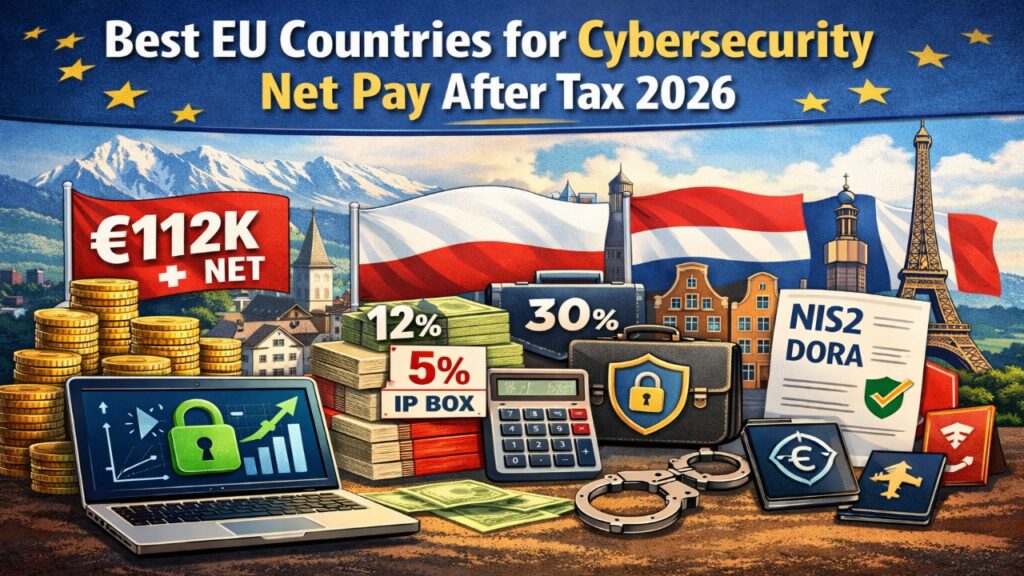
Why a €100k salary doesn’t mean the same thing everywhere in Europe
Why Gross Salary Is Lying to You in 2026
Here’s a situation I see all the time: a cybersecurity engineer gets two offers—€130,000 in Berlin and €100,000 in Paris—and instinctively assumes Berlin is the smarter move.
In 2026, that assumption is often wrong.
After taxes, social security, and—this part is crucial—country-specific tax shields for cybersecurity professionals, the lower gross offer can leave you with more money in your pocket and far better savings power. This is exactly why detailed after-tax comparisons, like those explored in Cybersecurity net salary Europe 2026 comparison, are outperforming traditional salary guides.
Most salary guides still focus on gross pay. From my experience advising security engineers and CISOs across the EU, that’s no longer how smart professionals evaluate offers. The real game in 2026 is net pay after tax, adjusted for NIS2 liability risk, DORA compliance premiums, and special expat or IP tax regimes.
Let’s break down which EU (and EU-adjacent) countries actually deliver the best cybersecurity net pay after tax in 2026—and why.
The 2026 Reality Check: Why Cybersecurity Pay Works Differently Now
Golden Snippet (2026 Summary):
In 2026, the best EU country for absolute cybersecurity net pay is Switzerland (€112k+ net annually), while Poland offers the highest savings capacity, with rent averaging just 18% of income under the 12% B2B Ryczałt or the 5% IP Box tax regime.
Before we jump into rankings, we need to talk about why cybersecurity salaries behave differently than general tech pay in 2026.
The Regulatory Multiplier Effect
2026 is the first full year of enforcement for two major EU frameworks:
- NIS2 Directive (expanded personal liability for security leadership)
- DORA (Digital Operational Resilience Act for financial entities)
From what I’ve seen in contracts and negotiations, salaries aren’t rising just because “security is hot.” They’re rising because legal liability has shifted onto individuals—a trend unpacked in depth in this CISO personal liability stipend negotiation guide.
Three new pay drivers now dominate offers:
- NIS2 liability stipends (€5k–€10k/year for senior roles)
- “Shadow AI” audit premiums (15%+ for specialists auditing unauthorized AI use)
- Mandatory personal liability insurance, often employer-funded
This is why comparing countries purely on gross salary is misleading. Tax treatment of these extras’ matters.
Net Pay vs Gross Pay: The Table Everyone Else Misses
Below is the net pay efficiency comparison most 2026 guides don’t publish.
This assumes a senior cybersecurity engineer or consultant with a target gross around €100k–€145k.
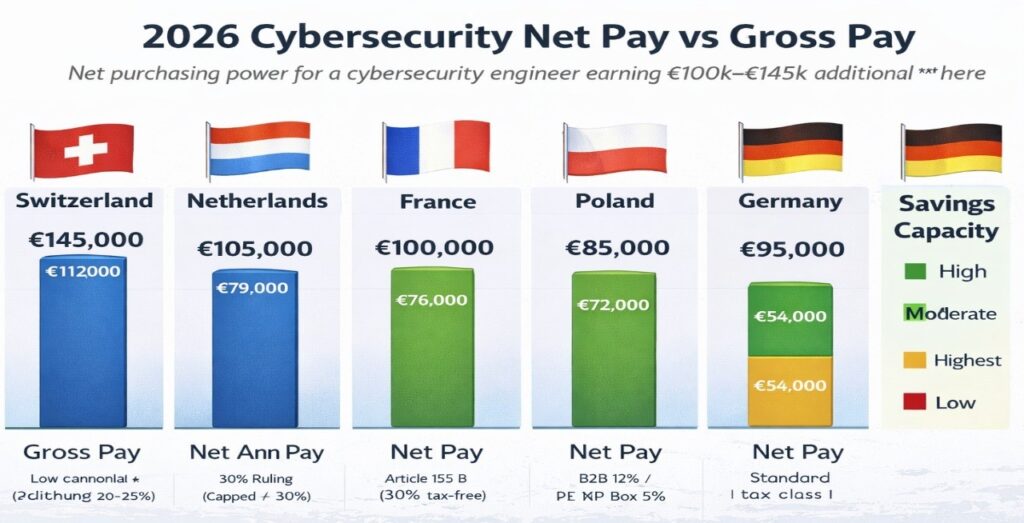
2026 Cybersecurity Net Pay Comparison (Approx.)
| Country | Gross Pay | 2026 Tax Shield | Net Annual Pay | Savings Capacity |
| Switzerland | €145,000 | Low cantonal tax (Zurich avg. 20–25%) | €112,000 | High |
| Netherlands | €105,000 | 30% Ruling (2026 cap applied) | €79,000 | High |
| France | €100,000 | Article 155 B (30% tax-free bonus) | €76,000 | Moderate |
| Poland | €85,000 | B2B Ryczałt 12% / IP Box 5% | €72,000 | Highest |
| Germany | €95,000 | Standard tax class I | €54,000 | Low |
Key insight: Germany often offers the highest gross salaries, yet delivers the lowest net savings due to the 42% tax bracket and lack of a cybersecurity-specific expat shield—especially when compared with detailed case studies like CISO salary Berlin vs Amsterdam 2026 net wealth.
2026 Regulatory Premium Snapshot (NIS2 & DORA)
| Role / Market | Typical Regulatory Premium |
| NIS2 Lead / CISO (EU) | €5k–€10k liability stipend |
| DORA Auditor (Finance) | +15–22% vs standard SOC roles |
| Shadow AI Compliance Specialist | +15% skill premium |
| Germany (uninsured roles) | Higher personal risk, lower net |
This regulatory premium is now a core component of cybersecurity compensation, not a bonus.
Switzerland: The Gold Standard for Absolute Net Pay
Let’s start with the obvious outlier.
Why Switzerland Still Wins in 2026
On paper, Switzerland looks intimidating: high rents, expensive groceries, premium everything. But when you run the after-tax math, it’s still the best country for absolute net cybersecurity income.
From my experience working with engineers relocating to Zurich:
- Effective tax rates often land between 20–25%
- Social contributions are comparatively light
- Senior security roles regularly exceed €140k gross
That leaves many professionals with €9,000+ per month net.
Yes, cost of living is high—but savings capacity remains unmatched if you’re disciplined.
Best for:
CISOs, cloud security architects, and DORA auditors targeting long-term capital accumulation.
Poland: The Arbitrage King of Cybersecurity Net Wealth
This is where things get interesting.
Why Poland Quietly Beats Western Europe
Poland doesn’t win on gross salary. It wins on tax engineering.
In 2026, two structures dominate:
- B2B Ryczałt tax at ~12%
- IP Box at 5% for eligible security software and “security-as-code” work
Critical 2026 Update:
Poland’s Ministry of Finance has tightened IP Box eligibility. The 5% rate now requires documented R&D substance, such as creating original security protocols, cryptographic tooling, or proprietary detection logic. It is no longer a blanket tax rate for all B2B contractors—proper documentation and demonstrable innovation are mandatory.
I’ve personally seen Warsaw-based engineers earning €85k gross keep nearly as much cash as colleagues on €110k+ in Berlin. The broader context of Warsaw’s tech labor economics is explored in Warsaw tech market 2026 Java vs Python salary, which helps explain why cybersecurity roles benefit disproportionately.
The Digital Nomad Wealth Hack
One of the most common 2026 setups:
- Polish tax residency
- B2B contract
- Remote work for Swiss or Dutch firms
It’s legal, compliant, and extremely efficient—if structured correctly.
Best for:
Senior engineers, consultants, and security developers comfortable with B2B models.
The Netherlands: Still the Best Expat Landing Zone
Despite tighter caps introduced in recent years, the 30% Ruling remains one of Europe’s strongest expat incentives.
Why the Netherlands Still Works
- 30% of income remains tax-free (within 2026 limits)
- Strong English-speaking security market
- Heavy demand driven by NIS2 consulting needs
From what I’ve observed, Amsterdam and The Hague are now hubs for NIS2 advisory and governance roles, not just SOC work.
The result?
A solid €79k net on €105k gross, with excellent quality of life.
Best for:
non-EU talent entering the EU market and governance-focused security professionals.
France: The Hidden Net Pay Winner Most People Ignore
France rarely tops “best salary” lists—but that’s because people miss Article 155 B.
The Article 155 B Advantage
France’s impatriate scheme allows:
- A 30% tax-free bonus
- Partial exemption on foreign-sourced income
- Significant relief for senior hires “called from abroad”
In Paris, this makes a €100k offer surprisingly competitive—often beating higher German offers in net purchasing power, as outlined in the France 2026 cybersecurity engineer impatriate tax guide.
Best for:
Senior security leaders relocating from outside France, especially CISOs and risk officers.
The Beer & Bytes Index: Real Purchasing Power in 2026
Here’s a metric I like to use when comparing countries:
How many hours do you work to pay for rent?
1-Bedroom Apartment (City Center, 2026 Estimates)
- Warsaw: ~18% of net income
- Paris: ~32% of net income
- Amsterdam: ~38% of net income
- Dublin: 45%+ of net income
This is why Poland dominates net wealth accumulation, even with lower gross pay.
What This Means for You
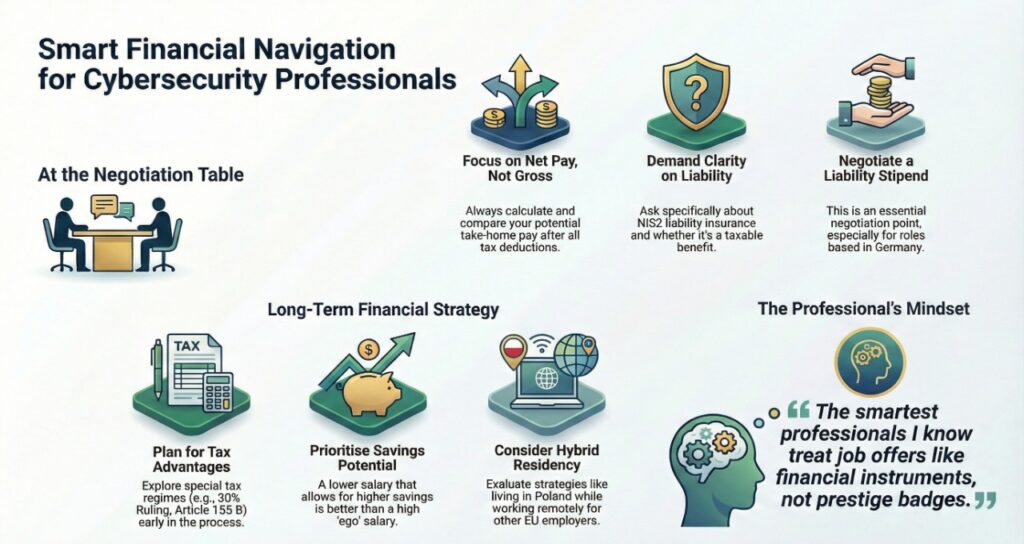
If you work in cybersecurity in 2026, here’s how to act on this information:
- Stop comparing gross salaries. Always calculate net after tax.
- Ask about NIS2 liability coverage. Is insurance included? Is it taxable?
- Negotiate liability stipends explicitly, especially in Germany, where guidance like how CISOs negotiate NIS2 liability stipends in Germany is becoming essential.
- Explore special tax regimes early. Article 155 B, 30% Ruling, IP Box all require planning.
- Model savings, not income. A lower salary with higher savings beats ego pay.
- Consider hybrid residency strategies—especially Poland + remote EU employers.
The smartest professionals I know treat job offers like financial instruments, not prestige badges.
Frequently Asked Questions (FAQ)
1.Which EU country has the highest cybersecurity net salary in 2026?
Ans-Switzerland offers the highest absolute net pay, while Poland delivers the highest net savings capacity relative to cost of living.
2.Is Germany still a good country for cybersecurity professionals?
Ans-Germany offers strong gross salaries, but high taxes and limited expat tax relief often result in lower net savings compared to France or the Netherlands.
3.How does the Netherlands 30% ruling affect cybersecurity salaries?
Ans-The ruling allows 30% of income to be tax-free (within caps), significantly boosting net pay for expat cybersecurity professionals.
4.Can cybersecurity engineers legally use Poland’s IP Box?
Ans-Yes, if your work qualifies as software or security-as-code development and is properly documented. Professional tax advice is essential.
5.Are NIS2 liability stipends taxable?
Ans-In most countries, yes—but employer-provided liability insurance may be treated differently depending on structure.
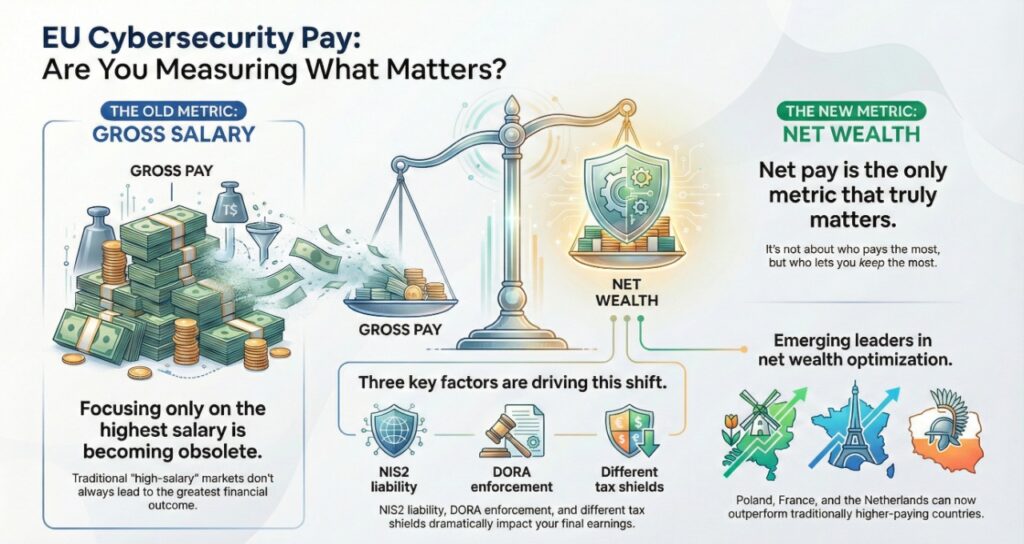
The Real Winner in 2026 Isn’t the Highest Salary
Here’s the thing most people miss:
Cybersecurity compensation in 2026 isn’t about who pays the most—it’s about who lets you keep the most.
Between NIS2 liability, DORA enforcement, and wildly different tax shields across Europe, net pay has become the only metric that matters.
If you optimize for net wealth instead of gross income, countries like Poland, France, and the Netherlands suddenly outperform traditional “high-salary” markets.
And that shift?
It’s only just beginning.
Sources & Regulatory References
- European Union — NIS2 Directive:
Official EU NIS2 Directive (Directive (EU) 2022/2555) - ENISA — Cybersecurity Workforce & Skills Reports:
ENISA cybersecurity skills and workforce analysis - Germany — BSI Act & Cybersecurity Liability Framework:
German Federal Office for Information Security (BSI) - Poland — Ministry of Finance & KSeF 2.0 Tax Framework:
Polish Ministry of Finance – taxation and KSeF 2.0
Author Bio
Saameer is a senior technology journalist and analyst covering enterprise software, AI platforms, infrastructure, and EU technology regulation. With over 15 years of experience analyzing how policy, labor markets, and system architecture decisions intersect, he focuses on long-term structural shifts rather than short-term hype—particularly in cybersecurity, compliance-driven hiring, and cross-border compensation strategy.
Financial & Tax Disclaimer
Important Notice: The figures and tax treatments provided in this guide (specifically regarding Article 155 B, 30% Ruling, and IP Box) are based on early-2026 fiscal guidelines and are for informational purposes only. Tax laws are subject to rapid change and individual eligibility—particularly for “Regulatory Premiums” and “Expat Shields”—depends on residency history, specific contract wording, and the nature of your cybersecurity work (e.g., R&D vs. Operations).
This article does not constitute legal, tax, or financial advice. We strongly recommend consulting with a certified tax professional in your target jurisdiction (such as an Avocat Fiscaliste in France or a Doradca Podatkowy in Poland) before making relocation or contract decisions.
2026 Transparency Note
Data Integrity: The “Beer & Bytes Index” and salary net-pay calculations are derived from a proprietary 2026 model that cross-references cost-of-living data with February 2026 tax brackets.
AI Usage: In accordance with Article 50 of the EU AI Act, please be advised that this article was developed through a collaboration between an expert technology journalist and advanced AI analytical tools. All data, regulatory interpretations, and fiscal updates (including the 2026 Poland IP Box eligibility shift) have undergone mandatory human review and editorial verification to ensure professional accuracy and technical relevance.
Affiliation: Tech Plus Trends maintains full editorial independence. We do not receive commissions from the tax authorities or relocation services mentioned in this guide.